How to Evaluate Bordereaux Reconciliation Technology
In delegated authority insurance, bordereaux reconciliation isn’t a reporting task. It’s how you establish financial truth.
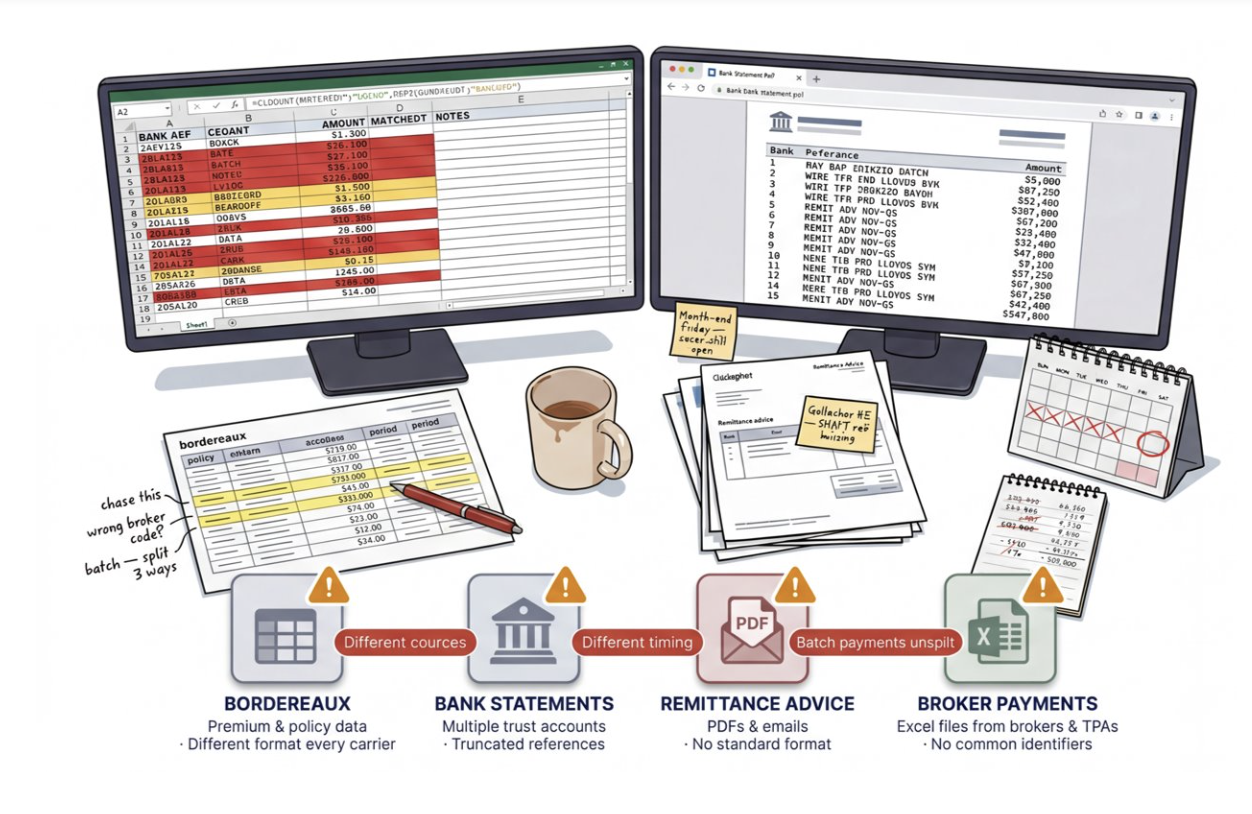
Every month, premium bordereaux, claims bordereaux, and bank statements move between brokers, MGAs, carriers, and reinsurers. On paper, they should align. In practice, they rarely do.
That gap—between what should align and what actually aligns—is where most operational risk sits. It’s why evaluating bordereaux reconciliation technology matters more than most teams expect. You’re not buying a faster way to compare spreadsheets. You’re deciding how your organization determines what has actually been written, collected, paid, and changed over time.
The Mistake Most Teams Make
Most evaluations start with files. Teams look for a system that can match one spreadsheet to another, flag differences, and tie out totals across reports. Those capabilities matter, but they’re not where reconciliation actually succeeds or fails.
The real issue isn’t files. It’s state.
Bordereaux are typically inception-to-date datasets that are re-sent every month. Each version contains a mix of:
- new business
- updates to existing policies
- corrections and cancellations
- claims movements
As a result, the data is constantly evolving.
So the core question isn’t whether two files match. It’s whether the data accurately represents reality over time.
Any system that treats bordereaux as static snapshots—rather than as records that change month to month—will struggle to produce a reliable view of the business.
Where Bordereaux Reconciliation Actually Breaks
Most reconciliation processes look functional from the outside. Files are received, reviewed, and signed off. Reports get produced. Nothing obviously fails.
But underneath, the same issues keep surfacing.
- Premium doesn’t tie cleanly to cash
- Transactions don’t match exactly
- Identifiers shift across systems
- Records are updated retroactively
To keep things moving, teams compensate with manual adjustments, side calculations, and “known differences” that carry forward from one period to the next.
That approach works—until it doesn’t.
Over time, those gaps compound. Teams can no longer explain their cash position clearly. Audits become forensic exercises. Decisions get made using numbers that nobody fully trusts.
At that point, the issue isn’t efficiency. It’s control. Any technology you evaluate needs to handle these realities natively. If it doesn’t, the process will break in the same places—just faster.
What You Should Actually Evaluate
When you strip away the demos and feature lists, evaluating bordereaux reconciliation technology comes down to a few things that actually determine whether it works.
The easiest way to evaluate a solution is to test whether it handles these realities by default, not as edge cases.
1. Can it track change over time?
A good system should be able to track how records evolve over time—not just when they appear, but how they change, when they close, and whether something is genuinely new or simply a correction to what came before.
If it can’t handle inception-to-date bordereaux without double counting or losing record history, it’s not reconciling properly.
2. Can it tie premium to cash?
This is where the real exposure sits.
Matching bordereaux to bordereaux is useful, but matching premium to actual cash movement is what matters. That includes partial receipts, unapplied cash, timing differences, and the inevitable mismatches between bank references and bordereaux records.
If the platform can’t handle that cleanly, you still don’t have financial truth.
3. Can it explain exceptions?
Every reconciliation process has exceptions. The question is whether the system can explain them in a way your team can act on.
It’s not enough to say, “These records don’t match.”
You need to know:
- why they don’t match
- what type of issue it is
- who should deal with it
- what happens next
If that logic lives in analysts’ heads instead of inside the process, the technology hasn’t really solved the problem.
4. Can your team trust the output?
This is the question that matters most.
If analysts still feel the need to re-check the output manually, you haven’t solved reconciliation. You’ve just added another layer to it.
The goal isn’t just automation. It’s trust.
Because once the business trusts the output, the process changes completely. Teams stop rebuilding the answer every month and start using the data to make decisions.
5. How quickly can it prove value?
Most teams don’t need another long implementation.
They need to see whether the system can handle real bordereaux, real cash data, and real exceptions in a live environment. If it takes months of setup before you can validate basic outcomes, the path to value is already too long.
The best systems work with the formats you already have — Excel, CSV, PDFs, emails — and show meaningful results quickly.
The Hidden Risk in “Good Enough”
The most dangerous reconciliation process isn’t one that fails outright. It’s one that appears to work. Reports get produced. Numbers get signed off. Nothing visibly breaks.
Meanwhile, issues continue in the background:
- unallocated cash
- duplicate records
- timing mismatches
- persistent data quality problems
Because the process repeats every month, those issues become normalized.
We’ve seen cases where patterns like this remained hidden for years. When the full dataset was analyzed properly, it revealed material differences in actual performance that had never surfaced through the standard reconciliation process.
The work was being done. But the signal wasn’t visible.
What Changes When It’s Done Properly
When bordereaux reconciliation is designed correctly, the improvement isn’t just incremental.
Processing compresses from weeks to hours. Audit trails are created automatically instead of reconstructed after the fact. Exception handling becomes structured and repeatable.
More importantly, the role of the process changes. Teams stop asking whether reconciliation has been completed and start using the data to understand performance, exposure, and trends in real time.
That shift—from manual verification to actual visibility—is where the real value sits.
We Built Brisc Because We Lived The Problem
We didn’t start with a product idea. We started with the reality of how delegated authority reconciliation actually works.
Too much of the process still depends on people manually stitching together spreadsheets, emails, and statements to recreate the same answer every month. Most tools either focus too narrowly on extraction or require long implementations before they deliver value.
What’s needed is something that can handle the full problem:
- messy bordereaux formats
- records that change over time
- premium-to-cash matching
- clear exception handling
- complete auditability
That’s the standard you should evaluate any bordereaux reconciliation technology against. Because the hardest part of reconciliation isn’t processing the data. It’s being able to trust the numbers that come out the other side.
Can you confidently explain every number in your reconciliation today?
Most teams we talk to can produce a reconciliation report. Far fewer can explain what’s inside it — why a number moved, where a difference came from, whether what was signed off last month is still accurate. If that sounds familiar, it’s worth a conversation.
Book a demo and bring your real data. We’ll show you what it looks like when reconciliation actually works.
FAQs
What is bordereaux reconciliation in delegated authority insurance?
Bordereaux reconciliation is the process of matching premium and claims bordereaux with financial records—such as bank statements and ledgers—to ensure the data accurately reflects what has been written, paid, and collected.
In delegated authority, this is complicated by inception-to-date reporting, frequent updates, and inconsistencies across brokers and systems.
Why is bordereaux reconciliation so difficult?
Because bordereaux are not static files. They are re-sent every month with changes, corrections, and updates.
This creates challenges such as:
- records changing retroactively
- mismatches between premium and cash
- inconsistent formats across brokers
- lack of clear audit trails
Most manual processes struggle to maintain accuracy and continuity over time.
What should you look for in bordereaux reconciliation technology?
The most important capabilities are:
- the ability to track how records change over time
- accurate premium-to-cash matching
- clear and structured exception handling
- full auditability and data traceability
- outputs that can be trusted without manual rework
If a system cannot handle these consistently, it won’t provide a reliable view of financial performance.
What is the difference between matching files and true reconciliation?
Matching files compares data between two sources and highlights differences. True reconciliation goes further. It tracks how records evolve over time, connects premium to actual cash movement, and explains discrepancies in a way that can be validated and audited. Without that capability, you’re identifying differences—but not resolving them.
How do you evaluate bordereaux reconciliation software?
The best way to evaluate a solution is to test it with real data. A strong platform should be able to:
- process inception-to-date bordereaux without duplication
- handle messy formats like Excel, PDFs, and emails
- reconcile premium to cash accurately
- explain exceptions clearly
- deliver results quickly without heavy implementation
If it can’t handle these scenarios in practice, it won’t perform reliably at scale.
What are the risks of poor bordereaux reconciliation?
The biggest risk is false confidence. Processes may appear to work while underlying issues persist, including unallocated cash, duplicate or inconsistent records, timing mismatches, hidden profitability or exposure gaps. Over time, this leads to audit challenges, financial inaccuracies, and reduced trust in reporting.
How long does it take to implement bordereaux reconciliation technology?
It depends on the approach. Traditional solutions can take months due to integrations and configuration.
Modern approaches like Brisc’s CashOps AI Agent are designed to work with existing data formats and can demonstrate value much faster—often within weeks—by processing real bordereaux and financial data without heavy setup.