How to Grow GWP: A Practical Guide for MGA Underwriting Leaders
GWP grows when MGAs review more submissions, quote faster, and respond more consistently to broker opportunities. The most effective growth strategies focus on increasing underwriting capacity, reducing manual work, and improving early-stage underwriting decisions.
BriscBlogFeatured (1200 x 627 px) (2)-1
How to Grow GWP
Growing GWP (Gross Written Premium) requires increasing underwriting capacity, speeding up time-to-quote, and capturing a larger share of broker submissions — all driven by operational execution rather than market conditions.
While expanding broker distribution and market access remains important, long-term GWP growth is now determined by how efficiently underwriting teams operate.
McKinsey’s 2025 Global Insurance Report notes that in commercial P&C lines, although where insurers operate is important, the majority of their financial performance is driven by how they operate.
As market conditions soften and growth beyond rate increases becomes essential, MGAs must strengthen the core capabilities that improve how reliably and rapidly they convert existing opportunities. AI-powered submission intake — led by solutions like Brisc’s Submissions Agent — has become a critical enabler, allowing MGAs to process, quote, and win more opportunities with existing teams.
Key Takeaways
- GWP growth is fundamentally an operational challenge. MGAs that outperform the market do so not only because they see more demand, but because they can review more submissions, move faster, and convert opportunities more consistently. Manual intake slows down quoting, impacts broker relationships, and limits the number of risks underwriters can evaluate.
- Modern MGAs accelerate GWP growth by expanding capacity, improving data quality, and reducing time-to-quote. Intelligent automation is now one of the most important levers for writing more premium.
- Brisc’s Submissions AI Agent processes submissions in ~60 seconds (versus 20+ minutes manually) and increases underwriting capacity by up to 10x. Faster, more complete intake gives teams the ability to respond sooner, improve hit ratios, and capture more premium without increasing operating costs.
- MGAs that modernize submission intake and early-stage underwriting workflows outperform their peers in distribution competitiveness, broker satisfaction, and GWP growth.
The Operational Reality Behind GWP Growth
For most MGAs, premium growth is capped not by demand, but by operational friction. Underwriters spend nearly 40% of their time preparing submissions instead of evaluating them. Manual data extraction, inconsistent submission formats, and slow triage reduce throughput, extend turnaround time, and diminish broker confidence.
Submission intake has become one of the biggest drivers of competitiveness. When intake slows, underwriters evaluate fewer risks, brokers wait longer for quotes, and MGAs lose winnable business.
Automation in early-stage underwriting removes these constraints and increases both submission coverage and speed-to-quote — two of the strongest predictors of GWP growth. Brisc enables underwriting teams to process a submission in ~60 seconds instead of 20+ minutes, dramatically increasing the number of opportunities teams can review and quote. Faster intake, more complete data, and more consistent workflows all directly lift GWP.
Key Factors That Drive GWP Growth
MGAs that consistently grow GWP excel in a handful of operational disciplines:
- Submission review capacity — the more submissions an MGA can review, the more opportunities it can quote.
- Speed-to-quote — brokers overwhelmingly bind with the first credible market to respond.
- Quote-to-bind ratio — improved conversion reflects better prioritization and faster underwriting cycles.
- Submission completeness — clean, structured data reduces rework and accelerates decision-making.
- Broker responsiveness — the easiest market to work with consistently receives the most business.
Teams using Brisc’s Submissions Agent routinely review 4× more submissions than before, significantly expanding the number of opportunities they can evaluate and quote.
Challenges MGAs Face in Growing GWP
Even high-performing MGAs face structural constraints that limit their ability to grow GWP. Most of these challenges stem from friction in the earliest stages of underwriting — before a single risk is evaluated.
- Rising submission volume — teams receive more opportunities than they can realistically review.
- Unstructured submission formats — PDFs, Excel, scanned attachments, and mixed emails slow down intake and increase variability.
- Manual data extraction — underwriters spend significant time gathering and rekeying information instead of assessing risk.
- Slow early-stage review — delays in surfacing appetite fit or missing information extend time-to-quote and reduce bind rates.
- Workflow inconsistency — every underwriter processes files differently, creating uneven speed and quality.
- Broker dissatisfaction — unpredictable turnaround times damage broker relationships and lead to lost submissions.
By reducing submission processing time to ~60 seconds and standardizing intake, Brisc eliminates the friction that slows down underwriting teams. This accelerates time-to-quote, increases submission coverage, and improves the reliability of broker-facing SLAs — all essential for GWP growth.
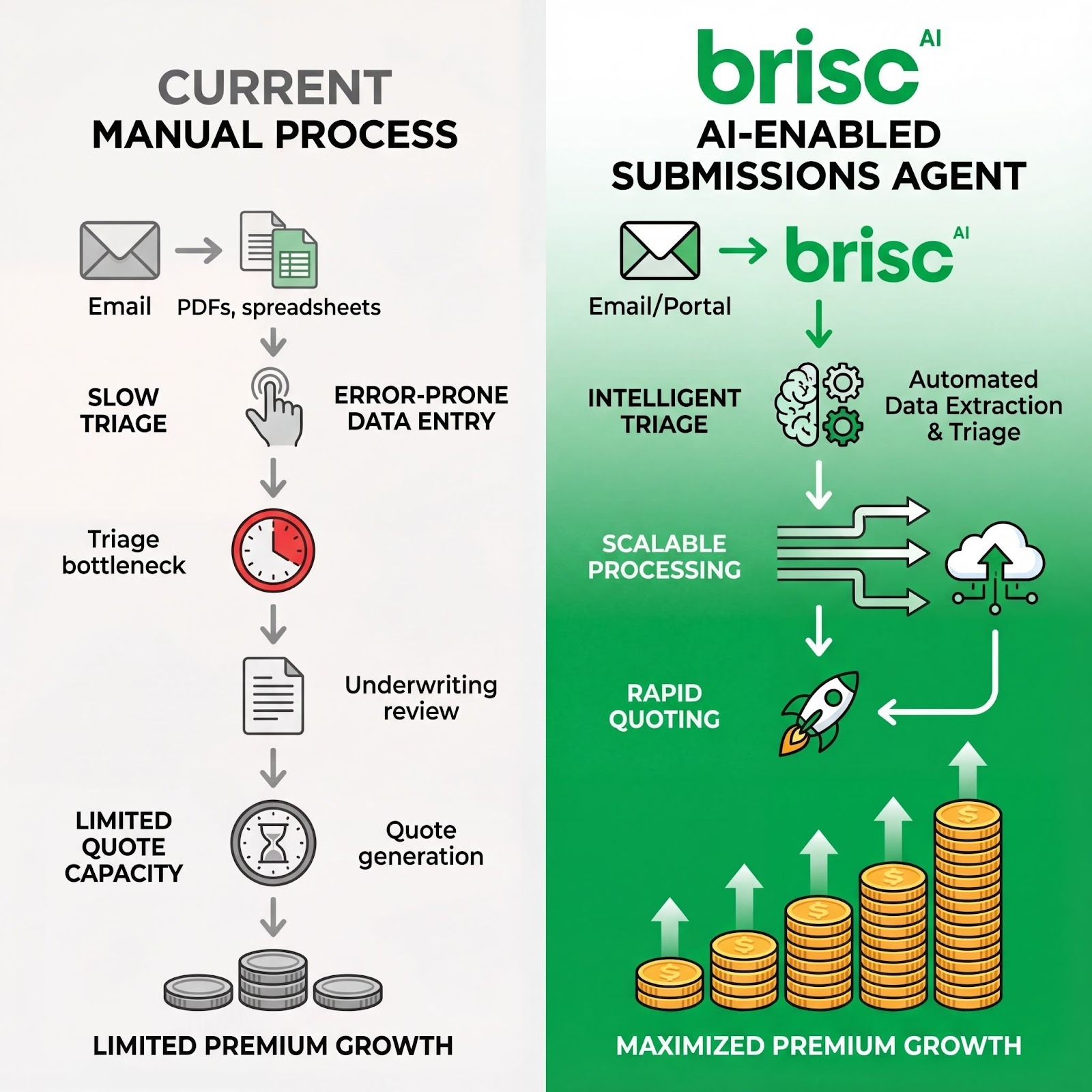
Strategies for Increasing GWP for MGAs
MGAs that consistently grow GWP focus on the operational levers that expand submission coverage, increase quoting velocity, and improve conversion. The most effective strategies are not about doing more work, but about removing friction from the underwriting process so teams can focus on high-value decisions.
1. Increase submission review capacity
GWP growth is a function of how many opportunities an MGA can realistically evaluate. Expanding submission review capacity — without adding headcount — creates immediate potential for premium lift.
2. Accelerate time-to-quote
Speed remains one of the strongest determinants of bind ratio. Brokers overwhelmingly place business with markets that respond first, even when pricing and terms are comparable.
3. Improve early-stage triage
High-growth MGAs quickly identify appetite fit, complexity, and data quality. Effective triage ensures underwriters spend time on the most promising opportunities and improves overall quote-to-bind performance.
4. Standardize and streamline intake workflows
Variability slows underwriting. Standardized, technology-enabled intake processes reduce rework, increase consistency, and create predictable broker-facing turnaround times.
5. Reduce administrative burden for underwriters
The more time underwriters spend preparing submissions, the fewer risks they can evaluate. Reducing manual tasks increases underwriting throughput and improves portfolio quality.
Brisc automates intake and triage so underwriters can focus on evaluating risk — not chasing down information or re-keying data.
Distribution Strategies That Drive GWP
Broker relationships remain one of the strongest drivers of premium growth. Markets that respond quickly, consistently, and clearly are rewarded with more opportunities, better submission quality, and stronger long-term placement performance.
High-growth MGAs strengthen broker relationships by:
- Quoting faster — speed remains one of the most decisive factors in winning business.
- Setting clear expectations — predictable SLAs improve broker confidence.
- Providing reliable turnaround times — consistency builds trust and encourages brokers to route more flow.
- Reducing friction — the easier a market is to work with, the more business it receives.
Brisc enables MGAs to respond in minutes rather than hours or days, improving hit ratios and making it easier for brokers to do business with your team — a direct driver of GWP growth.
Technology’s Impact on GWP Growth
Technology now plays a central role in how quickly and effectively MGAs can process submissions, prepare risks, and quote business. The shift toward AI-enabled underwriting is accelerating because teams are under increasing pressure to grow premium without proportionally increasing operating costs.
AI-enabled submission intake helps MGAs:
- Instantly structure submission data
- Automate data extraction and validation
- Reduce rekeying and manual administration
- Prioritize risks more effectively
- Quote at materially higher velocity
Brisc reduces intake time by more than 90%, enabling underwriters to evaluate more opportunities, quote faster, and improve win rates — all core contributors to premium growth.
How to Measure & Benchmark GWP Performance
Underwriting leaders track upstream operational metrics that correlate directly with premium growth. These indicators reveal where capacity is constrained, where opportunities are lost, and where operational improvement can unlock immediate GWP lift.
Key metrics include:
- Submission-to-quote coverage — percentage of submissions actually reviewed.
- Time-to-quote — speed remains one of the strongest predictors of bind ratio.
- Quote-to-bind ratio — measures conversion effectiveness.
- Broker response time — reflects ease of doing business and responsiveness.
- Underwriter capacity utilization — indicates whether teams are hitting throughput limits.
- Submission completeness — improves risk assessment and reduces rework.
Improvements in these upstream metrics result in predictable increases in bound premium and stronger broker relationships.
Underwriting Profitability & Its Effect on GWP
GWP growth and underwriting profitability are closely linked. Strong intake processes improve risk selection, accelerate decision-making, and support sustainable portfolio performance.
High-quality intake improves profitability by:
- Delivering complete, structured data early
- Reducing rework for underwriters
- Improving appetite fit identification
- Supporting more accurate pricing
- Reducing leakage caused by incomplete submissions
Brisc strengthens underwriting discipline by providing complete, structured submission data at the start of the process — enabling better risk selection and more predictable profitability alongside GWP growth.
Future Trends Impacting MGA GWP Growth
The next decade of MGA premium growth will be shaped by accelerating complexity in distribution, underwriting expectations, and operational demands. The most significant trends include:
- Increasing submission volume driven by broker consolidation and digital distribution.
- Heightened broker expectations for near-real-time turnaround and consistent SLAs.
- AI-enabled underwriting teams operating with higher throughput and better data.
- Pressure for faster decision cycles across all commercial lines.
- Demand for structured, real-time submission data to support pricing and portfolio decisions.
MGAs that modernize intake and early-stage underwriting will capture more broker flow, improve profitability, and grow GWP faster than competitors that rely on manual processes.
FAQ
What factors drive MGA GWP growth?
GWP grows when MGAs review more submissions, quote faster, and respond to brokers more consistently than competing markets. Submission capacity, speed-to-quote, and quote-to-bind ratio are the strongest predictors of premium growth.
How can MGAs improve quote-to-bind ratio?
Quote-to-bind performance improves when MGAs respond quickly, prioritize high-value risks, and deliver clear, accurate quotes. Faster turnaround strengthens broker preference and increases conversion.
Why do MGAs struggle to grow GWP?
Most challenges stem from operational bottlenecks — manual intake, slow triage, inconsistent workflows, and incomplete data — rather than a lack of market demand. These frictions cap throughput and reduce bound premium.
How does submission intake impact GWP?
Submission intake determines how quickly an MGA can understand, prepare, and prioritize a risk. Automated intake increases submission coverage, reduces time-to-quote, and improves overall competitiveness.
How does faster time-to-quote increase GWP?
Brokers often bind with the first suitable market to respond. Faster quoting improves win rates, expands broker flow, and increases the likelihood that MGAs receive the next opportunity.
What’s the role of technology in GWP growth?
Technology, particularly AI, accelerates data extraction, improves submission completeness, reduces administrative work, and increases underwriting capacity. These improvements allow teams to review more opportunities and quote faster.
How can MGAs grow GWP without adding headcount?
Automation via AI agents like Brisc’s Submissions Agent removes administrative burden and accelerates early-stage underwriting, enabling teams to operate at significantly higher throughput without increasing operating costs.
How does Brisc AI help MGAs grow GWP?
Brisc automates submission intake and data extraction, reducing processing time to ~60 seconds and increasing underwriting capacity by up to 10×. Faster, more complete intake directly leads to more quotes — and more premium.
What underwriting KPIs correlate with GWP growth?
Time-to-quote, submission coverage, broker response time, quote-to-bind ratio, and underwriter capacity utilization are the strongest upstream indicators of premium growth.
What trends will impact MGA GWP in the future?
MGAs will face rising submission volume, heightened broker expectations, and widespread adoption of AI-enabled underwriting. Those that modernize intake and quoting will capture more broker flow and grow GWP faster.
Unlock Faster GWP Growth With Brisc
Brisc’s Submissions Agent increases underwriting capacity, accelerates time-to-quote, and helps MGAs capture more premium — without adding headcount.