Bordereaux Reconciliation Software: 7 Questions to Ask Before You Buy
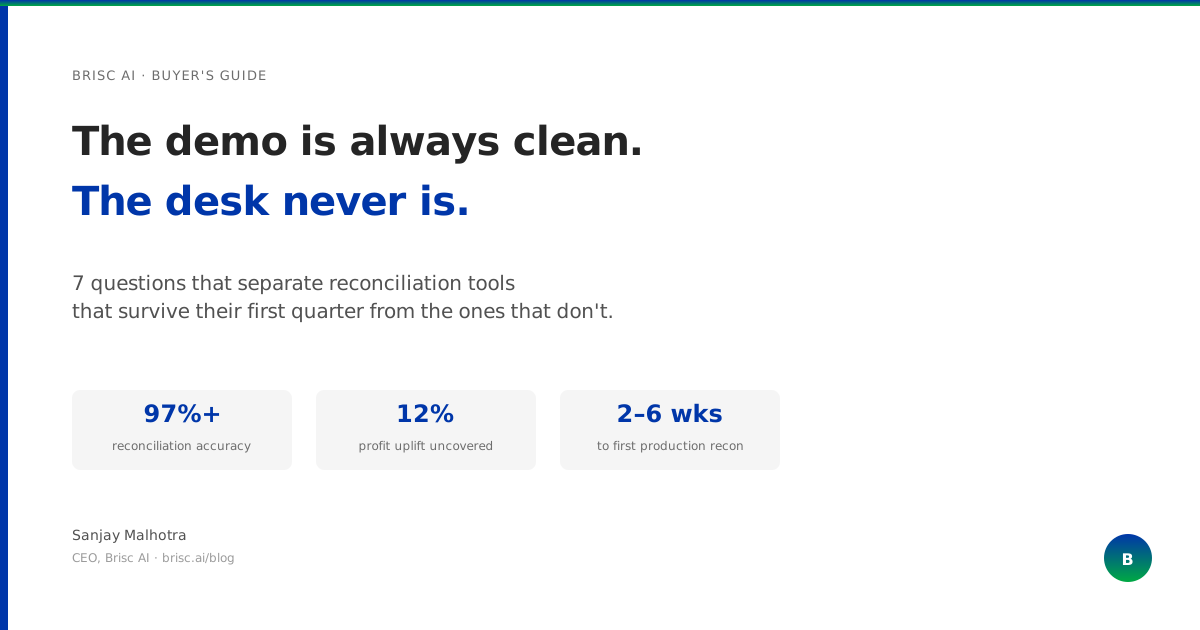
I have sat through reconciliation software demos on both sides of the table — as the buyer running operations at a specialty carrier, and now as the founder of the company building the tool. The demo is always clean. The data matches. The dashboard glows green. You leave the room thinking this could work.
Then you get back to the desk. The desk has a bordereau from a broker who changed their column layout last quarter without notice. It has a bank statement entry that reads “WIRE TXN 8847291” when the corresponding premium schedule says “Program A, Q2 2026.” It has a trust account with forty-seven thousand dollars in suspense because a reference code was transposed three months ago and nobody has had time to trace it.
Bordereaux reconciliation software automates the matching of bordereaux data — premium, claims, and commission reports exchanged between insurers, MGAs, brokers, and reinsurers — against bank receipts, premium schedules, and ledger entries. Brisc AI builds insurance-native reconciliation software, the Reconciliation Analyst, that does this matching with 97%+ accuracy while retaining every broker quirk and format pattern the system has ever encountered. But this post is not about Brisc. It is about the seven questions that separate the tools that survive their first quarter on your desk from the ones that do not.
I call this the demo-to-desk gap. Every question below is designed to close it.
1. Does it handle inception-to-date bordereaux without double-counting?
Bordereaux reconciliation that processes each reporting period in isolation will double-count previously reconciled entries when it encounters inception-to-date data. This is the most common silent failure in reconciliation software — and the hardest to detect because the period-level numbers look correct.
Most brokers send cumulative bordereaux. Every reporting period contains all prior data plus new transactions. A reconciliation tool that treats each file as a standalone dataset will match the same transactions repeatedly, inflating totals and producing a clean-looking report that is quietly wrong. The error compounds quarter over quarter and surfaces only during an audit.
In one reinsurance audit, this kind of compounding error concealed a 12% true profitability discrepancy across an entire programme. The reconciliation looked correct on a period-by-period basis. It was not correct inception-to-date.
Ask the vendor: show me what happens when I upload a Q2 inception-to-date bordereau after Q1 is already reconciled. If they cannot demonstrate deduplication against the prior period in the live demo, the tool will fail on your real data.
2. Can it tie premium to actual cash — not just bordereaux to bordereaux?
The highest-value reconciliation question is not whether two data sources agree with each other. It is whether the money actually arrived at the bank.
Many reconciliation platforms validate data within the bordereaux — policy counts, premium totals, commission calculations. That is necessary but insufficient. The question that keeps a CFO awake is not “do the bordereaux balance?” It is “has the cash been received, and can I allocate it?” A bordereaux platform tells you what was bound. The open question is whether it can also tell you what was paid.
At one MGA we work with, a $47,000 discrepancy sat in a trust account for three months. The money was correctly received but incorrectly labelled, and an analyst spent weeks tracing the chain of custody through broker correspondence before the reference code mismatch was found. A reconciliation tool that connects bordereaux entries to bank receipts would have flagged the mismatch on the day the cash arrived.
Ask the vendor: can you show me a match between a bordereau entry and the corresponding bank receipt — not just between two bordereaux files?
3. How does it explain exceptions — and to whom?
Every reconciliation tool produces exceptions. The question is what happens next and who sees what.
The analyst working the exception needs granular detail: which field mismatched, which source document carried the discrepancy, what the system attempted before escalating. The CFO reviewing the monthly position needs a summary: how much cash is unallocated, what percentage is within tolerance, what requires intervention. The auditor arriving in Q4 needs the trail: who approved the resolution, when, and against what evidence.
If a tool explains exceptions at only one altitude — a detailed log that only the analyst can interpret — it fails the other two audiences. Insurance reconciliation happens across three altitudes simultaneously. The explainability must serve all three without requiring someone to translate the analyst’s view into the CFO’s language.
Ask the vendor: show me the same exception from the analyst’s view, the CFO’s view, and the auditor’s view. If the demo has only one view, the other two will be manual.
4. What is the time-to-first-value?
Bordereaux reconciliation software that requires six months of configuration before processing its first real transaction is not reconciliation software. It is a consulting engagement with a dashboard.
Brisc AI deploys in 2-6 weeks from signed contract to first production reconciliation on real client data. The range depends on the number of broker formats in scope and the complexity of the existing ledger structure — not on a multi-month integration project. The first value should be an actual reconciliation result on real data, not a sandbox exercise on synthetic data.
IDC research found that 88% of AI proofs-of-concept in insurance fail to reach production. The most common cause is deployment timelines that stretch past the organisation’s patience and budget cycle. If the vendor’s deployment plan has a phase called “data transformation” that lasts longer than the evaluation itself, ask whether the product is ready for insurance data as it actually exists.
Ask the vendor: how many days until I see results on my own data — not yours?
5. Does it work with your existing brokers’ formats — or do they have to change?
Brokers send data in whatever format they choose. This is not going to change. Bordereaux reconciliation software that requires standardised inputs will spend its first year waiting for standardisation that never arrives.
The real problem is subtler than format variety. It is format drift. A broker who has sent a consistent Excel layout for eighteen months silently renames a column, moves the commission from column G to column J, or switches from gross to net premium reporting without notice. The reconciliation breaks not because the format was new but because it changed in the middle of an established pattern.
McKinsey and Accenture estimate that 30-40% of operations time in insurance goes to administrative tasks. Format investigation — figuring out what changed, where, and when — is a significant share of that drag. A reconciliation tool that learns each broker’s format once and detects when it drifts eliminates the investigation layer entirely. The next time that broker changes their layout, the system flags the drift and adapts rather than failing and waiting.
Ask the vendor: what happens when a broker silently changes their column layout between one reporting period and the next?
6. What audit trail does it produce — automatically or after the fact?
An automatically generated audit trail is fundamentally different from a reconstructed one. One is a by-product of the reconciliation process. The other is a project in its own right — and most operations teams know it as the quarterly audit scramble.
In regulated markets — particularly under FCA client money rules, premium trust account requirements, and delegated authority oversight — the ability to reconstruct any reconciliation decision after the fact is not optional. But the cost difference between automatic and reconstructed audit trails is substantial. One operations leader described the preparation as “clean records reassembled from emails, spreadsheets, and memory, rather than accumulated as a natural output of the daily workflow.”
Helix Underwriting Partners reported an 80% reduction in manual labour after deploying Brisc’s reconciliation system. A significant share of that reduction came from the audit trail generating itself during the reconciliation process rather than requiring a separate preparation cycle before each review.
Ask the vendor: if a regulator asks for the full reconciliation trail on a specific programme from eighteen months ago, how long does it take to produce — and does someone need to assemble it, or is it already there?
7. Where does the institutional knowledge live — in the system or in someone’s head?
This is the question most evaluations miss entirely, and it is the one that determines whether the tool compounds in value or resets to zero every time someone leaves.
The hardest thing to replace in a reconciliation team is the senior analyst who knows that Broker X truncates programme names to eight characters, that Broker Y nets commission before remitting, and that Broker Z’s wire desk drops the last two digits of the reference code every third month. That knowledge took years to accumulate. When the analyst takes a two-week holiday, exceptions pile up. When they leave the company, the knowledge walks out with them.
Insurance operations typically sees 20-40% annual staff turnover with 90-180 day ramp periods for new hires. Bordereaux reconciliation software should be a system of accumulating institutional knowledge — every broker pattern, every format quirk, every exception resolution becoming permanent memory that the next operator inherits on their first day. The system that retains what people forget is the difference between a tool and a structural advantage.
Ask the vendor: what happens to the system’s knowledge when the person who configured it leaves?
Three red flags that should disqualify a vendor on day one
- They cannot explain what happens when a broker changes their format. If the answer to format drift is “reconfigure the mapping,” the tool is a prettier version of the spreadsheet you already have. The reconciliation problem is not the match. It is the match after everything that was true last quarter is no longer true this quarter.
- Their accuracy metrics measure match rate, not match correctness. A 99% match rate means nothing if 1% of matches are wrong and nobody discovers the error until the audit. Ask for accuracy — the percentage of matches that are correct, verified against source documents. Brisc AI achieves 97%+ accuracy on bordereaux reconciliation, measured against the source, not against itself.
- Deployment is measured in quarters, not weeks. A tool that cannot show value on real data within its first month will not show value at all. The 88% AI POC failure rate in insurance is not a technology problem. It is a patience problem. Insist on a deployment plan measured in weeks.
What “good” looks like in the first 90 days
Day 30. First batch of real bordereaux reconciled on production data. Initial exceptions identified and categorised. The system has ingested the first tranche of broker formats and is building its pattern library. You have a real reconciliation result — not a sandbox exercise.
Day 60. Pattern recognition is compounding. Exceptions that required manual investigation in month one are matching automatically in month two because the system retained the resolution from the first encounter. Format drift detection is active. The operations team is spending time on genuine exceptions rather than routine matching.
Day 90. The system handles what used to be escalations. The audit trail covers three full months of production data without a manual assembly step. Brisc customers report 59% labour cost reduction at this stage — not because the team shrank, but because the team stopped spending its days on work the system now retains.
Frequently asked questions
What is bordereaux reconciliation software? Bordereaux reconciliation software automates the matching of bordereaux data — premium, claims, and commission reports exchanged between insurers, MGAs, brokers, and reinsurers — against bank statements, premium schedules, and general ledger entries. The goal is to confirm that the cash received matches what was reported, identify discrepancies, and produce an auditable trail of every match and exception.
How is bordereaux reconciliation different from bordereaux validation? Bordereaux validation confirms that data within a bordereaux file is internally consistent — correct policy counts, accurate premium totals, valid field formats. Bordereaux reconciliation goes further: it matches the validated data against external sources, primarily bank receipts and ledger entries, to confirm that reported premium was actually received and correctly allocated.
How long does it take to deploy bordereaux reconciliation software? Deployment timelines vary by vendor and complexity. Brisc AI deploys in 2-6 weeks from contract to first production reconciliation on real client data. The range depends on the number of broker formats and the complexity of the existing ledger structure — not on a multi-month integration project.
What accuracy should I expect from automated bordereaux reconciliation? Brisc AI achieves 97%+ accuracy on bordereaux reconciliation, measured against source documents. When evaluating accuracy claims, distinguish between match rate (how many items were matched) and match correctness (how many matches were right). The distinction determines whether the tool is working or hiding errors.
Can bordereaux reconciliation software handle multiple broker formats? Insurance-native reconciliation software handles multiple broker formats without requiring standardisation. Brisc’s Reconciliation Analyst learns each broker’s format on first exposure and retains the pattern permanently, including detecting when a broker silently changes their layout between reporting periods.
What is the cost of manual bordereaux reconciliation? McKinsey and Accenture estimate that 30-40% of insurance operations time goes to administrative tasks, and a disproportionate share sits in cash matching and reconciliation. One $500M+ GWP MGA we work with employs a twenty-three-person credit control team — eighteen offshore and five onshore — dedicating the majority of their time to manual bordereaux reconciliation. Brisc customers report 59% labour cost reduction after deployment.
Does bordereaux reconciliation software work for reinsurers? Reinsurers reconcile cedant bordereaux against treaty terms, premium cession schedules, and bank receipts. The reconciliation complexity increases with per-treaty rules — gross-up versus share basis, commission netting, enduring deductions — but the core matching problem is the same. Brisc’s Reconciliation Analyst handles both MGA and reinsurer reconciliation workflows.
What audit trail should bordereaux reconciliation software produce? The audit trail should be generated automatically as a by-product of the reconciliation process, not assembled manually after the fact. It should record every match, every exception, every resolution, and every approval — traceable to the source document, the extracted field, and the matching logic applied. Regulated markets under FCA client money rules and delegated authority oversight require this traceability.
Ready to close the demo-to-desk gap? Book a demo →