MGA Premium Cash Application Automation: How It Works
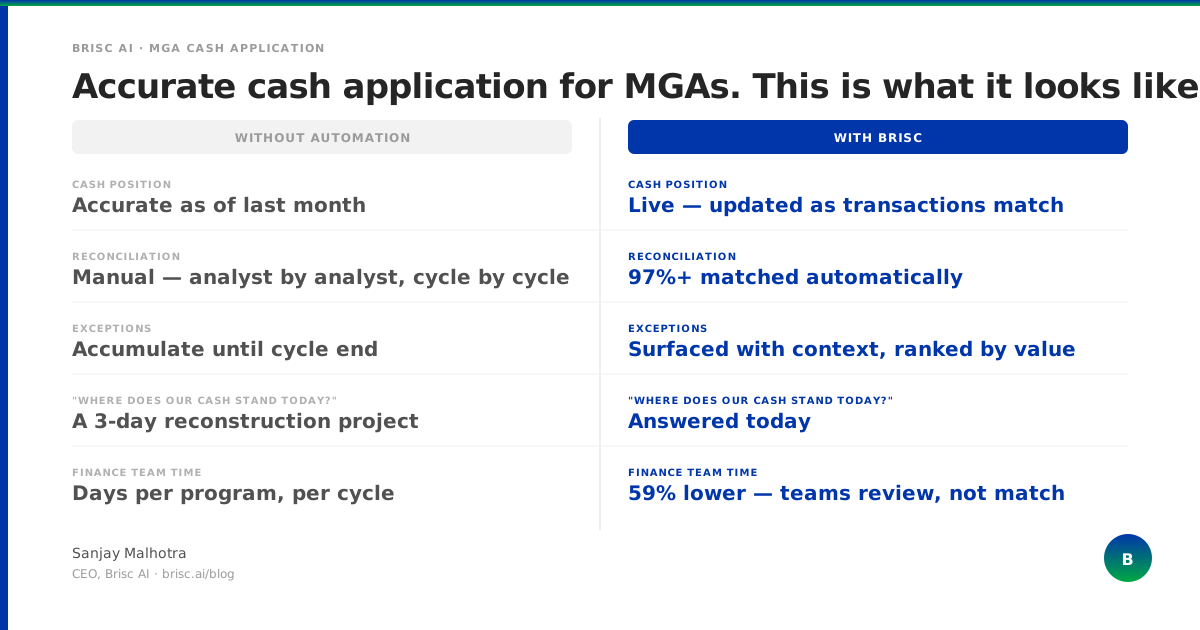
MGAs can automate premium cash application by deploying reconciliation intelligence that ingests bank statements alongside premium bordereaux and broker remittances, then matches transactions to policies without requiring clean reference codes or standardised input formats. Brisc builds this matching layer for insurance operations, reaching over 97% accuracy across MGA programs in production.
What Manual Premium Cash Application Actually Costs Your Finance Team
Brisc’s Reconciliation Analyst is an insurance-native solution built for MGAs and reinsurers operating delegated authority programs. Before solving the automation problem, it’s worth being precise about what the manual process looks like — because the failure points determine what automation needs to handle.
A finance team running cash application manually maintains an aging queue: a live ledger of premium that has been bound but not yet confirmed received. At cycle end, the team reconciles inbound bank transactions against that queue. Each reconciliation involves pulling the bank statement, locating the relevant bordereaux, identifying the broker remittance that corresponds to the wire, and manually attributing the cash across the policies the remittance covers.
On a well-run desk, this takes one to three analysts the better part of a week per cycle, depending on program volume. The work is mostly pattern-matching — finding which of the broker’s netted adjustments maps to which policy lines — interrupted by broker chases when remittance detail is missing or ambiguous.
The automation problem is not simply “make this faster.” It’s “replace the pattern-matching that analysts perform in their heads with matching logic that understands how insurance cash actually moves.” Those are different engineering challenges, which is why generic cash application tools don’t solve it.
What Connecting Automation Actually Involves
MGA cash application automation has three integration points. Getting all three right is what distinguishes a working implementation from one that creates a new category of exception.
Banking feed. Brisc connects to your bank statement data via direct feed or file ingestion. This is the starting point: every reconciliation is anchored to what arrived in the account and when.
Bordereaux data. The reconciliation layer needs access to your written premium records — what was bound, to which policies, under which programs, at which values. Brisc ingests bordereaux in any format: Excel, PDF extractions, CSV exports from your policy admin system. There is no prerequisite that bordereaux arrive in a standardized format; the system reads the format you already produce.
Broker remittances. Remittances arrive in PDF, embedded email tables, structured CSV, and proprietary formats — one per broker relationship, with no industry standard. Brisc ingests these in any format and extracts the underlying payment intent: which policies, which periods, what amounts net of what adjustments.
Once connected, the matching layer runs against all three simultaneously. It doesn’t require that a bank reference code match a bordereaux policy ID match a broker remittance reference — because in delegated authority programs, they typically don’t. The matching logic builds the correspondence from the combination of amounts, dates, counterparties, and program context.
Program-Level Attribution: The MGA-Specific Capability
Most MGAs run multiple programs at any given time — different carriers, different binder structures, different reporting cycles, different bordereaux formats. One wire transfer from a single broker may span three programs simultaneously.
Correctly attributing that wire requires program-level reconciliation: understanding that the gross remittance splits across Program A (carrier: X, reporting cycle: monthly), Program B (carrier: Y, reporting cycle: quarterly), and Program C (run-off), and that the net adjustments in the remittance are program-specific.
This is where generic cash application tools break irreparably. They reconcile against a flat chart of accounts. They have no concept of program hierarchy, and no way to split a single bank receipt across program-level bordereaux records with different carriers.
Brisc handles program-level attribution natively — because the matching model is built around the MGA’s actual structure, not around an accounts-receivable framework that’s been stretched to fit. MGAs running Brisc reduce reconciliation labour by 59% across their book, with the gains concentrated in exactly this cross-program attribution work that manual analysts spend most of their time on.
Where Brisc Fits in Your Existing Tech Stack
Implementation doesn’t require replacing your policy admin system or accounting software. Brisc sits alongside your existing stack as a reconciliation layer.
Policy admin system (PAS). Brisc ingests your PAS extract as one of its three core inputs alongside bank feeds and bordereaux files. PAS integration is the setup work done once on the first program; every subsequent program rides on the same connection.
General ledger. Brisc posts matched entries to the general ledger with a full audit trail. Unresolvable exceptions post to a suspense account with supporting context — the broker, the program, the amount — so nothing disappears into a black box pending investigation.
Exception queue. Unmatched transactions surface in an exception queue ranked by value and ambiguity. Your analysts review the cases that genuinely require human judgment; the rest clear automatically.
The result is that over 97% of transactions match automatically, with the remainder routed to the exception queue with context. Your team stops hunting for exceptions and starts deciding what to do about the ones that actually warrant it.
What the Workflow Looks Like After
Before automation, the cash application cycle looks like this: analysts pull files at cycle end, spend days reconstructing which cash corresponds to which bordereaux records, chase brokers for missing remittance detail, and produce a cash position that’s accurate as of last period.
With Brisc, the cycle looks like this: transactions match continuously as they arrive. The aging queue updates in real time. Brokers who remit without adequate detail trigger an automated exception for your team to review within hours, not at end-of-cycle. Cash position is available at any point during the period, not reconstructed after close.
The CFO question — “where does our premium cash stand today across all programs?” — has a live answer. The compliance question — “can we confirm receipts against bordereaux records for the carrier audit?” — has an auditable trail rather than a spreadsheet reconstruction project.
For MGAs approaching carrier reporting deadlines or audit events, this shift in cash position visibility is typically the highest-value operational change Brisc delivers.
Frequently Asked Questions
How can an MGA automate premium cash application? By connecting your banking feed, bordereaux exports, and broker remittances to a reconciliation layer that understands insurance payment structures — handling net remittances, program-level attribution, and identifier mismatches without requiring data standardisation upfront. Brisc deploys this for MGA operations, typically in weeks, reaching 97%+ matching accuracy in production.
How long does implementation take? Brisc deploys in 2-6 weeks for most MGA implementations. The main variable is the number of distinct remittance formats across the broker panel — each new format requires extraction configuration. Standard implementations with 5–15 active brokers are typically live within two to six weeks of data access being granted.
What data does Brisc need to connect to? Three sources: your bank statement feed (API or file), your bordereaux data (any format — PAS export, Excel, CSV), and your broker remittances (any format — PDF, CSV, email extract). No data standardization is required before go-live. Brisc reads the formats you currently produce.
Does my existing tech stack need to change? No. Brisc ingests from your existing systems — PAS extract, bank feeds, bordereaux files — and posts matched entries to the general ledger. Your team continues working in the same systems; Brisc handles the reconciliation layer between banking and bookkeeping.
How does it handle multiple programs simultaneously? Program-level attribution is a core capability — not an add-on. Brisc understands your program hierarchy: which carriers, which binder structures, which reporting cycles. A single broker remittance that spans three programs is split and attributed at program level, with separate postings per program’s carrier structure.
What happens to transactions that can’t be matched automatically? They surface as exceptions with supporting context: the counterparty, the program, the amount, the closest potential matches, and the reason automatic matching couldn’t resolve them. Your analysts review exceptions — they don’t hunt for them.
How do I measure ROI? The primary measures are labour cost per cycle and unallocated cash balance. MGAs running Brisc reduce reconciliation labour by 59% on average. The secondary measure is cash position accuracy — comparing how often the CFO’s cash position question can be answered intra-period versus requiring reconstruction at close. For audit preparation, the auditable trail Brisc produces replaces a manual reconstruction project that typically takes days.
Evaluating Premium Cash Application Automation for MGAs
Not every tool marketed as cash application automation will work for delegated authority programs. The capabilities that matter are specific.
The tool must handle net remittances — single payments representing multiple policies, multiple periods, and multiple deduction types. If it expects one-to-one payment-to-invoice correspondence, it will fail in the same ways your current manual process does, just faster.
It must read your bordereaux formats as-is. A prerequisite data standardization project adds months and risk before you see any benefit — and often fails, because bordereaux formats change when carriers update their templates.
It must support program-level attribution. Flat-account reconciliation won’t correctly split a cross-program remittance.
And it must write back to your systems in a form they can accept — not just produce a reconciliation report that your team then has to manually repost. Automation that produces a report your analysts still have to action isn’t automation; it’s a better spreadsheet.
Those four capabilities are table stakes for the delegated authority environment. Brisc was built around all four because they define the actual problem — which is why insurance bank reconciliation is genuinely solvable when the tool understands what it’s reconciling.
Brisc’s Reconciliation Analyst is purpose-built for bank-to-bordereaux reconciliation in delegated authority programs. See how it works.