Excel Archaeology: A Day in the Life of an Insurance Cash Matcher
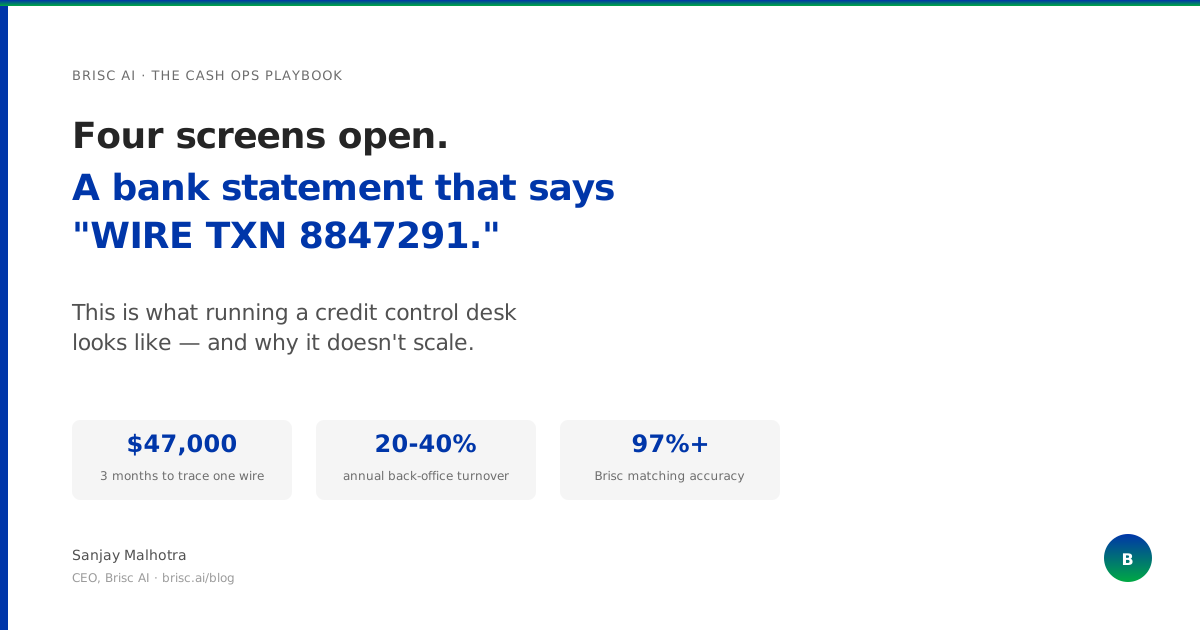
Four screens open. A bank statement that says “WIRE TXN 8847291.” A bordereau that says “Program A, Q2 2026.” A broker email asking why his commission netted differently this month. A general ledger waiting for a journal entry that can’t be posted until someone figures out which of those three things connects to which.
This is what a cash matcher’s morning looks like in a delegated authority MGA or reinsurer, and if you’ve spent any time in insurance operations, you recognize the scene. The person sitting in that chair is usually one of the most experienced people in the building. They carry the institutional knowledge of how each broker reports, which reference codes always arrive truncated, and which cedant’s quarterly file swaps column headers without warning. The work is skilled, detail-intensive, and almost entirely invisible to the rest of the organization.
Brisc AI is an insurance-native AI platform that automates cash matching, bordereaux reconciliation, and premium allocation for MGAs and reinsurers. We built the Reconciliation Analyst because every credit control team we talk to describes the same daily cycle — and the same structural reason it doesn’t scale.
Here is that cycle, step by step. If you manage one of these teams, you’ll recognize every stage. If you’re a CFO or COO wondering why the function costs what it costs, this is why.
Step 1: Ingest — the morning download
The day begins with downloads. Bank statements arrive from the treasury portal. Bordereaux files arrive from brokers — some as Excel, some as CSV, some as PDF attachments to emails with a subject line that says “see attached.” Remittance advices land in a separate inbox, sometimes matching the broker’s bordereau, sometimes not.
At one MGA we work with, the credit control team processes approximately eighty bordereaux per month from thirty-eight binder partners across six geographies. Each partner has its own file format, its own column naming conventions, its own currency and tax treatment. The first hour of every day is spent organizing what arrived overnight — sorting it into folders, identifying which program each file belongs to, and flagging the ones where something looks different from last month.
This is the step where format drift shows up. A broker’s remittance file used the same twelve-column layout for eighteen months, then one quarter the accounts team on the other end rearranged the columns and renamed “Gross Premium” to “Written Premium (Gross).” Nobody announced it. The analyst who catches the change adjusts the spreadsheet logic. The analyst who doesn’t produces a mismatch that takes three days to trace.
McKinsey and Accenture estimate that 30-40% of operations time in insurance goes to administrative tasks. A disproportionate share of that time lives right here — in the ingest stage — before the actual matching has even started.
Step 2: Identify — the translation layer
Once the files are organized, the real work begins: translating what the broker sent into something the general ledger can accept. The bank statement says “WIRE TXN 8847291.” The bordereaux says “Program A — Cyber SME — Q2 2026 — Net of Brokerage.” The remittance advice says “Settlement Ref: BRK-2026-Q2-047.”
None of these identifiers match. The analyst’s job is to recognize that all three refer to the same underlying payment — and to do it across hundreds of transactions per month.
This is where institutional knowledge lives. An experienced cash matcher knows that Broker X always truncates program names to eight characters. Broker Y nets commission before remitting, even though the bordereau shows gross. Broker Z’s wire desk drops the last two digits of the reference code every third month — not every month, every third month, because it’s a manual batch process on their side that overflows a character limit in their legacy system.
None of this knowledge is documented. It lives in one person’s head. The industry average for back-office staff turnover in insurance operations runs 20-40% annually, and the ramp time for a new hire to reach full productivity in a credit control role is typically ninety to one hundred and eighty days. When the person who holds those patterns leaves, the next person rediscovers them the hard way — by producing mismatches that take weeks to resolve.
Step 3: Match — the seventeen-tab spreadsheet
Matching is where the spreadsheet earns its reputation. The analyst opens the master reconciliation file — spreadsheets with seventeen tabs, one per program, each with its own formula chain — and begins lining up bank entries against bordereau records.
The clean matches go fast. Wire amount equals expected premium, reference codes align within tolerance, currency and tax treatment are standard. In a well-run team, these clear in minutes.
It’s the rest that defines the job. Part-payments where a broker remitted eighty percent and held the remainder pending a query. Over-payments where two programs were lumped into a single wire. Net-of-commission amounts that don’t match the gross bordereaux because the brokerage percentage was renegotiated mid-term and the bordereau still reflects the old rate.
At one MGA, a single $47,000 discrepancy took three months of broker correspondence to trace. The money was never missing — it was sitting in a trust account, correctly received but incorrectly labeled, while an analyst rebuilt the chain of custody one email at a time. That three-month trace consumed analyst time that could have been spent on eighty other matches.
Step 4: Exception — the escalation queue
Every match attempt that fails becomes an exception. Exceptions accumulate in a queue — sometimes a formal ticketing system, more often another tab in the spreadsheet — and each one requires investigation.
The CFO of a $500M+ GWP Lloyd’s hybrid MGA told us her team’s single most time-consuming activity was not the matching itself but the exception investigation. “We know where the cash is,” she said. “We just can’t prove it yet.” The gap between received and allocated is the gap between cash in the bank and cash on the books, and every day that gap stays open, the reported cash position is understated and weeks behind reality.
Cross-jurisdiction tax variance compounds the problem. A UK-originated policy carries Insurance Premium Tax at one rate. An EU policy carries a stamp duty at a different rate. A Bermuda-fronted program carries no premium tax at all. When a single wire bundles policies from three jurisdictions, the expected net amount depends on which tax treatment applies to which line — and the analyst handling the exception needs to know all three.
Step 5: Post — the journal entry
Once a match is confirmed, the journal entry is prepared. Program, period, amount, tax treatment, commission split, offsetting entries. The posting connects the bank to the general ledger, the ledger to the program accounts, and the program accounts to the financial reports that the CFO reads.
In a continuous reconciliation environment, this happens the same day. In most manual operations, it happens at month-end — or later. The consequence is a cash position that is technically accurate as of the last close date but stale by the time anyone reads it. Finance can see what was allocated as of April 30. It cannot see what arrived on May 3 and where it belongs until the May cycle runs.
This lag is what makes the question “how much cash is sitting unallocated right now?” so difficult to answer. The cash is there. The information to allocate it is there. But the process to connect them can’t keep pace with the volume.
Step 6: Document — the audit trail nobody built on purpose
The final step is documentation. Every match needs a record. Every exception needs a resolution trail. Every journal entry needs a supporting reference that an auditor can follow from the bank statement to the general ledger entry without asking the analyst to explain the logic.
In most operations we’ve seen, this documentation is assembled after the fact rather than accumulated as the work happens. The audit trail lives in email threads, annotated spreadsheet cells, and whatever notes the analyst kept in a personal file. We’ve seen organizations where several million dollars sat in suspense accounts for months because the reconciliation backlog meant nobody could confirm which program the money belonged to.
When audit season arrives — internal review, regulatory examination, reinsurance commutation — the scramble to produce clean records exposes every shortcut that accumulated during the year. In one multi-year reinsurance audit, AI-powered processing across the full dataset surfaced a 12% uplift in true profitability that manual review had missed entirely. The issue wasn’t fraud or negligence. The issue was that the monthly reconciliation process was too close to the individual line items to see systemic patterns.
What changes when the cycle breaks
The cycle described above — ingest, identify, match, exception, post, document — is not fundamentally wrong. It is the right process. The problem is that it depends entirely on human memory, human pattern recognition, and human endurance across hundreds of transactions per month, and those dependencies break at scale.
Brisc’s Reconciliation Analyst runs the same cycle but retains every pattern it encounters permanently. The broker who truncates program names to eight characters is learned once and recognized automatically on every subsequent file. The cedant whose quarterly bordereaux swaps column headers is mapped once and handled without intervention. The cross-jurisdiction tax variance that requires manual calculation today is codified and applied consistently at scale.
Helix Underwriting Partners, an MGA using Brisc for submissions intake, reports an 80% reduction in manual labour on the workflows they’ve automated. Across our customer base, organizations running Brisc’s reconciliation platform see 97%+ matching accuracy and a 59% reduction in labour costs — not because the work disappears, but because the system retains the institutional knowledge that previously lived in one analyst’s head.
The deployment timeline is typically two to six weeks because Brisc works alongside existing banking and accounting systems rather than replacing them. The dictionary the system builds — broker patterns, format variations, reference code quirks, tax treatments — compounds across cycles, so matching on day ninety is materially better than matching on day one.
The question for your team
If you manage a credit control team, you already know whether you’re living inside the cycle described above. The test is simple: could your team function if your most experienced cash matcher took a three-week vacation tomorrow?
If the answer is no — if the knowledge that holds the operation together lives in someone’s head rather than in a system — then the function is one resignation away from a multi-month recovery.
The technology to break this cycle exists. The cash matching process is not inherently a human-memory problem. It is a pattern-recognition problem, and pattern recognition is exactly what insurance-native AI was built for.
If your cash-matching cycle is consuming more of your team’s capacity than it should, let’s look at the data together.
Frequently asked questions
What is a cash matcher in insurance? A cash matcher is the analyst (often called a credit controller or premium operations specialist) who reconciles incoming bank payments against bordereaux records, remittance advices, and general ledger entries. In delegated authority programs, this role is responsible for confirming that every premium pound or dollar that arrives at the trust account is correctly allocated to the right program, period, and transaction.
Why is insurance cash matching harder than cash matching in other industries? Insurance cash matching is harder because a single bank deposit may contain premiums from multiple programs, each reported through separate bordereaux from different brokers with different formats and different reference codes. The identifiers on the bank statement almost never match the identifiers on the bordereaux, and claims payments flow through separate accounts with different settlement timing. Most off-the-shelf reconciliation tools are built for clean, structured data with consistent identifiers — insurance cash flow has none of those properties.
What is “Excel archaeology” in insurance operations? Excel archaeology is the operator shorthand for the process of tracing a cash discrepancy backward through multiple spreadsheets, broker emails, and remittance files to reconstruct the chain of custody for a specific payment. The term captures the reality that matching data in insurance operations is often reconstructed after the fact rather than documented as it happens.
How much time does manual cash matching consume? For a typical MGA or reinsurer, a credit control team of fifteen to twenty-five people can spend the equivalent of two to three full-time employees solely on the ingest and identify steps — before any actual matching begins. McKinsey and Accenture estimate that 30-40% of operations time in insurance goes to administrative tasks, and cash matching is among the most labour-intensive of those tasks.
What happens when a cash matcher leaves? When an experienced cash matcher leaves, the broker-specific patterns, format quirks, and reference code logic they carried leave with them. A new hire typically takes ninety to one hundred and eighty days to reach full productivity because the knowledge isn’t documented — it is accumulated through months of exception handling. During that ramp period, unmatched cash accumulates faster than it clears.
What is a trust account in suspense? A trust account in suspense holds cash that has been received by the MGA or reinsurer but cannot yet be allocated to a specific program because the reference information on the payment doesn’t match the expected bordereau entry. Suspense balances grow when matching falls behind the ingest volume, and they shrink only when an analyst manually traces each payment to its corresponding record.
Can AI really handle the format variability in insurance bordereaux? Insurance-native AI can, because it is built to understand that “gross written premium,” “GWP,” and “written premium” are the same field — and that one broker sends loss dates in MM/DD/YYYY while another sends them in DD-MMM-YY. Generic RPA and rule-based extraction tools fail on bordereaux because they cannot handle the format variability and insurance-specific terminology that makes this data challenging. Brisc’s Reconciliation Analyst achieves 97%+ matching accuracy across formats because it retains every format variation and broker pattern it encounters.
How long does it take to deploy a cash-matching AI system? Brisc deploys in two to six weeks because it works alongside existing banking and accounting systems rather than replacing them. The system learns broker patterns, format variations, and matching logic from the team’s existing processes, so the deployment builds on institutional knowledge rather than discarding it.
See the Brisc Reconciliation Analyst in Action. Book a demo →