Insurance Cash Ops: The Hidden Cost Stack
The COO of a $500M+ GWP Lloyd’s hybrid MGA sat across from me last month and described a problem that nobody on her board had named. Her company was about to launch a high-volume cyber product — micro-policies, automated underwriting, aggressive distribution. The front-office economics were sound.
But when her credit control lead modeled what it would cost to match each premium payment to the corresponding bordereau, the per-policy match cost was approaching the premium itself. A twenty-three-person credit control team — eighteen offshore through a BPO and five onshore — already consumed a significant share of the operating budget. Scaling the team proportionally with the new product would make the line uneconomic before the first quarter closed.
Brisc AI is an insurance-native AI platform that automates cash matching, bordereaux reconciliation, and premium allocation for MGAs and reinsurers. We built the Reconciliation Analyst because every operations leader we talk to describes the same structural problem: the function that matches cash to contracts has no single owner, no single budget, and no single upgrade path — and it has quietly become one of the largest cost stacks in the insurance back office.
This is what we call Cash Ops.
What Cash Ops actually is
Cash Ops is the umbrella for every workflow that sits between “cash arrived at the bank” and “cash is correctly allocated against the right program, period, and transaction in the general ledger.” It includes:
- Cash matching — reconciling bank statement entries against bordereaux and premium schedules
- Premium allocation — assigning received funds to the correct program, binder, or treaty
- Suspense management — identifying and resolving unallocated cash sitting in trust accounts
- Commission reconciliation — confirming brokerage and commission deductions against agreed terms
- Audit trail construction — documenting the lineage of every match, exception, and resolution
In a typical MGA, no single team owns all five. Treasury handles the bank. Accounting handles the ledger. Finance reports the position. Operations processes the bordereaux. And somewhere between them, a team of analysts — often the most experienced people in the building — spends their days tracing payments through spreadsheets with seventeen tabs, broker emails with mismatched reference codes, and bordereaux files whose column definitions changed last quarter without notice.
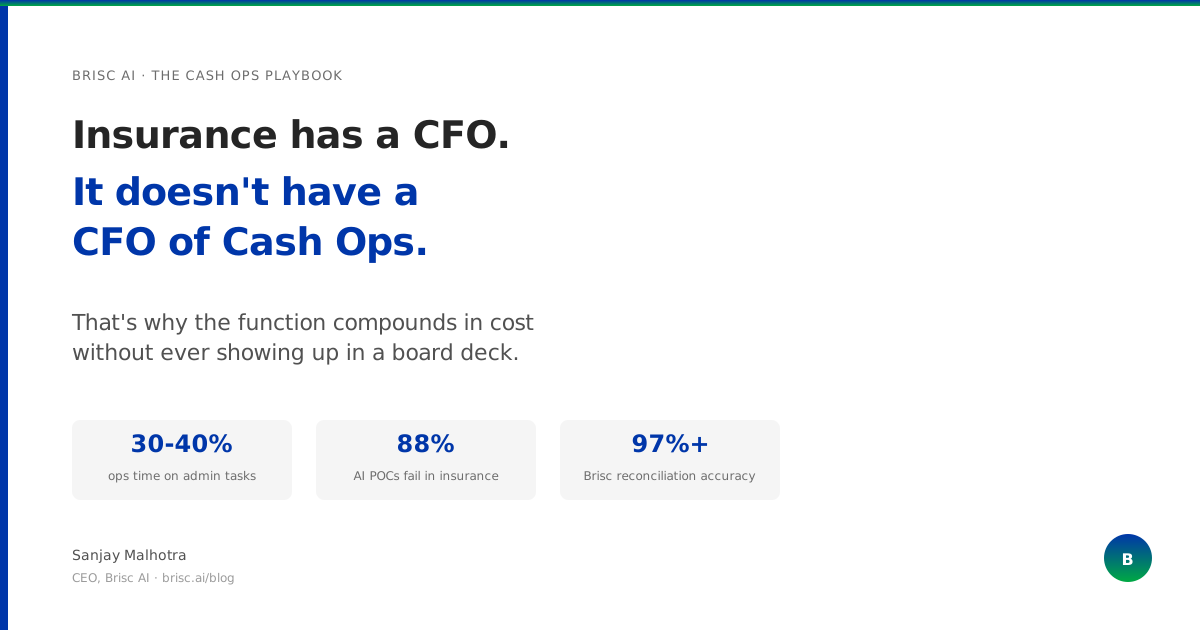
McKinsey and Accenture estimate that 30-40% of operations time in insurance goes to administrative tasks. A disproportionate share of that time lives in Cash Ops — but it never appears as a line item because it is distributed across departments that each carry their own slice.
Why Cash Ops stays hidden
The reason Cash Ops doesn’t show up in board decks is architectural, not incidental. Cash Ops is not a function — it is a seam.
When an MGA runs five programs with three brokers, cash matching is manageable. One experienced analyst knows the formats, knows the quirks, recognizes the discrepancies. At fifteen programs across eight brokers and three jurisdictions, the same function requires a team. At thirty programs, it requires a department — but no one calls it that, because the work is still split across treasury, operations, and finance.
The cost compounds silently. Each new program introduces interactions with every existing format and process. The relationship between program count and matching difficulty is not linear — it is multiplicative. A $47,000 discrepancy at one MGA took three months of broker correspondence to resolve. The money was never missing. It was sitting in a trust account, correctly received, incorrectly labeled, while an analyst reconstructed the chain of custody one email at a time.
Cash Ops has no CFO. It has no single owner, no unified budget, and no upgrade path. So the function scales by adding people — and the people leave, taking the institutional knowledge with them. Industry data points to 20-40% annual turnover in insurance back-office roles, with a 90-to-180-day ramp before a new hire becomes productive in cash matching. Every departure resets the clock on broker-quirk knowledge that took months to accumulate.
One referral partner put it plainly: “Nobody’s saying cash matching. It’s a huge, huge opportunity.” The opportunity exists precisely because the problem has never had a name — and problems without names don’t get budgets.
Why now
Two things changed in the last eighteen months that made Cash Ops automatable in a way it wasn’t before.
1. The category opened. AI in insurance has been discussed for a decade, but most investment went into underwriting — pricing models, risk selection, portfolio optimization. The operations side was left to RPA and rules-based automation, which clear the clean cases and leave the hard ones to people. IDC data shows that 88% of AI proofs-of-concept in insurance fail to reach production. Most of those failures were horizontal tools applied to a vertical problem. They could classify a document but couldn’t remember that Broker X truncates program names to eight characters, or that Cedant Y nets commission before remitting, or that the third-quarter report from Cedant Z always arrives in a different format than Q1 and Q2.
The percentage of insurers fully embedding AI into core operations jumped from 8% to 34% in 2025. That jump happened because a new category of insurance-native AI — systems trained on insurance documents, not general business documents — reached production reliability. Brisc’s Reconciliation Analyst operates at 97%+ accuracy on bordereaux reconciliation because it was built from insurance workflows, not retrofitted from a general-purpose model.
2. The economics forced the conversation.
The COO I described at the opening is not unusual. Every MGA scaling from five programs to twenty discovers that back-office costs grow faster than premium revenue. Every PE-backed MGA discovers that the board’s scoring function is cost reduction, not new technology spend. And every reinsurance CFO who models the cost of matching three thousand bordereaux per year against four hundred treaties discovers that the manual workflow costs more than many of their technology contracts combined.
One reinsurance audit revealed a 12% uplift in true profitability that had been invisible — masked by periodic reconciliation that couldn’t surface systematic under-reporting across three years of cedant data. The money was there. The matching wasn’t.
The question isn’t whether Cash Ops will be automated. It is whether the automation retains the institutional knowledge that makes the function work — or whether it replaces experienced analysts with tools that can’t remember what they processed last month.
The knowledge-retention test
This is the structural difference between Cash Ops automation that works and Cash Ops automation that becomes another failed POC.
Rules-based matching clears the clean cases: exact amounts, exact references, exact timing. Part-payments, over-payments, cross-jurisdiction tax variance, and format drift — the cases that actually require expertise — fall back to people. The automation handles the portion that didn’t need help. The other half still sits on someone’s desk.
Insurance-native AI approaches the problem differently. Brisc’s Reconciliation Analyst accumulates every broker quirk, every format exception, every cedant-specific rule into a permanent dictionary. Helix Underwriting Partners reports that Brisc removed 80% of manual labour from their operations — and the mechanism is knowledge retention. Every pattern the system encounters compounds into the next cycle, so the team that runs thirty programs operates with the accumulated context of every program it has ever onboarded.
The result — a 59% reduction in labour costs that Brisc customers report — is not a speed gain. It is the elimination of rework that should never have existed: the re-learning of broker formats, the re-tracing of discrepancies, the re-building of institutional knowledge every time an experienced analyst moves on.
Frequently Asked Questions
What is Cash Ops in insurance? Cash Ops is the umbrella term for every workflow between “cash arrived at the bank” and “cash is correctly allocated in the general ledger.” It spans cash matching, premium allocation, suspense management, commission reconciliation, and audit trail construction. In most insurance organizations, no single team owns all of these — which is why the function grows in cost without governance.
Who owns Cash Ops at a typical MGA? Usually nobody does — and that is the structural problem. Cash Ops sits at the seam between treasury, accounting, operations, and finance. Each department handles one piece; no one holds the full picture. This distributed ownership is why the function scales by adding people rather than by investing in systems.
Why is cash matching getting harder for growing MGAs? Growth introduces format fragmentation, jurisdictional complexity, and knowledge concentration. Each new program introduces interactions with every existing broker format and process. Cross-jurisdiction tax variance — UK Insurance Premium Tax, EU stamp duties, US surplus lines taxes — means the same premium can be reported three different ways by three brokers in three countries for the same program.
What is the difference between Cash Ops and AR automation? AR automation typically addresses the cash-application step: matching a payment to an invoice. Cash Ops in insurance is broader. It includes bordereaux-to-bank reconciliation, commission netting, suspense resolution, and audit trail construction — all of which require domain-specific knowledge about how insurance cash flows work. General AR automation tools do not understand broker remittance formats, trust account structures, or programme-level allocation rules.
Why do most insurance AI projects fail to reach production? IDC reports that 88% of AI proofs-of-concept in insurance fail to scale. The most common failure mode is a horizontal tool applied to a vertical problem — a general-purpose model that can extract data but cannot retain the domain-specific rules that make insurance operations work. Insurance-native AI systems are purpose-built for the document types, workflows, and exception patterns that insurance operations teams handle daily.
How does Brisc’s Reconciliation Analyst automate Cash Ops? Brisc’s Reconciliation Analyst ingests broker remittances, bank statements, and bordereaux in any format — PDF, Excel, email, EDI, or portal scrape. It matches cash to contracts using an accumulated dictionary of broker-specific patterns, flags exceptions with confidence scores for human review, and posts matched entries to the general ledger with a full audit trail. Typical deployment takes 2-6 weeks, depending on the number of programs and the complexity of existing broker formats.
If the function your team hasn’t named is the one holding back your next product launch, you’re looking at a Cash Ops problem. See how Brisc’s Reconciliation Analyst works with your data →