What Happens When Your Best SICS Operator Leaves
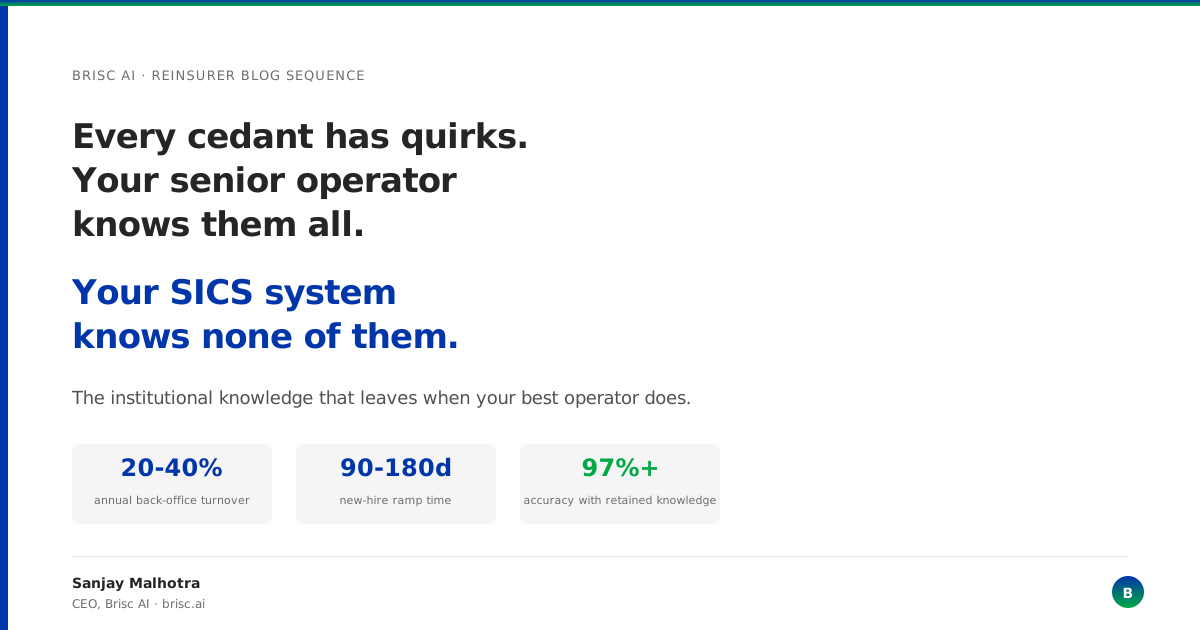
The cession-accounting manager at a mid-size reinsurer gets a resignation letter on a Tuesday. The senior operator — the one who has been running SICS data entry for seven years — is leaving for a competitor. She has two weeks of notice. In those two weeks, the manager needs to capture everything she knows about 80 cedants, 200 contracts, and the formatting quirks of every bordereaux that arrives every month.
It’s not possible. Not in two weeks. Not in two months. Most of that knowledge has never been written down because it does not fit in any system the reinsurer owns.
SICS runs the reinsurance back office at over 100 reinsurers in 38 countries. Brisc AI is an insurance-native AI platform that retains cedant-specific knowledge permanently, so reinsurers stop losing institutional memory every time an operator leaves. SICS is a powerful system of record for treaty management and cession accounting. But it stores the structured output of the translation work — the entry codes, the settled amounts, the treaty balances. It does not store the translation logic — the accumulated knowledge of how each cedant’s unstructured documents map to those entries.
That translation logic lives in the operator’s head. And when she leaves, it leaves with her.
The Notebook That Doesn’t Exist in Any System
Every experienced SICS operator carries an informal reference — sometimes literal, usually mental — of what each cedant’s documents actually mean. The insurance industry loses 20-40% of its back-office staff annually to turnover. Each departure takes this notebook with it.
Here is what the notebook contains, organized by the six SICS entry categories that consume the day:
Written premium. Cedant A always reports premium net of brokerage in column F. Cedant B reports gross premium in one tab and tax adjustments in another, and the operator knows to subtract before entering. Cedant C sends the same premium data in two different reports from two different internal systems, and the operator knows which to trust.
Commission. Cedant D bundles ceding commission, override commission, and profit commission into a single column labelled “comm.” The operator knows to split it three ways because she has been reading Cedant D’s reports since 2019. The new hire sees one number.
Brokerage. Cedant E does not separate brokerage from commission because its own accounting system does not distinguish them. The operator knows that Broker X has been on the contract since inception at 2.5%, and she separates the brokerage by memory. SICS expects it as a distinct entry code.
Paid loss and case reserves. Cedant F’s claim bordereaux understates case reserves until the external auditor reconciles them every Q3. The operator knows to flag Q3 numbers as provisional. The new hire books them as final.
Premium adjustments. Cedant G sends mid-term endorsement adjustments as narrative letters — three paragraphs of context, one number buried in the second page. The operator reads the narrative and knows which treaty period to apply the adjustment against. A new hire might apply it against the wrong quarter and never know until the reconciliation breaks.
None of this is stored in SICS. SICS holds the final entry codes. The mapping from unstructured cedant document to structured entry code is not a SICS capability. It is a human capability. And the human who carries it is a single point of failure.
What It Costs to Rebuild the Notebook
When the senior operator leaves, the reinsurer faces three compounding costs that McKinsey and Accenture estimate contribute to the 30-40% administrative overhead burden across insurance operations.
The ramp. A new cession-accounting hire can take months to reach productive independence — and that timeline assumes the cedant base doesn’t change during ramp-up. Every new cedant resets the learning clock. At a reinsurer processing 3,000 bordereaux a year across 400 contracts, there is no stable state to learn — the base shifts quarterly.
The error window. During the ramp, the new operator makes the mistakes the departing operator learned to avoid five years ago. Cedant A’s column F gets entered gross instead of net. Cedant D’s commission doesn’t get split. Cedant F’s Q3 reserves get booked as final. Each error surfaces not at the time of entry but at the next quarterly reconciliation — three months later, buried in a balance that no longer ties.
The discovery tax. When the reconciliation breaks, someone has to find the error. A $47,000 discrepancy traced through three months of broker correspondence is not unusual in reinsurance — it is the expected consequence of lost institutional knowledge. One reinsurance audit found that restoring the knowledge a single departing operator carried led to a 12% true profitability uplift because errors had been compounding silently for years.
The total cost of one senior operator’s departure is not her replacement salary. It is six months of degraded accuracy, a quarterly reconciliation that takes twice as long, and a risk of compounding errors that may not surface for years. The Brisc stat library shows that reinsurers achieving 97%+ accuracy on bordereaux reconciliation reach it only when the translation logic is retained in the system, not in a person.
Why SICS Cannot Solve This (And Was Never Designed To)
SICS is a system of record. It is excellent at storing structured treaty data, managing settlement workflows, and producing regulatory outputs. It was designed to be the destination, not the translator.
The translation problem — reading an unstructured cedant document and knowing which data maps to which entry code, in which format, with which cedant-specific exceptions — is not a data-model problem. It is a knowledge-accumulation problem. SICS does not have a per-cedant knowledge layer that learns from prior documents. Each document is a fresh input, interpreted by a human operator using accumulated experience that exists nowhere in the platform.
ACORD’s ADEPT standard addresses a portion of this gap — the roughly 20% of cedants who have adopted structured digital exchange. ADEPT transactions grew 73% from 2024 to 2025, which reflects real progress. But the remaining 80% of cedants — the long tail of small and mid-size counterparties in every market — still send PDFs, Excel files, and narrative letters. They are not on a near-term adoption roadmap. The gap between the structured 20% and the unstructured 80% is the space where operators spend their days and where institutional knowledge compounds silently.
The Alternative: Institutional Memory That Does Not Resign
Brisc’s Reinsurance Accounting Analyst is built to hold the notebook — permanently.
When a cedant’s bordereaux arrives, the Reinsurance Accounting Analyst does not start fresh. It reads the document against a per-cedant dictionary that has been accumulating since the first document was processed. Cedant A’s column F convention, Cedant D’s commission split, Cedant F’s provisional Q3 reserves, Cedant G’s narrative adjustment format — every pattern the senior operator learned over seven years becomes a system-level memory that no departure can erase.
The dictionary is not static. Each time the Reinsurance Accounting Analyst processes a new document, it compares against the accumulated patterns and surfaces exceptions for human review. When a cedant changes its format — and cedants change formats without notice — the exception is flagged, reviewed by a human, and the dictionary updates. The knowledge compounds across cycles instead of degrading across headcount changes.
Brisc achieves 97%+ accuracy on bordereaux reconciliation because accuracy is a function of retained knowledge, not individual effort. Reinsurers deploying the Reinsurance Accounting Analyst report a 59% reduction in labor costs — not because the work disappears, but because the knowledge-dependent work (the translation) moves from human memory to system memory, and the human reviews the exceptions that genuinely require judgment.
Deployment takes 2-6 weeks. The per-cedant dictionary begins accumulating from the first processed document. Within two months, the system carries more cedant-specific context than any single operator — because it retains the knowledge of every operator who has ever reviewed an exception, compounded.
For reinsurers running SICS, Sapiens ReinsuranceMaster, Verisk Sequel, or in-house platforms, the architecture is the same. Only the output template changes. The dictionary — the accumulated institutional knowledge of your cedant base — carries across platforms and survives every staffing transition.
Frequently Asked Questions
What kind of institutional knowledge does the Cession Analyst retain? Brisc’s Reinsurance Accounting Analyst builds a per-cedant dictionary that captures format conventions, column-mapping quirks, commission-split structures, currency and tax treatment patterns, and exception-handling history. Every document processed adds to the dictionary.
Does the Reinsurance Accounting Analyst replace the human operator entirely? No. The Analyst handles the knowledge-dependent translation — the 80% of work that scales with cedant count and document volume. Human operators review exceptions, apply judgment on edge cases, and manage broker relationships. The division is: Analyst translates, human decides.
How does Brisc handle cedants that change their format without notice? When a cedant’s document deviates from the accumulated dictionary pattern, the Cession Analyst flags the exception for human review. The human resolves it, and the dictionary updates. The next time the cedant sends a document in the new format, the system already knows.
Is the Cession Analyst specific to SICS, or does it work with other platforms? Brisc works with SICS, Sapiens ReinsuranceMaster, Verisk Sequel, and in-house systems. The translation engine and dictionary are platform-agnostic. Only the output template — the format your system of record accepts — changes per platform.
How long does deployment take? Deployment takes 2-6 weeks. The per-cedant dictionary begins accumulating from the first processed document and reaches productive coverage within two months of steady document flow.
What is the accuracy level Brisc achieves on cession-accounting translation? Brisc achieves 97%+ accuracy on bordereaux reconciliation. That accuracy holds across cedant count and document volume because it is a function of the accumulated dictionary, not individual operator effort.
The reinsurer who retains institutional knowledge in a system rather than a person does not lose it when staffing changes. If you are running SICS and want to see what the Cession Analyst does with your cedant documents*, start with a sample bordereaux.*