AI for Ops, Not AI for Underwriting: Why the Distinction Matters
By Sanjay Malhotra, CEO, Brisc AI
Published: 2026-09-03
I sat on a conference panel last year titled “AI in Insurance.” Four panelists. Forty-five minutes. Every answer was about underwriting: pricing models, risk selection, portfolio optimization, predictive analytics. When the moderator asked about back-office operations, the room went quiet for a beat, and then someone pivoted back to underwriting.
After the session, the COO of a Lloyd’s hybrid MGA pulled me aside. She wasn’t thinking about AI for underwriting. She was thinking about her twenty-three-person credit control team, eighteen offshore through a BPO and five onshore, who spent their days matching premium payments to bordereaux line by line. She was about to launch a high-volume cyber product, and the per-policy cost of manual matching was approaching the premium itself. Nobody on that panel had said a word about her problem.
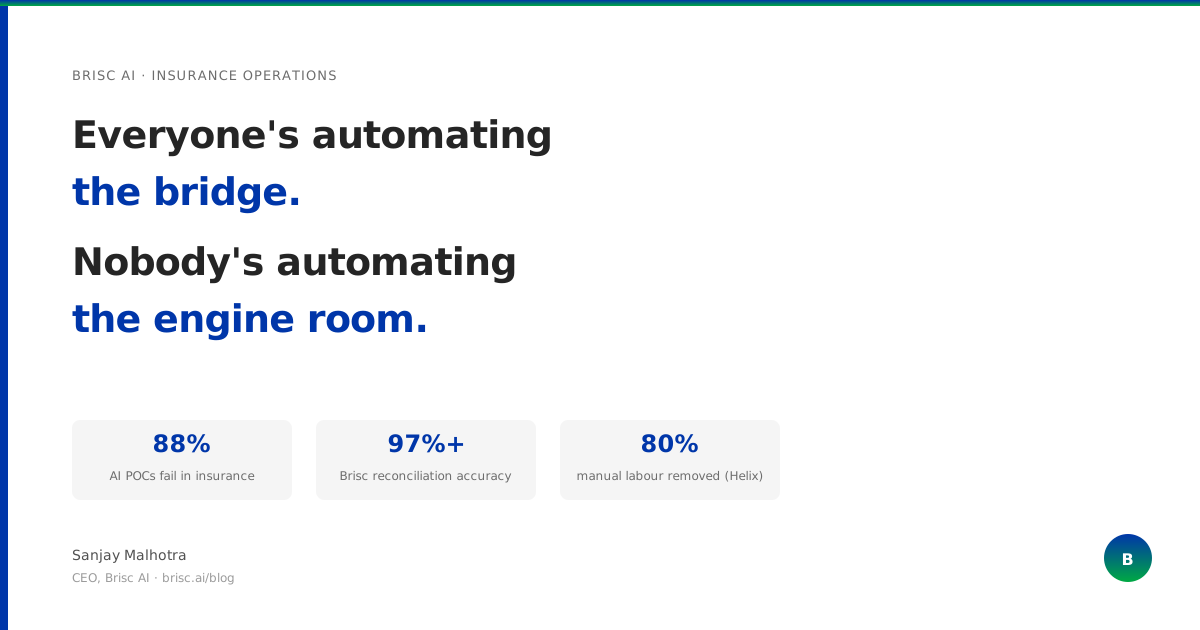
Brisc AI is an insurance-native AI platform that automates the operational workflows sitting behind underwriting decisions: cash matching, bordereaux reconciliation, premium allocation, and claims processing. We built Brisc for the engine room, not the bridge, because the engine room is where the volume actually gets processed, the errors compound, and the institutional knowledge walks out the door every time a senior analyst leaves.
The category confusion nobody names
When a buyer hears “AI in insurance,” they think underwriting. The mental model is Cytora for risk enrichment, Federato for portfolio shaping, Coalition for cyber pricing. These are real companies solving real problems. But they all sit on the same side of the house: the front office, where underwriting decisions get made.
The back office, where those decisions get executed, where premiums get matched to policies, where bordereaux get reconciled against bank statements, where exceptions get investigated and resolved, has no category champion. McKinsey and Accenture estimate that 30–40% of operations time in insurance goes to administrative tasks. A disproportionate share of that time lives in the gap between “the underwriter said yes” and “the cash is correctly allocated in the ledger.” Yet when the industry talks about AI, it talks almost exclusively about the decision, not the execution.
This matters because the two problems require fundamentally different AI. Underwriting AI optimizes a prediction: given this risk, what price? Operations AI manages a process: given this payment, this bordereaux, this broker format that changed last quarter without notice, match the cash to the contract, accurately, at scale, with an audit trail a regulator can follow.
Why operations AI is a different discipline
The five things an operations team needs from AI map to a different set of requirements than what an underwriting team needs. Every one of these is a design decision Brisc made, and every one runs counter to how the industry’s underwriting-AI companies are built.
Accuracy over speed. An underwriting model that is 85% accurate on risk selection is commercially useful: it prices most risks correctly and the portfolio absorbs the misses. An operations system that is 85% accurate on cash matching creates a 15% exception queue that a human team still has to process. Brisc’s Reconciliation Analyst operates at 97%+ accuracy on bordereaux reconciliation because in operations, being wrong at scale is worse than being slow.
Institutional memory over model sophistication. The hard part of cash matching is not the algorithm. It is knowing that Broker X truncates program names to eight characters, that Cedant Y nets commission before remitting, and that the third-quarter report from Cedant Z always arrives in a different format than Q1 and Q2. Underwriting AI improves by training on more data. Operations AI improves by retaining every broker quirk, every format exception, every cedant-specific rule it has ever encountered. Helix Underwriting Partners reports that Brisc removed 80% of manual labour from their operations, and the mechanism is knowledge retention, not model size.
Audit trail over prediction confidence. An underwriting model can output a confidence score and let the underwriter decide. An operations system must produce a record that a compliance officer, an auditor, and the team’s own quarterly review can reconstruct after the fact. In regulated insurance markets, every matched transaction needs a traceable lineage from bank statement to bordereaux entry to ledger posting.
Scale without headcount over scale with new models. Underwriting AI scales by deploying new models for new lines of business. Operations AI scales by absorbing new programs, new brokers, and new jurisdictions into the same team, without hiring. The customers who deploy Brisc report a 59% reduction in labour costs, not because they replaced people with software, but because their existing teams stopped re-learning the same edge cases every cycle and every staff change.
The 88% failure rate has a structural explanation
IDC data shows that 88% of AI proofs-of-concept in insurance fail to reach production. Most of those failures were horizontal tools (general-purpose document extraction, generic RPA, broad-spectrum automation platforms) applied to a vertical problem. They could classify a document but couldn’t remember what they classified last month. They could parse a bordereaux but didn’t know that the column definitions changed between Q2 and Q3.
Insurance operations is not a document problem. It is a knowledge problem wrapped in documents. The formats are inconsistent. The rules are unwritten. The expertise lives in people’s heads, and those people turn over at rates that industry surveys place between 20% and 40% annually in back-office roles. A new hire takes 90 to 180 days to become productive in cash matching, and every departure resets the clock on broker-quirk knowledge that took months to accumulate.
The percentage of insurers fully embedding AI into core operations jumped from 8% to 34% in 2025. That jump happened because a new category of insurance-native AI, systems built from insurance workflows rather than retrofitted from general-purpose models, reached production reliability. The tools that made it through the 88% filter were the ones built for the specific domain, not the ones adapted to it after the fact.
What happens when you automate the engine room
The front office sets the strategy: which risks to write, at what price, through which distribution channels. The back office determines whether that strategy is economically viable. A twenty-three-person credit-control team is not a support function. It is the operating cost that decides whether a high-volume product line makes money or loses it.
When operations AI works, retaining institutional knowledge, holding accuracy at scale, and producing an auditable trail, three things change.
First, new product lines become viable. A high-volume, low-premium product like cyber SME or embedded insurance generates volume that manual operations cannot absorb profitably. The per-policy match cost matters when the premium is measured in hundreds, not thousands.
Second, the team’s expertise compounds instead of resetting. Every cedant quirk, every format exception, every resolution pattern becomes part of a permanent operational dictionary. The team that processes thirty programs operates with the accumulated context of every program it has ever handled.
Third, the cost of growth decouples from the cost of hiring. A Brisc-equipped team scales the book without scaling the team, and in a market where specialized insurance operations talent is scarce, that decoupling is structural, not incremental.
The rest of the market is automating the bridge. The bridge matters. But the bridge gives the orders. The engine room is what makes them executable. Automating underwriting decisions without automating the operations that fulfill them is building a faster front office on top of a back office that can’t keep up.
Common questions
What is the difference between AI for insurance operations and AI for underwriting?
AI for underwriting optimizes pricing, risk selection, and portfolio decisions, the front-office functions that determine which risks to write and at what price. AI for insurance operations automates the back-office workflows that execute those decisions: cash matching, bordereaux reconciliation, premium allocation, claims processing, and exception management. The two require fundamentally different system designs. Underwriting AI optimizes predictions. Operations AI manages processes that demand accuracy, institutional memory, and regulatory-grade audit trails.
Why do most insurance AI projects fail to reach production?
IDC data shows that 88% of AI proofs-of-concept in insurance fail to reach production. The primary structural reason is that most projects use horizontal, general-purpose AI tools applied to vertical insurance problems. These tools can process documents but cannot retain the institutional knowledge (broker-specific formats, cedant-specific rules, jurisdictional tax variances) that makes insurance operations work. Insurance-native AI, built from insurance workflows rather than retrofitted, crosses the production threshold because it matches the domain's actual complexity.
What does "insurance-native AI" mean for operations?
Insurance-native AI is software designed from the ground up for insurance-specific data structures, document formats (such as Lloyd's 5.2 bordereaux), regulatory requirements (such as FCA CASS client money rules), and operational workflows. In contrast to general-purpose AI adapted for insurance, an insurance-native operations platform retains every broker quirk, every format exception, and every cedant-specific rule it encounters, building a permanent operational dictionary that compounds over time.
How does Brisc AI differ from underwriting-focused AI companies?
Brisc AI automates the operational workflows behind underwriting decisions (cash matching, bordereaux reconciliation, premium allocation, and claims processing) rather than the underwriting decisions themselves. Brisc's Reconciliation Analyst operates at 97%+ accuracy on bordereaux reconciliation because operations accuracy cannot degrade at scale the way underwriting model confidence can. Helix Underwriting Partners reports that Brisc removed 80% of manual labour from their operations through knowledge retention, not model sophistication.
Can operations AI and underwriting AI work together?
They are complementary, not competing. Underwriting AI determines which risks to accept and how to price them. Operations AI ensures that the resulting premium payments, bordereaux, and claims are matched, reconciled, and allocated accurately. The front office sets the strategy; the back office determines whether that strategy is economically executable. Automating one without the other creates a bottleneck: either a fast front office on a slow back office, or an efficient back office with no volume to process.
What results do insurance operations teams see with Brisc?
Brisc customers report a 59% reduction in labour costs and Helix Underwriting Partners reports an 80% reduction in manual labour. These outcomes are driven by knowledge retention, eliminating the rework that comes from re-learning broker formats, re-tracing discrepancies, and re-building institutional knowledge after staff turnover, rather than by processing speed. Brisc's Reconciliation Analyst maintains 97%+ accuracy on bordereaux reconciliation at scale, which means the exception queue stays small as the book grows.