What the First 90 Days Look Like When You Deploy a Reconciliation Analyst
A Head of Operations at a specialty MGA told me recently that her team had evaluated three reconciliation tools in the past eighteen months. Two made it to pilot. Both worked on the demo data. Neither survived the first full month of production bordereaux.
The failure pattern was always the same. Day one looked clean, structured documents, standard formats, tidy match rates. By week three, the broker whose commission-netting changed quarterly had broken the extraction. By week six, the cedant who reports premium adjustments as narrative footnotes had created a queue of exceptions no one on the team had time to work through. By month two, the tool was generating more work than it was absorbing, and the team was back to spreadsheets.
Brisc AI is an insurance-native AI platform that automates bordereaux reconciliation, cash matching, and submissions intake for MGAs and reinsurers. IDC reports that 88% of AI proof-of-concept projects fail to reach production deployment. In insurance operations, the reason is almost always the same: the system has no memory. Every document is a first encounter. It can read a bordereaux, but it cannot remember what it learned about the cedant who sent it yesterday.
The Reconciliation Analyst is built to solve that specific failure mode. This post is a week-by-week walkthrough of what actually happens when you deploy it, not the demo, but the desk.
Week 1: Ingestion and Baseline
The deployment starts with your historical data. Brisc ingests your existing bordereaux, bank statements, premium schedules, and broker correspondence, typically twelve to eighteen months of operational history. The system is not learning to reconcile in the abstract. It is learning to reconcile your book, with your cedants, in your formats.
During the first week, two things happen simultaneously.
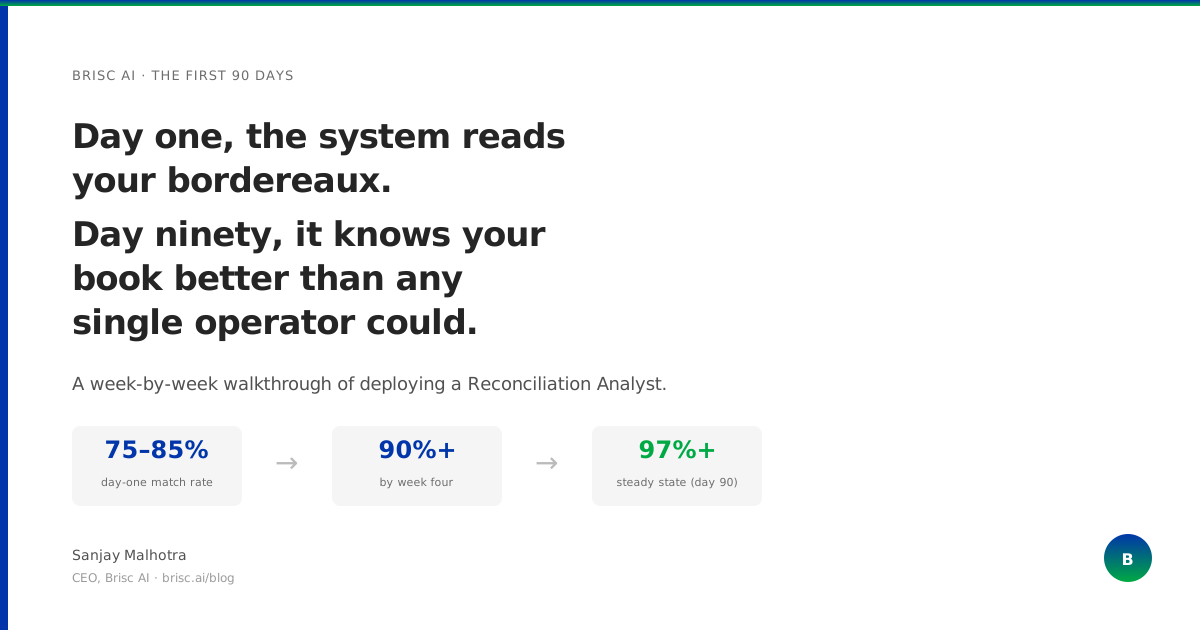
The Reconciliation Analyst processes your historical documents and establishes a baseline match rate. For most books, that initial rate lands between 75% and 85%, strong on the structured majority, weaker on the format variations and naming inconsistencies that make up the long tail. The structured 60-70% of documents that arrive in predictable layouts match immediately. The remainder, the PDFs with merged cells, the Excel files where “commission” means three different things depending on the broker, the wire memos that reference transactions by internal codes no one outside the originating bank recognises, surfaces as an exception queue for your team to review.
At the same time, Brisc’s three feedback loops begin accumulating knowledge. Deterministic rules capture explicit corrections. Prompt tuning sharpens the model’s extraction behaviour on your specific data. The learned-alias store begins mapping every broker name, account reference, and payer variation your team confirms. By the end of week one, the alias store alone typically holds 40-60 confirmed variations, each one a permanent reference that the system never has to guess again.
Your team’s role in week one is what it has always been: matching and reviewing. The difference is that every correction they make compounds. A rejected match becomes a rule. A confirmed alias becomes permanent. The institutional dictionary that normally lives in one senior operator’s head is being written into the system from the first day.
Weeks 2–4: The Dictionary Fills
This is where the deployment curve separates Brisc from the tools that don’t survive their first quarter.
By the start of week two, the Reconciliation Analyst has processed the most common cedant formats and broker patterns in your book. The alias store has absorbed the standard naming variations. The rule base has captured the corrections your team made during the initial review. Match rates climb, typically from that 75-85% baseline toward 88-92%.
The climb is not uniform. A cedant whose format has been stable for three years might reach 95%+ by week two. A broker who changes column layouts quarterly will take longer, the system needs to encounter at least one variation to learn it. But every variation it encounters becomes permanent knowledge. By the fiftieth bordereaux from a given cedant, the Reconciliation Analyst has absorbed every format quirk that cedant has ever produced.
McKinsey and Accenture estimate that 30-40% of operations time in insurance goes to administrative tasks. During weeks two through four, your team starts to feel that percentage shift. The exception queue shrinks as the rule base grows. The matches your senior operator used to handle by memory, “Broker X always truncates program names to eight characters,” “Cedant Y nets commission at 12.5% against the first two layers”, are now handled automatically.
The critical transition in this window is not a number. It is a shift in the operator’s workload. In week one, your team is doing the matching and the system is learning from it. By week four, the system is doing the matching and your team is auditing the results. The work changes from keying to reviewing.
Weeks 4–8: From Matching to Reviewing
By week four, the operational model has inverted. The Reconciliation Analyst handles the bulk matching, typically 90-93% of records, and surfaces the exceptions for human review. Your team’s job is no longer to find the match. It is to review the matches the system found, confirm them, and correct the small percentage the system flagged as uncertain.
This is the window where the deployment pays for itself. Helix Underwriting Partners reports an 80% reduction in manual labour across their reconciliation workflow. That number is not a day-one result. It is the steady-state outcome of six weeks of compounding accuracy, each correction feeding back into the rule base, each confirmed alias reducing the exception rate on the next cycle.
During this window, something else happens that is harder to measure but operationally significant: your team starts catching errors they would have missed under the manual process. The Reconciliation Analyst flags discrepancies that fall below the threshold a human reviewer notices under time pressure, a premium adjustment that nets to zero across two line items but is off by $3,200 on one of them, a commission split that rounds correctly but was calculated on the wrong base amount. In one reinsurance audit, this kind of systematic accuracy surfaced a 12% true profitability uplift that had been obscured by accumulated small errors.
The 30-40% administrative burden that McKinsey identified does not disappear. It shifts. Your operators spend less time matching and more time on the 20% of the workflow that requires judgment, exception investigation, broker communication, regulatory documentation. The people who were data-entry operators become analysts in practice, not just in title.
Day 90: Steady State
By day ninety, the Reconciliation Analyst has processed a full quarter of your operational data in production. The institutional dictionary, every cedant format, every broker alias, every commission-netting pattern, every naming convention, is comprehensive across your current book.
Three things define the steady state.
Accuracy holds at 97%+. Brisc AI maintains 97%+ accuracy on bordereaux reconciliation, verified across production deployments. That number is not a benchmark on clean data. It is the production match rate after the system has absorbed the full complexity of a real book, the narrative footnotes, the quarterly format changes, the broker who spells “Syndicate 2623” four different ways.
Knowledge survives turnover. With 20-40% annual turnover in insurance back offices and 90-180 days for a new analyst to reach full productivity, the institutional dictionary is a structural risk under the manual model. In the Reconciliation Analyst, the dictionary is a system asset. When your senior operator retires, their successor starts on day one with the full accumulated knowledge of every cedant and broker your organisation has ever processed. The 90-180 day ramp shrinks to the time it takes to learn the review workflow, days, not months.
The team operates at a different altitude. Brisc customers report a 59% labour cost reduction across operations. At day ninety, that reduction is visible in where your team spends its time. They are not keying data. They are auditing matched results, investigating flagged exceptions, and managing broker relationships. The back office that was a scaling constraint has become infrastructure that absorbs growth without absorbing headcount.
What Day 91 Looks Like (And Why It Matters)
The deployment curve does not flatten at day ninety. Every new cedant onboarded, every new broker format encountered, every new program added to the book adds to the institutional dictionary. A reconciliation desk that processes ten cedants at deployment and thirty at month twelve does not need three times the staff. The Reconciliation Analyst scales with the book, not with the hiring plan.
This is the structural difference between a system with memory and one without. A tool that processes every document from scratch gives you the same accuracy on day three hundred as on day one. A system that accumulates knowledge gives you better accuracy on day three hundred than on day ninety, because it has seen more, remembered more, and resolved more ambiguities than any individual operator ever could.
The question most teams ask before signing is whether the deployment will survive their real data. The answer is in the architecture: three feedback loops that accumulate knowledge permanently, an alias store that grows with every confirmed match, and a rule base that captures every correction your team has ever made. The first ninety days are the proof. Everything after that is compound interest.
Common questions
How long does the initial setup take before the system starts processing?
Deployment typically takes 2-6 weeks from contract to first production documents. The timeline depends on data connectivity, how your bordereaux, bank feeds, and PAS are accessed. The system begins learning from historical data during setup, so the baseline match rate on day one already reflects your book's patterns.
What happens if a cedant changes their format after deployment?
The Reconciliation Analyst detects format changes automatically. A new column layout or naming convention surfaces as an exception on the first occurrence. Once your team confirms the correct mapping, the new format becomes a permanent rule, every future document from that cedant matches without intervention.
Do we need dedicated technical staff to manage the system?
No. The Reconciliation Analyst is managed by Brisc, updates, model improvements, and infrastructure are handled on our side. Your team interacts through the review interface, the same way they interact with their current reconciliation workflow. The shift is in what they review, not how they access it.
What if our match rate is lower than 75% in week one?
Some books with unusually high format diversity or legacy data-quality issues start lower. The learning curve is steeper but follows the same pattern: every correction compounds, and books that start lower climb faster in the early weeks because there are more patterns for the system to learn from.
How is the analyst deployed and hosted?
Brisc is SaaS on Microsoft Azure with one dedicated tenant per customer: your data is never pooled with anyone else's, and your policy administration system stays the system of record. SOC 2 Type II controls and tenant isolation apply to every deployment.
How does this compare to building an in-house reconciliation pipeline?
IDC reports that 88% of AI proof-of-concept projects fail to reach production deployment. The pattern in insurance is consistent: in-house builds handle the clean 60% of documents and break on the unstructured 40%, the tail where institutional knowledge, not raw computing power, is the missing ingredient. The Reconciliation Analyst is purpose-built for that tail.
What does the team do with the time they get back?
Exception investigation, broker relationship management, regulatory documentation, and audit preparation. The work that requires judgment, the 20% that was always the most valuable part of the role but was crowded out by data entry.
Is the 97%+ accuracy claim based on production data or test data?
Production data, verified across live deployments. The accuracy reflects the steady-state match rate after the system has absorbed a full quarter of real operational data, format variations, naming inconsistencies, and all. --- *Brisc AI is an insurance-native AI platform purpose-built for insurance operations. To see the Reconciliation Analyst on your data, [book a demo](/demo).* ---