What Does the AI Actually Learn? Inside an Insurance Analyst's Feedback Loops
By Sanjay Malhotra, CEO, Brisc AI
Published: 2026-06-29
A data science team at a specialty insurer spent fourteen months building a bordereaux extraction pipeline. The clean documents, the 60% that arrived in predictable column layouts from established cedants, processed beautifully. Then the team tested the other 40%: the PDFs with merged cells, the Excel files where “commission” meant three different things depending on the broker, the scanned cover notes with narrative adjustments referencing transactions from two quarters ago.
The pipeline choked. Not because the models were bad, but because the models had no memory. Every document was a first encounter. The system could read a bordereaux, but it could not remember what it had already learned about the cedant who sent it.
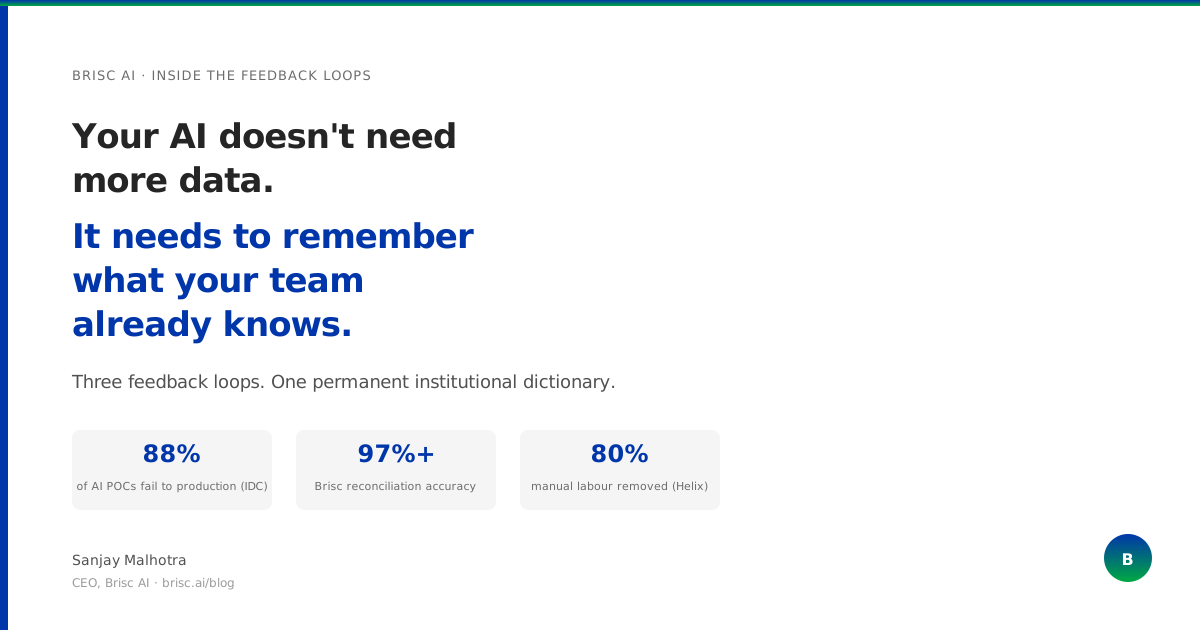
That team’s experience is not unusual. IDC reports that 88% of AI proof-of-concept projects fail to reach production deployment. In insurance operations, the failure pattern is almost always the same: the model handles the structured majority and breaks on the unstructured long tail, the tail where institutional knowledge, not raw computing power, is the missing ingredient.
Brisc AI is an insurance-native AI platform purpose-built for insurance operations, submissions intake, bordereaux reconciliation, claims management. The question every technical buyer asks us is not whether the AI works. It is what happens after it works: what exactly does the system learn, how does it learn it, and where does that knowledge live?
This post answers that question completely.
Three Feedback Loops Running in Parallel
Brisc’s Reconciliation Analyst and Submissions Analyst improve through three distinct mechanisms that operate simultaneously. Each one targets a different layer of the matching problem.
Loop 1: Deterministic rules. When a reviewer rejects a match or corrects a classification, the specific rule behind the decision is logged and folded into the rule base. This is not statistical learning, it is explicit instruction. If a reviewer says “Cedant X’s column F is always net of brokerage, not gross premium,” that rule applies to every future document from Cedant X. The rule does not degrade, does not need retraining, and does not depend on the reviewer being present for the next occurrence.
Brisc AI maintains 97%+ accuracy on bordereaux reconciliation, verified across production deployments. A significant portion of that accuracy comes from accumulated deterministic rules, the kind of knowledge that, in a human team, lives in one senior operator’s head and leaves when they do.
Loop 2: Prompt tuning. Rejected cases and edge-case corrections sharpen the model’s extraction and classification behaviour on your specific data. This is not a generic foundation-model retrain, it is a targeted refinement scoped to your book, your cedants, and your document types. The model becomes more accurate on the patterns your team encounters, not on abstract benchmarks.
The practical effect: a match rate that starts around 80% on day one and climbs to 92 to 95% by roughly 90 days as the system absorbs your operational context. Helix Underwriting Partners reports an 80% reduction in manual labour, a number that reflects not just initial automation but the compounding accuracy that comes from sustained tuning.
Loop 3: A learned-alias store. Every broker, account, payer name, and reference-code variation your team confirms becomes permanent reference data. The first time the system encounters “Syndicate 2623” written as “Syn2623,” “S-2623,” and “Syndicate Twenty-Six Twenty-Three” across three different brokers, it needs a human to confirm the match. The second time any of those aliases appears, the match is automatic.
This alias store is not a lookup table. It is a growing, cross-referenced map of every naming convention, abbreviation, and formatting quirk your counterparties have ever used. By the fiftieth bordereaux from a cedant, the store has absorbed every variation that cedant has ever produced.
What Rules Handle vs. What the Model Handles
Technical buyers, the CDAOs and Heads of Data Science who have tried to build this internally, want to know the boundary between deterministic logic and learned inference. The honest answer is that Brisc runs both simultaneously and deliberately.
Rules handle what is known. When your team has seen a pattern, confirmed it, and logged it, the system applies that pattern without inference. Column F from Cedant X is always net of brokerage. Broker Y always nets commission at 12.5% against the first two layers. These are facts about your book, not predictions.
The model handles what is new. When a cedant sends a format variation the system has not encountered before, a new column layout, a new way of reporting premium adjustments, a previously unseen broker, the model extracts fields using its insurance-trained understanding of document structure and classifies them using the closest match in the existing dictionary.
Every model-handled case that a human reviewer confirms becomes a rule-handled case the next time it appears. The boundary between “model inference” and “deterministic rule” shifts constantly, always in the direction of more rules, less inference, higher accuracy.
This is the structural advantage of insurance-native AI over general-purpose LLMs. A general model processes every document from scratch. Brisc processes every document with the accumulated memory of every document your team has ever reviewed.
Where the Knowledge Lives (And Why It Stays)
The most expensive knowledge loss in insurance operations is not a technology failure. It is a resignation letter.
With 20-40% annual turnover in insurance back offices, the institutional dictionary, every cedant’s format quirks, every broker’s commission-netting pattern, every treaty’s reporting conventions, leaks constantly. McKinsey and Accenture estimate that 30-40% of operations time goes to administrative tasks, and a meaningful share of that time is spent rediscovering what a departed colleague already knew.
In Brisc’s architecture, all three feedback loops write to a persistent, per-customer knowledge store. Rules, tuned prompts, and the alias map are system assets, not personal knowledge. When your senior operator retires, their successor starts on day one with the full accumulated dictionary of every cedant, every broker, and every treaty your organisation has ever processed.
Brisc customers report a 59% labour cost reduction across operations. That number is not a one-time automation gain. It is the compounding result of institutional knowledge that stays when people leave.
What the System Does Not Learn
Honesty about boundaries builds trust faster than overclaiming.
Brisc does not make underwriting decisions. The Submissions Analyst triages, classifies, and routes, it does not bind. The Reconciliation Analyst matches cash to premium, it does not approve payments. The system’s judgments are operational, not commercial, and every one of them produces a traceable audit trail back to the source document, the extracted field, and the classification logic that produced the output.
Brisc does not retrain foundation models on your data. The three feedback loops refine the system’s behaviour within your operational scope. Your data does not cross tenant boundaries. SOC 2 Type II controls and tenant isolation apply to every deployment: Brisc is SaaS on Microsoft Azure with one dedicated tenant per customer.
Brisc does not learn silently. Every rule addition, every alias confirmation, and every tuning adjustment is logged and auditable. When a regulator asks why a specific match was made, the answer traces to a specific rule or a specific model inference, never to an unexplained output.
Why Day One Is Not the Whole Story
The teams that have tried to build this in-house, and at $250K+ in failed build costs, many have, discover the same gap: the extraction layer is the easy part. The hard part is institutional memory.
A custom build that reads a bordereaux accurately on day one reads it exactly as accurately on day three hundred. Nothing accumulates. The team still reviews the same edge cases, still re-establishes context on the same cedants, still rebuilds the dictionary every time a team member changes.
Brisc’s value proposition is not that it reads documents faster than a human. It is that it remembers everything it has ever read, and the system’s understanding of your book deepens with every cycle. Day-one accuracy is the floor, not the ceiling.
Deployments of the Brisc Reconciliation Analyst typically go live in 2-6 weeks. The variable is the number of cedant dictionaries to configure at launch. Each subsequent cedant onboarded is faster than the last, because the dictionary accumulates shared patterns across your book.
Common questions
What exactly does "the analyst learns" mean in technical terms?
Three mechanisms operate in parallel: deterministic rules logged from reviewer corrections, model prompt tuning refined on your specific document patterns, and a learned-alias store that permanently maps every naming variation your counterparties use. Each mechanism writes to a persistent, per-customer knowledge store.
Does Brisc retrain its foundation model on my data?
No. The three feedback loops refine the system's operational behaviour within your tenant. Your data does not leave your environment and does not cross tenant boundaries. Foundation model updates are managed by Brisc and deployed separately from your operational tuning.
How quickly does accuracy improve after deployment?
Day-one match rates start around 80% because the engine is pre-trained on insurance documents as a category. They climb to 92 to 95% by roughly 90 days as the rule base, prompt tuning, and alias store absorb your specific operational context. The improvement compounds: each reporting cycle adds knowledge that accelerates the next.
What happens to the system's knowledge when a team member leaves?
Nothing changes. All three feedback loops write to a system-level knowledge store, not to individual user profiles. When a team member departs, their successor inherits the full accumulated dictionary from day one. This is the core of Brisc's knowledge-retention value: the institutional memory stays in the system, not in anyone's head.
Can I audit what the system has learned?
Yes. Every rule addition, alias confirmation, and tuning adjustment is logged with timestamps, the reviewer who confirmed it, and the source document that triggered it. The audit trail is available for regulatory review and is the same trail your internal team uses for quality assurance.
How is this different from building an in-house extraction pipeline?
An in-house build typically handles the structured majority of documents well. It fails on the unstructured long tail, the 40% where institutional knowledge, not extraction capability, is the bottleneck. IDC reports that 88% of AI POC projects fail to reach production. Brisc's three feedback loops are the layer most in-house builds never get to: the system that remembers what your team has already figured out. --- *Brisc AI is an insurance-native AI platform for submissions intake, bordereaux reconciliation, and claims management. To see how the feedback loops work on your own data, [book a demo](/demo).* ---