Why Adding People to Reconciliation Stops Working
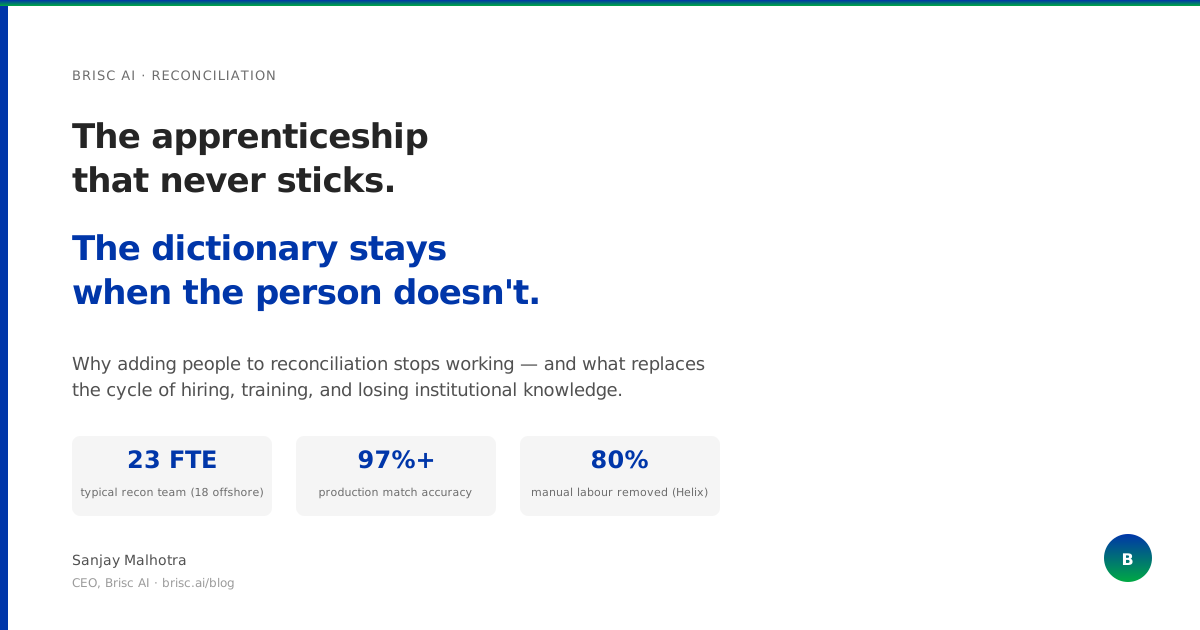
The COO of a specialty MGA, hybrid Lloyd’s program, north of $500 million in gross written premium, described his reconciliation operation to me like this: twenty-three people, eighteen of them offshore, five onshore coordinators. Four of the eighteen had turned over in the previous six months. Every departure triggered the same sequence: recruit, onboard, ramp, shadow a senior analyst for weeks, then wait. And wait. Because it takes ninety to a hundred and eighty days before a new reconciliation analyst is genuinely productive on a complex book.
He wasn’t calling about headcount. He was calling because a $47,000 discrepancy had slipped through during the last handover, not fraud, just a match that the departing analyst carried in their head and the replacement never learned.
This is the story I hear in some form on almost every operations call. Not “we need fewer people.” Not “our team is bad.” The problem is structural: reconciliation knowledge doesn’t survive the people who hold it.
The apprenticeship that never sticks
Think of reconciliation as an apprenticeship. A new analyst joins, sits beside someone experienced, and slowly absorbs the institutional memory that makes matching work: which broker uses a different policy numbering convention, which cedent sends premium net of commission in Q1 but gross the rest of the year, which Lloyd’s syndicate splits a single cash receipt across three layers and sends the breakdown in a PDF attachment nobody told you to open.
None of this is written down. It lives in the heads of the people doing the work. McKinsey’s research puts the administrative overhead in insurance operations at thirty to forty percent of operating costs, and a meaningful share of that overhead is the cost of relearning what the last person already knew.
The apprenticeship model works when turnover is low and volume is stable. In insurance back-office operations, neither condition holds. Turnover runs between twenty and forty percent annually. Books grow. Programs launch. And every time someone leaves, a slice of the institutional dictionary walks out with them.
The offshore model was supposed to solve the cost problem, and it did, for a while. You can staff eighteen analysts in Manila or Hyderabad for less than five onshore. But the knowledge problem doesn’t care about geography. An offshore analyst who leaves after eight months takes eight months of learned exceptions with them, just like an onshore analyst would. The ramp is the same. The knowledge loss is the same. The only thing that changed is the hourly rate.
Why more people makes it worse
Here’s the part that isn’t intuitive. When reconciliation volume grows, more bordereaux, more payment streams, more cedents, more programs, the natural response is to hire. And hiring works, until it doesn’t.
The breaking point comes from the interaction between three forces:
Volume scales linearly; knowledge scales combinatorially. Double the number of programs and you haven’t doubled the matching rules, you’ve multiplied them. Each new cedent introduces its own reporting conventions, its own payment timing, its own exception patterns. A team of ten people matching three thousand bordereaux across four hundred contracts isn’t doing ten times the work of one person. They’re navigating a web of cross-references that grows faster than the headcount.
Turnover compounds. At twenty to forty percent annual attrition, a twenty-three-person team loses five to nine people a year. Each departure creates a window of degraded accuracy. With rolling turnover, those windows overlap. There is never a moment when the full team is at full institutional knowledge. The steady state isn’t twenty-three productive analysts, it’s fifteen productive analysts and eight who are still ramping.
Coordination costs rise with headcount. Five onshore coordinators for eighteen offshore analysts isn’t unusual. It’s the overhead that keeps the operation coherent. But that coordination layer doesn’t do reconciliation, it does project management, quality assurance, exception triage. Add more offshore analysts and you eventually need another coordinator. The management tax on the operation grows alongside it.
A mid-market MGA spending $250,000 to $400,000 annually on reconciliation staff isn’t overspending on any individual person. The cost isn’t in the rate card. The cost is in the aggregate: hiring, ramping, losing, rehiring, re-ramping, a cycle that never reaches equilibrium because the knowledge never accumulates.
The dictionary stays when the person doesn’t
The alternative isn’t “replace people with AI.” That framing misses the point. The alternative is to separate the knowledge from the person.
When Brisc’s Reconciliation Analyst matches a bank receipt to a premium instalment, three things happen in parallel:
- A deterministic rule captures the logic of the match.
- A learned-alias store records the broker name, the account reference, the payer variation, so the system recognises it next time without asking.
- A prompt-tuning loop sharpens the model’s ability to handle similar patterns on this book.
The result: match rates start around eighty percent on day one and climb to ninety-two to ninety-five percent by about ninety days, as the rule base absorbs what the model surfaces and the alias store grows. Output accuracy runs at ninety-seven percent or above.
Here’s the part that matters for the outsourcing comparison: none of that knowledge leaves when a person does. The dictionary, every alias, every exception rule, every learned pattern, is infrastructure, not memory. A new team member reviews exceptions against a system that already knows the book. They aren’t rebuilding from scratch. They aren’t shadowing someone for ninety days. They’re auditing a process that retains what it learned yesterday.
That fifty-nine percent reduction in labour costs isn’t about paying less per hour. It’s about stopping the bleed: the knowledge loss, the ramp cost, the coordination overhead, the discrepancies that slip through during handovers.
The math favours the system
The argument for outsourcing was always about the rate card. Offshore analysts cost less per hour, so you get the same work for less money. That arithmetic is real, and it worked when reconciliation was a stable, repetitive task on a static book.
It stops working when three things change, and all three are changing simultaneously in insurance operations today.
Books are growing. Premium volume is up. Program count is up. The number of cedents, brokers, and payment streams an MGA manages is larger than it was five years ago. That means reconciliation volume is growing, and the people model scales by adding heads.
Complexity is growing. Cross-jurisdiction tax variance, multi-currency settlement, layered reinsurance structures, bordereau formats that vary by cedent and vintage, the matching problem isn’t getting simpler. Each increment of complexity extends the ramp time for a new analyst and increases the risk of a missed match.
Tolerance is shrinking. Regulatory scrutiny on premium allocation, Lloyd’s oversight on unallocated cash, PE boards asking for real-time visibility into cash position, the acceptable error rate is lower than it was, and the cost of a missed match is higher. A forty-seven-thousand-dollar discrepancy that might have been caught at quarter-end now triggers an audit.
In that environment, the question isn’t whether offshore analysts are cheaper per hour. The question is whether a system that retains knowledge, improves with use, and doesn’t lose its institutional memory every time someone resigns can deliver a lower total cost of reconciliation, including the cost of errors, ramp time, and coordination.
The answer, increasingly, is yes. An MGA that built its entire back office on Brisc, fifteen users, all senior staff, one hundred percent of submissions, claims, and reconciliation on the platform, avoided two to three times the cost of a traditional staffing model. Not by eliminating people. By changing what the people do: from rekeying and matching to reviewing and deciding.
McKinsey’s thirty to forty percent administrative cost figure isn’t a technology problem. It’s a knowledge-retention problem wearing a labour-cost disguise. The admin overhead persists because every new hire repeats the learning curve of the person who left. Solve the retention problem and the cost follows.
What to ask your current provider
If you’re running reconciliation with an outsourced or offshore team, or evaluating whether to, here are five questions worth asking:
- What happens to institutional knowledge when an analyst leaves? If the answer is “we document processes,” ask to see the documentation. Most of the time, the real matching logic lives in the heads of the senior analysts, not in a runbook.
- What is your effective ramp time for a new analyst on our book? Not classroom training, time to full productivity on your specific programs, with your specific cedents and broker conventions. Ninety to a hundred and eighty days is typical. If they claim less, ask how they’re measuring it.
- What is your annualised turnover rate for the team assigned to our account? Twenty to forty percent is the industry norm for back-office operations. If they don’t track it at the account level, that’s an answer in itself.
- How do you handle the transition period after a departure? Does accuracy degrade? Do exceptions spike? Who absorbs the extra load? The transition window is where discrepancies happen, and it recurs every time someone leaves.
- What is the total cost of reconciliation, not just the rate card? Include coordination overhead, ramp cost, error remediation, and the opportunity cost of senior staff doing QA instead of analysis. The rate card is the visible cost. The total cost is usually two to three times higher.
The reconciliation problem isn’t a people problem, it’s a knowledge problem. See how the Reconciliation Analyst works →
Common questions
Does this mean we should fire our reconciliation team?
No. The Reconciliation Analyst handles eighty percent of the matching, the repetitive, pattern-based, high-volume work. Your team handles the residual twenty percent: exceptions, judgement calls, broker conversations, audit. The operating model shifts from "everyone matches" to "the system matches; people review."
How long does deployment take?
Two to six weeks, depending on the number of payment streams and bordereaux formats. The system starts matching on day one; accuracy improves as the rule base and alias store absorb your book's patterns.
What accuracy should we expect?
Day-one accuracy is typically around eighty percent. Within weeks of tuning, production systems run at ninety-seven percent or above. The unmatched remainder surfaces as flagged exceptions with source documents attached, your team resolves those, and each resolution makes the system smarter.
Is this just another system we have to maintain alongside our PAS?
No. Your policy administration system stays the system of record. The Reconciliation Analyst is a matching layer that posts back to your PAS, matched cash against the right premium, with evidence. It's not a second ledger. It's the audit trail that explains the number your PAS already holds.
Can we run this in our own environment?
Not in your own cloud. Brisc is SaaS on Microsoft Azure with one dedicated tenant per customer, so your data is never pooled with anyone else's. SOC 2 Type II controls and tenant isolation apply to every deployment.
What about our existing offshore team?
They don't disappear. They transition from keying and matching to exception management, audit, and broker liaison, higher-value work that's harder to automate and less vulnerable to turnover. The team gets smaller and more senior, not eliminated.
How does pricing work?
Your cost tracks the premium you manage, not every transaction you process. A busy month doesn't spike your bill. As your book grows, so does the value the system manages, and yes, your price grows with it, but on a slope far below the cost of another hire and another ninety-day ramp.
What does "the analyst learns" actually mean?
Three feedback loops run in parallel. Deterministic rules capture the logic of confirmed matches. A learned-alias store records every broker, account, and payer variation your team confirms. Prompt tuning sharpens the model on your data. The result is a system that improves with use, not a black box you have to trust, but a process you can watch get sharper.