Your Reconciliation Process Is the Audit Finding
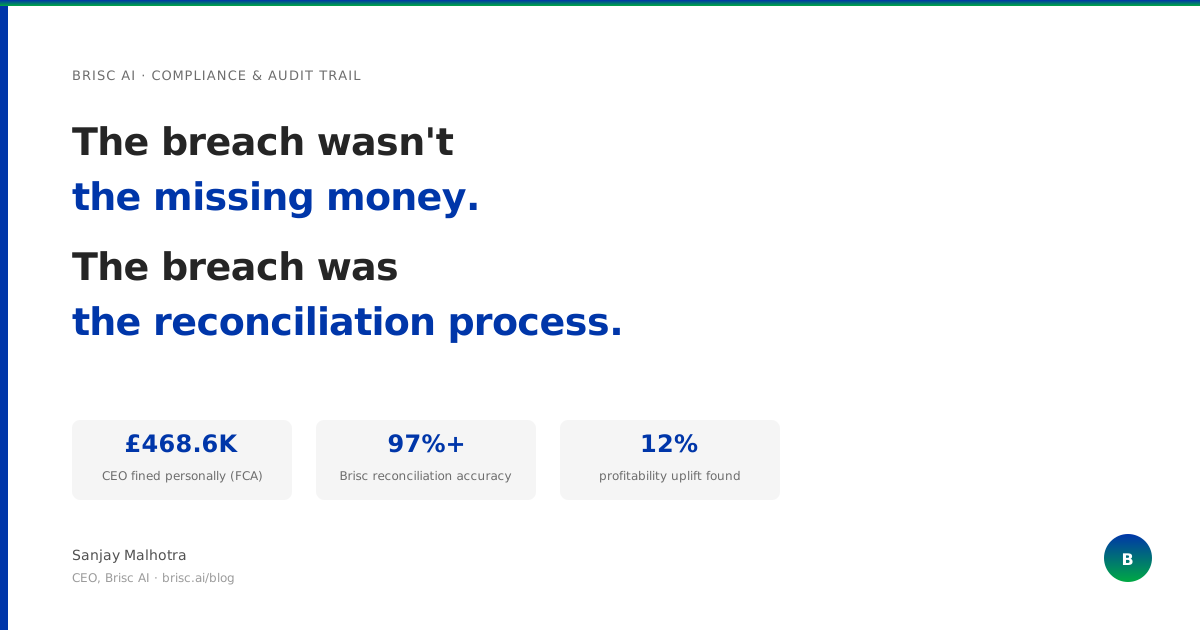
The One Call Insurance final notice runs eighteen pages. The FCA’s conclusion is two sentences: the firm failed to perform adequate client money reconciliations. The CEO was fined £468,600 personally. The finding was not that money was stolen. The finding was that the reconciliation process, the mechanism for proving every pound of client money sat where it should, was inadequate. The breach was negligent, not deliberate, and the regulator fined anyway.
I sat with that sentence for a long time, because it reframes everything a finance director is told about reconciliation. We talk about reconciliation as an operations problem, slow, manual, error-prone. The regulators see it differently. They see reconciliation as a control. When the control is absent, the absence is the finding.
Brisc AI builds insurance-native Reconciliation Analysts that match premium cash to the right policy, with the evidence attached, every day. The audit trail is not a feature. It is the product.
The desk nobody staffs is the desk your regulator examines by name
The pattern repeats across jurisdictions. The slice of the reconciliation desk that gets deprioritised, because the team is chasing brokers, or because matching unidentified cash is the task nobody volunteers for, is the exact slice that statutory accounting, fiduciary law, and regulatory examiners look at first.
Four mechanisms make this concrete.
US statutory accounting: unapplied cash stops counting toward surplus
Under SSAP No. 6 ¶9(a), any uncollected premium balance over ninety days due becomes a non-admitted asset, to the extent there is no offsetting unearned premium, it literally stops counting toward surplus. The cascade is worse than the bucket: if a single installment is more than 90 days overdue, the overdue amount plus all future recorded installments on that policy are non-admitted.
Annual statements age premium into 1–30, 31–60, 61–90, and over-90-day buckets with admitted and non-admitted columns. The aging is not private. Cash that a reconciliation desk cannot apply to the right policy ages into this bucket at quarter end. It is not an untidiness problem. It is a direct surplus hit, visible to every examiner who reads the statutory filing.
UK: the reconciliation itself is the regulated act
Under CASS 5.5.63R, intermediaries holding client money must perform the client money calculation at least every 25 business days, rectify any shortfall the same day, and notify the FCA immediately if the calculation cannot be performed. An annual auditor’s client-assets report closes the loop.
The enforcement record shows what that standard means in practice.
One Call Insurance was fined £684,000. Its CEO, John Radford, was fined £468,600 personally and barred from client-money responsibility. A 121-day restriction on charging renewal fees cost approximately £4.6 million. The client money account had a £17.3 million hole. The breaches ran from 2005 to 2015. The FCA found the breaches negligent, not deliberate, and fined anyway. The fines reflected a 30% early-settlement discount.
Towergate was fined £2.6 million for client-money failings that left £12.6 million in shortfalls undetected for years. The defect was specifically ineffective bank reconciliations: business units reconciled ledger balances against swept accounts showing roughly nil, nobody reconciled aggregated ledgers to the central sweep accounts, and £10.5 million was mis-identified as commission and transferred out.
In both cases, no customer needed to lose money and negligence sufficed. The reconciliation process itself was the breach.
Lloyd’s delegated authority: your reporting record is your reputation
Coverholder Reporting Standards are mandated for binders incepting or renewing from July 2017. Premium bordereaux are typically monthly, with submission deadlines set in each binding authority agreement. Persistently late or poor-quality bordereaux drive increased audit frequency, delegated-authority review, and curtailed or terminated binding authority.
The mechanism is straightforward: your reporting track record determines your audit frequency, which determines how closely your delegated authority is scrutinised. A reconciliation process that cannot produce a timely, accurate bordereau on the contractual deadline puts the binding authority itself at risk.
Premium trust: fiduciary obligation at the policy level
Producers and agencies receive premium in a fiduciary capacity and must hold it in separate premium trust accounts until remitted. Commingling is a violation even if every dollar is eventually remitted, regulators call it “technical commingling.” Penalties range from per-violation fines to license suspension or revocation, escalating to misappropriation if mixed funds are used.
The reconciliation mechanism that prevents technical commingling is the one that ties every dollar in the trust account back to a specific policy. Without that tie, the desk cannot prove compliance, regardless of whether the money was, in fact, handled correctly.
The common thread: nobody matched every dollar to every policy
Every enforcement action, every surplus haircut, every audit escalation in this article shares a root cause. Not fraud. Not incompetence. An inadequate mechanism for proving that cash went where it was supposed to go.
One Call’s reconciliation was performed, but not well enough. Towergate reconciled, but at the wrong level. The mechanism existed; the mechanism was insufficient. And in a regulated industry, “we reconciled but missed it” is not a defence. It is the finding.
The remediation in each case was the same: build the lineage that should have existed from day one, cash to remittance to policy to evidence.
What changes when every dollar has provable lineage
Brisc’s Reconciliation Analyst matches incoming cash to the policy it belongs to, with the source documents attached, every day. The output is not a reconciled spreadsheet. It is a provable chain: bank receipt to broker remittance to bordereau row to policy to the operator who confirmed it.
Three regulatory exposures close.
The over-90-day aging bucket is worked before it non-admits. Every unapplied dollar is attributed while it still counts toward surplus, because the matching runs daily, not monthly, not quarterly.
The CASS 5 client money calculation is produced, not rebuilt. The 25-business-day calculation runs on matched, attributed cash. Shortfalls surface the day they occur, which is the same-day standard the rule demands.
The coverholder bordereau goes out on the contractual deadline with lineage. Audit frequency tracks reporting quality; accurate, timely reporting protects the binding authority.
The accuracy holds. Brisc’s Reconciliation Analyst maintains 97%+ accuracy on bordereaux reconciliation, and accuracy does not degrade with volume. In one reinsurance audit, matched-cash review produced a 12% true profitability uplift, the program’s economics were wrong until the cash was matched. Helix Underwriting Partners reports that Brisc removed 80% of their manual labour. The team stopped finding matches and started confirming them. Deployment takes 2–6 weeks.
Common questions
Is reconciliation really a compliance risk, or just an operations problem?
Both, but the compliance dimension is the one that carries personal liability. The FCA fined One Call's CEO £468,600 personally for inadequate client money reconciliations. SSAP No. 6 makes unapplied premium a balance-sheet event. These are documented enforcement actions, not theoretical risks.
What is SSAP No. 6, and how does it affect unapplied premium?
SSAP No. 6 governs the admissibility of premium receivables in US statutory accounting. Under ¶9(a), uncollected premium beyond 90 days due becomes a non-admitted asset. The cascade rule means a single overdue installment can non-admit all future installments on that policy. Cash your team cannot apply to the right policy ages into this bucket at quarter end.
What are the FCA CASS 5 requirements for premium reconciliation?
CASS 5.5.63R requires firms holding client money to perform the client money calculation at least every 25 business days, rectify any shortfall the same day, and notify the FCA immediately if the calculation cannot be performed. An annual auditor's client-assets report provides external oversight.
What happened at One Call and Towergate?
One Call was fined £684,000 (with the CEO fined £468,600 personally) for client-money failings that left a £17.3 million hole in the client money account. Towergate was fined £2.6 million for ineffective bank reconciliations that left £12.6 million in shortfalls undetected. In both cases, negligence, not fraud, was the finding.
How does Brisc's Reconciliation Analyst help with audit readiness?
Every matched dollar carries a clickable evidence chain: cash to remittance to bordereau row to policy to the operator who confirmed the match. Auditors examining the reconciliation process find a system of record rather than a reconstructed spreadsheet. Accuracy holds at 97%+ regardless of volume.
Does the Reconciliation Analyst replace our compliance team?
No. The Reconciliation Analyst is the matching and evidence layer, it absorbs the repetitive reconciliation work and produces the audit trail your compliance team reviews. Compliance judgment, exception handling, and regulatory reporting stay with your team. The model is 80/20: the Analyst handles the matching; your people handle the exceptions and the oversight.
How long does deployment take?
Brisc deploys in 2–6 weeks. Day-30 match rates typically reach 80%+, climbing to 92–95% as the system tunes to your book's broker formats and payer aliases.
What accuracy does the Reconciliation Analyst achieve?
Brisc maintains 97%+ accuracy on bordereaux reconciliation, and accuracy does not degrade with volume. Every broker quirk, payer alias, and netting pattern the system learns becomes permanent institutional memory, it does not reset with staff turnover. --- *Sanjay Malhotra is CEO of [Brisc AI](https://brisc.ai). To see how the Reconciliation Analyst works on your book, [request a demo](/demo) or explore the [Bordereaux Reconciliation](/bordereaux-reconciliation) page.* ---