High-Volume, Low-Premium Lines: When Cost to Match Exceeds the Premium
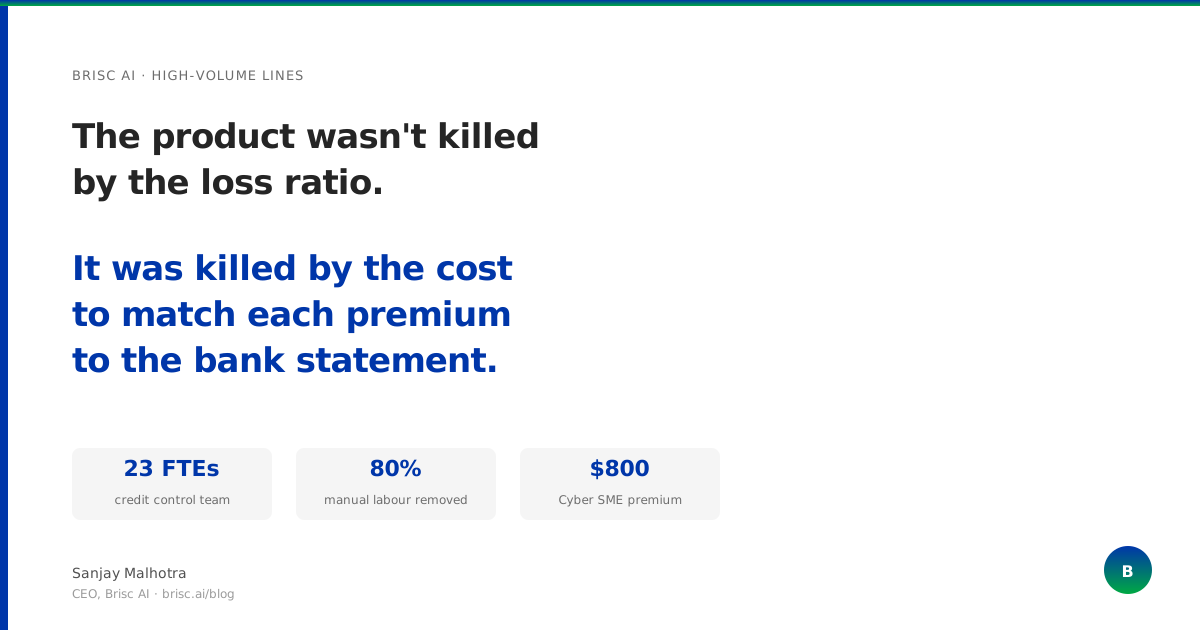
The COO of a $500M+ GWP Lloyd’s hybrid MGA walked me through her team’s plan for a new Cyber SME product last month. Everything about the front office was ready — automated underwriting, distribution locked, capacity placed. The economics on paper were sound. Then her credit control lead ran the numbers on what it would take to match each premium payment to the corresponding bank entry. The per-policy cost of manual matching was approaching the premium itself.
She cancelled the launch discussion. Not because the underwriting didn’t work. Because the back office couldn’t absorb the volume without hiring proportionally — and proportional hiring would erase the margin the product was designed to capture.
Brisc AI is an insurance-native AI platform that automates cash matching, bordereaux reconciliation, and premium allocation for MGAs and reinsurers. We built the Reconciliation Analyst because the problem that COO described isn’t unusual. It’s structural. And it’s about to hit every specialty insurer launching a high-volume, low-premium product line.
The math that kills high-volume products
The economics of a traditional DA program assume a certain ratio between premium per policy and the operational cost to process that policy through the back office. When an MGA writes commercial property at $50,000 per policy, the cost of one analyst spending twenty minutes matching a payment to a bank entry is noise. The premium absorbs it.
Now change the product. Cyber SME policies at $800 per policy. Embedded warranty coverage at $200. Parametric micro-policies at $50. The underwriting per policy is automated and fast — front-office AI handles appetite-matching, pricing, and binding. But the back-office work doesn’t change. Each policy still generates a remittance. Each remittance still needs to be matched to a bank statement entry, reconciled against a bordereau, and allocated to the correct program. The work per policy is the same; the premium per policy has dropped by two orders of magnitude.
One hybrid MGA we spoke with runs a twenty-three-person credit control team — eighteen offshore through a BPO and five onshore — matching eighty bordereaux per month across thirty-eight binder partners and six geographies. At $50,000 per policy, that team is a rounding error on the combined ratio. At $800 per policy, it’s a line item that scales linearly with volume. At $200 per policy, it’s a business case that doesn’t close.
McKinsey estimates that 30-40% of underwriter and operations time in insurance goes to administrative tasks. On a high-premium book, that administrative tax is absorbed by the margin. On a high-volume, low-premium book, it is the margin.
Three product lines hitting this wall right now
This isn’t a hypothetical. Three classes of product are running into this structural mismatch today.
Cyber SME. The fastest-growing specialty line in the London market. Automated underwriting can bind 500-600 risks per month. But each bound risk generates a premium that needs to be matched, reconciled, and allocated — and the matching cost per policy doesn’t drop just because the premium did. The COO I spoke with put it plainly: “Unless we find a solution for that, it’s not scalable. We cannot grow it if we’re processing it that way.”
Embedded insurance. Travel, warranty, device protection — policies sold inside another product’s checkout flow. Per-policy premium is often double digits. Per-policy matching cost is the same as a $100,000 treaty placement. The distribution is automated; the reconciliation isn’t.
Parametric micro-policies. Crop insurance, event cancellation, weather-indexed products — policies that trigger automatically on a data feed. The front office is fully algorithmic. The back office is still an analyst with a spreadsheet, matching a $50 payment to a wire transfer that says “WIRE TXN 8847291.”
In every case, the front-office automation works. The underwriting economics work. What doesn’t work is the assumption that the back office can scale at the same rate without proportional cost.
Why front-office AI doesn’t solve this
There is a natural assumption that if a company has invested in front-office automation — AI-driven underwriting, automated binding, algorithmic pricing — the back-office problem is already handled. It isn’t. They are different layers of the stack.
Front-office AI automates the decision to write a risk. It doesn’t automate the financial reconciliation after the risk is written. It doesn’t match the premium payment that arrives from a broker three weeks later to the correct bordereau entry. It doesn’t resolve the discrepancy when a wire transfer references a program name that doesn’t match the bordereau format. It doesn’t know that Broker X nets commission before remitting, or that Broker Y truncates reference codes, or that Broker Z’s wire desk drops the last two digits of the ID number every other month.
That operational knowledge — the accumulated pattern library of how each broker actually sends money — is where the reconciliation problem lives. And it lives in a layer that front-office AI was never designed to touch.
How Brisc closes the loop
Brisc’s Reconciliation Analyst operates at the layer between the bank statement and the bordereau — the layer where cash matching actually happens. It learns each broker’s remittance patterns, retains every format quirk and reference-code convention, and applies that accumulated knowledge to every incoming payment automatically.
The structural advantage for high-volume lines is that the compute cost of matching doesn’t scale linearly with volume the way human effort does. An analyst matching eighty bordereaux per month hits a wall at eight hundred. The Reconciliation Analyst doesn’t — because the institutional knowledge it has built from the first eighty applies directly to the next eight hundred. Knowledge compounds instead of resetting.
Helix Underwriting Partners reports that Brisc removed 80% of manual labour from their submission processing. The mechanism for cash matching is the same: retained knowledge eliminates re-learning. A team of four with the Reconciliation Analyst carries the operational memory of a team that’s been working together for a decade. Brisc customers report a 59% reduction in labour costs associated with cash matching and reconciliation — driven by eliminating the re-work that manual format translation creates at scale.
For the MGA launching a Cyber SME line, or an embedded product, or a parametric book, this changes the business case. Doubling the book is a configuration change, not a hiring plan. The per-policy cost of reconciliation decouples from the volume of policies written — which is the only way these product lines work.
Frequently Asked Questions
What is the cost-to-match problem on high-volume insurance lines?
The cost-to-match problem occurs when the per-policy operational cost of matching a premium payment to a bank statement entry and reconciling it against a bordereau approaches or exceeds the premium itself. This makes the product line unprofitable regardless of underwriting performance — the back-office economics, not the loss ratio, are the binding constraint.
Which insurance product lines are most affected?
Cyber SME, embedded insurance (travel, warranty, device protection), and parametric micro-policies (crop, event cancellation, weather-indexed) are the three leading categories. All share the same structural feature: automated front-office underwriting combined with high policy volume and low per-policy premium.
Why doesn’t front-office AI solve the matching problem?
Front-office AI automates the decision to write a risk — pricing, appetite-matching, binding. Back-office cash matching is a different operational layer: reconciling actual cash received against reported bordereaux data, resolving reference-code discrepancies, and allocating payments to the correct programs. The two layers require different systems.
How does Brisc’s Reconciliation Analyst handle broker format variation?
The Reconciliation Analyst learns each broker’s remittance patterns — which brokers net commission, which truncate reference codes, which change column definitions without notice. Every pattern it encounters becomes part of a permanent dictionary. The next time the same pattern appears, the match is automatic.
What results do Brisc customers see on high-volume books?
Brisc customers report a 59% reduction in labour costs and 80% removal of manual work (Helix Underwriting Partners). For high-volume lines, the critical metric is that reconciliation accuracy holds as volume scales — 97%+ accuracy at eighty bordereaux per month or eight hundred.
How long does deployment take?
Typical deployment takes 2-6 weeks, depending on the number of programs and the complexity of existing broker formats. The system ingests historical files to build its initial broker-format dictionary, then accuracy improves with each subsequent cycle.
If your MGA is launching a high-volume product line and the back-office economics don’t work at scale, you’re not alone. See how Brisc’s Reconciliation Analyst works with your data →