The Bordereaux Tools Are Crossing the Atlantic. Here Is What US Program Carriers Were Doing Meanwhile
It is a Tuesday in the finance department of a US fronting carrier. The contractor who runs the bordereaux process has forty-one program feeds to close this month. Each MGA sends a different file. He loads them into SQL, runs the queries he wrote last year, exports to Excel, and starts hunting for the policies that appear on a written bordereau and never appear on a paid one. The contract ends in March. Nobody has written down the queries.
That is not an unusual desk. It is the median desk in US program business, and until this year nobody was selling anything to replace it.
Brisc AI builds insurance-native AI Analysts for carriers, MGAs and reinsurers. Its Reconciliation Analyst reads the bordereaux each program sends, the carrier’s bank statements and the remittance advice, matches what was written to what was paid to what arrived, and returns every match with its evidence attached. The policy system stays the system of record. Brisc never holds or moves money. This post is about the market that desk sits in, what has changed in 2026, and what a program carrier should reconcile first.
Think of it as a railway arriving in a town that already built its own roads. The London-market bordereaux platforms are the railway: engineered for one route, Lloyd’s, with a timetable and a gauge. The US program carriers built dirt roads because the railway was not coming: SQL, Excel, contractors. The railway is now being laid, and the town still has to decide what travels on it.
How big is US program business, and who carries the risk?
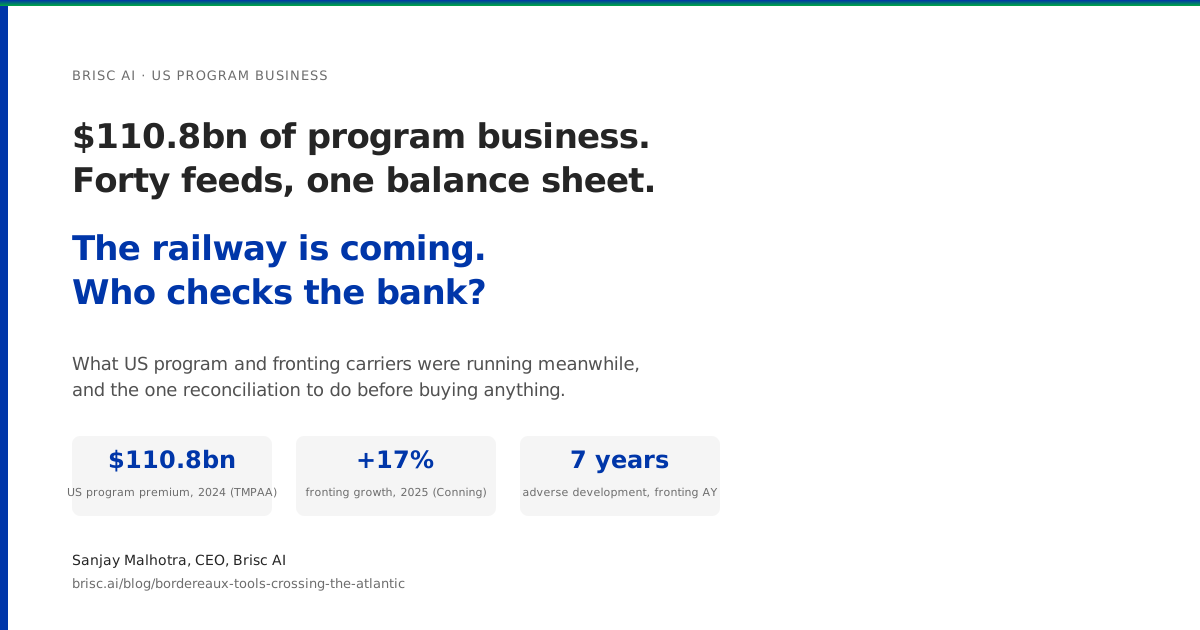
US program business reached $110.8 billion of premium in 2024, carried by about 1,150 program administrators, and a growing share of it sits on a fronting carrier’s paper. The Target Markets Program Administrators Association’s 2025 State of Program Business Study, reported by Risk & Insurance, puts growth at 40% between 2022 and 2024 against 21% for commercial P&C. The share of administrators using hybrid fronting rose from 15% to 19% over those two years, and the share using a fronting carrier rose from 9% to 16%. The same study names “fragmented technology infrastructure” as an ongoing challenge.
Fronting is the fastest-growing piece of that paper. Conning’s August 2026 fronting study counts more than $22 billion of fronted gross premium in 2025, up 17% after 26% the year before. AM Best’s September 2026 review, reported by Insurance Business, counts it more broadly at upwards of $30 billion, across 16 rated organisations whose primary business is fronting and roughly 30 in total. Five of those have exited or scaled back.
AM Best revised its outlook on the delegated underwriting authority enterprise segment from positive to stable on 17 November 2025, citing selective capacity, tighter renewal economics and more oversight. Growth is no longer the story. Control is.
What were US program carriers actually using for bordereaux?
Mostly people, SQL and Excel, on contract. The clearest evidence is in the job postings. Through 2025 and 2026, the US roles titled “Bordereaux (BDX) Analyst” that we could find were almost all remote contract positions placed through staffing firms, like this one, asking for advanced SQL, Excel and a reporting tool, and describing the job as reconciling “differences between written and paid bordereaux” and investigating discrepancies. Not one of the US postings we read named a bordereaux platform. The equivalent London postings name one.
That pattern tells you three things about the median program carrier. The reconciliation logic lives in a contractor’s query folder, not in a system. The written-to-paid check is done, but by hand and after the fact. And the knowledge of why program seventeen’s file is always late walks out when the contract does.
It also explains why the TMPAA study finds “fragmented technology infrastructure” at the top of the challenge list in a market that has just grown 40%. The feeds multiplied. The desk did not.
Why does “platform quality” now mean data?
Because the fronting carrier is the party left holding the loss when the data was wrong, and the market has stopped pretending otherwise. Conning’s Alan Dobbins put it plainly in the August 2026 study: “the next phase will be a test of platform quality rather than simply capacity and growth,” and softer conditions “should make differences in program selection, credit controls, operating depth, and risk management more visible.” The same study finds that initial gross accident-year loss ratios in fronting have developed adversely in each of the past seven accident years. The first number a fronting carrier books on a program has been too low, seven years running.
AM Best’s David Blades adds the balance-sheet consequence: if the reinsurer behind a program fails to pay, the fronting company “assumes the counterparty credit risk.” Greg Williams at AM Best describes reinsurers responding by requiring higher retentions, “striving to ensure underwriting discipline.” Every one of those pressures runs through the same artefact. The bordereau is how a fronting carrier knows what it has written, what it has collected, what it has ceded and what it owes. If the bordereau is late or wrong, the loss pick is wrong, the cession is wrong and the collateral call is wrong, in that order.
A fronting carrier backing forty programs is running forty reporting pipelines into one balance sheet. Each has its own lag and its own definitions. Platform quality, in Conning’s phrase, is whether those forty pipelines produce one number you would sign.
What are the London-market platforms bringing, and where do they stop?
They bring the validation layer, and they stop at what was bound. The London-market bordereaux platforms grew up on Lloyd’s Coverholder Reporting Standards: ingest the coverholder’s file, map it to the standard, validate every field, flag what is missing or out of bounds, and hand the managing agent a clean written bordereau. That is real work, and the US market has never had a native vendor doing it; the only North American specialist is small, and the London firms are now opening US offices to sell into the largest insurance market in the world.
What a validation platform does not do is open the bank statement. A clean written bordereau tells you what the MGA says it bound. A clean paid bordereau tells you what the MGA says it collected. Neither tells you what reached your account, in which currency, net of which fees, against which policies. That three-way match, written to paid to bank, is the step that the contractor in the opening scene was approximating in SQL, and it is the step the railway does not carry. The bordereaux management guide lays out the layers of the category and who sits in each; the short version is that validation and cash reconciliation are different jobs, and most carriers are about to buy the first and still need the second.
What should a fronting or program carrier do first?
Reconcile one program, three ways, before buying anything. The order matters because the first step costs nothing and tells you what the second should be.
- Inventory the feeds. For every program: who sends the written file, who sends the paid file, when, in what layout, and who on your side opens it. Most carriers have never written this list down. It usually surprises them.
- Pick the program with the biggest gap between written and paid, and match it to the bank for the last three months, policy by policy. Not the totals. The policies. The gap you find is the number your loss pick, your cession and your collateral are built on.
- Write down the rules the contractor is applying. Tolerances, currency treatment, fee netting, how a cancellation credit is traced back to its policy. If those rules exist only in a query folder, your control exists only until March.
- Decide what the system of record is, and insist that whatever you buy posts back to it with evidence rather than becoming a second ledger.
- Then evaluate tools, with the three-month reconciliation in hand. A validation platform will clean the written file. Ask every vendor what happens after that, and whether the answer involves your bank statement.
This is where Brisc sits. The Reconciliation Analyst does step two for every program, every month, on rules the carrier sets, and leaves the evidence on every match. It does not replace the validation layer and it does not replace the policy system. It answers the question the fronting carrier is actually being graded on: not whether the file is clean, but whether the money matches it. The cash application guide covers the mechanics of that match in detail.
The railway is coming to town. It will carry clean files from the MGA to the carrier faster than the dirt road did. What it will not do is tell you whether the freight that arrived is the freight on the manifest. Someone still has to check the bank, and for $110 billion of program business, almost nobody is.
Bring one program’s written and paid bordereaux and three months of bank statements. We will show you the matches, the exceptions and the evidence on your own data. Book a demo →
Common questions
How big is the US program business market?
The TMPAA's 2025 State of Program Business Study puts US program premium at $110.8 billion in 2024, up 40% from 2022, written through about 1,150 program administrators. Commercial P&C grew 21% over the same period.
How big is the US fronting market?
Conning counts more than $22 billion of fronted gross premium in 2025, up 17%. AM Best counts it more broadly at upwards of $30 billion across roughly 30 organisations, 16 of them rated with fronting as their primary business.
What is the difference between a written and a paid bordereau?
A written bordereau lists the policies bound in the period and the premium due on them. A paid bordereau lists the premium the MGA has actually collected. They differ because binding and collecting happen at different times, and neither tells the carrier what has reached its bank account.
What does a BDX analyst do?
In US postings, a bordereaux (BDX) analyst builds and validates bordereaux reports for carriers, MGAs and program business, reconciles differences between written and paid bordereaux, investigates discrepancies, and usually does it in SQL and Excel. The roles are often remote contract positions placed through staffing firms.
Why does a fronting carrier care about bordereaux more than other carriers?
A fronting carrier backs many programs on one balance sheet and cedes most of the risk. The bordereau is how it knows what was written, collected, ceded and owed. Conning found initial gross accident-year loss ratios in fronting developed adversely in each of the past seven accident years, and AM Best notes the fronting company assumes the counterparty credit risk if the reinsurer fails to pay.
Do the London-market bordereaux platforms reconcile cash?
They validate the written bordereau against a reporting standard and flag missing or out-of-bounds fields. They do not match the file to the carrier's bank statement. Cash reconciliation, written to paid to bank, is a separate layer.
Does Brisc replace a bordereaux validation platform or the policy system?
No. The Reconciliation Analyst sits after validation and before the ledger: it matches bordereaux to bank and remittance, returns every match with evidence, and posts back to the carrier's policy system. Brisc never holds or moves money.
References
- Risk & Insurance. "Program Business Premiums Surge to $110.8 Billion as Sector Outpaces Broader P&C Insurance Growth" (TMPAA 2025 State of Program Business Study). 31 October 2025. https://riskandinsurance.com/program-business-premiums-surge-to-110-8-billion-as-sector-outpaces-broader-pc-insurance-growth/ (accessed 2026-10-20).
- Conning. "Fronting Market 2026" (press release, Alan Dobbins). 27 August 2026. https://www.conning.com/about-us/news/ir-pr---fronting-market-2026 (accessed 2026-10-20).
- Insurance Business America. "Unrated reinsurers creep into $30bn US fronting market" (AM Best, "Front and Center: A Review of the Property/Casualty Fronting Market"; David Blades, Greg Williams). 30 September 2026. https://www.insurancebusinessmag.com/us/news/property/unrated-reinsurers-creep-into-30bn-us-fronting-market-591776.aspx (accessed 2026-10-20).
- Reinsurance News. "AM Best revises DUAE segment outlook to stable amid moderating growth." 17 November 2025. https://www.reinsurancene.ws/am-best-revises-duae-segment-outlook-to-stable-amid-moderating-growth/ (accessed 2026-10-20).
- Dice. "Bordereaux (BDX) Analyst / Insurance Data Analyst" (staffing-firm contract posting, remote US). 2026. https://www.dice.com/job-detail/494a8ff4-b180-4fbf-828a-0182bd304d10 (accessed 2026-10-20).
- The Insurer. "VIPR to open US office, targets growth in world's largest insurance market." 19 October 2026. https://www.theinsurer.com/program-manager/news/vipr-to-open-us-office-targets-growth-in-worlds-largest-insurance-market-2026-10-19/ (accessed 2026-10-20; paywalled, standfirst only).