Canada's MGA Market Is $4bn and Nobody Tracks the Data
It is the fifth working day of the month at a mid-sized carrier in Toronto. The finance analyst who looks after delegated business has eleven MGA bordereaux in her inbox. Nine are Excel files, each laid out the way that MGA’s system happens to export. Two came through Lloyd’s Canada’s Lineage portal, because those programs sit on Lloyd’s paper. None of them reconcile to what has landed in the bank. She opens a spreadsheet, starts matching, and does not finish until the eighth.
Nobody at that carrier can say, today, how much premium its MGAs bound last month, how much of it has been paid, and how much is still sitting in an MGA’s trust account. That is not a failing of the analyst. It is the condition of the Canadian market.
Brisc AI is a Toronto-based company that builds insurance-native AI Analysts for carriers, MGAs and reinsurers. Its Reconciliation Analyst reads an MGA’s bordereaux and the carrier’s bank statements, matches what was written to what was paid to what arrived, and returns every match with its evidence attached. The policy system stays the system of record. Brisc never holds or moves money. This post is about the data gap underneath that work in Canada, and what a carrier can do about it before anyone writes a rule.
Think of the Canadian MGA market as a hockey league in which every game gets played, every goal gets scored, and nobody keeps the standings. The games are real. The money is real. The table is blank.
How big is Canada’s MGA market, and why does nobody know for sure?
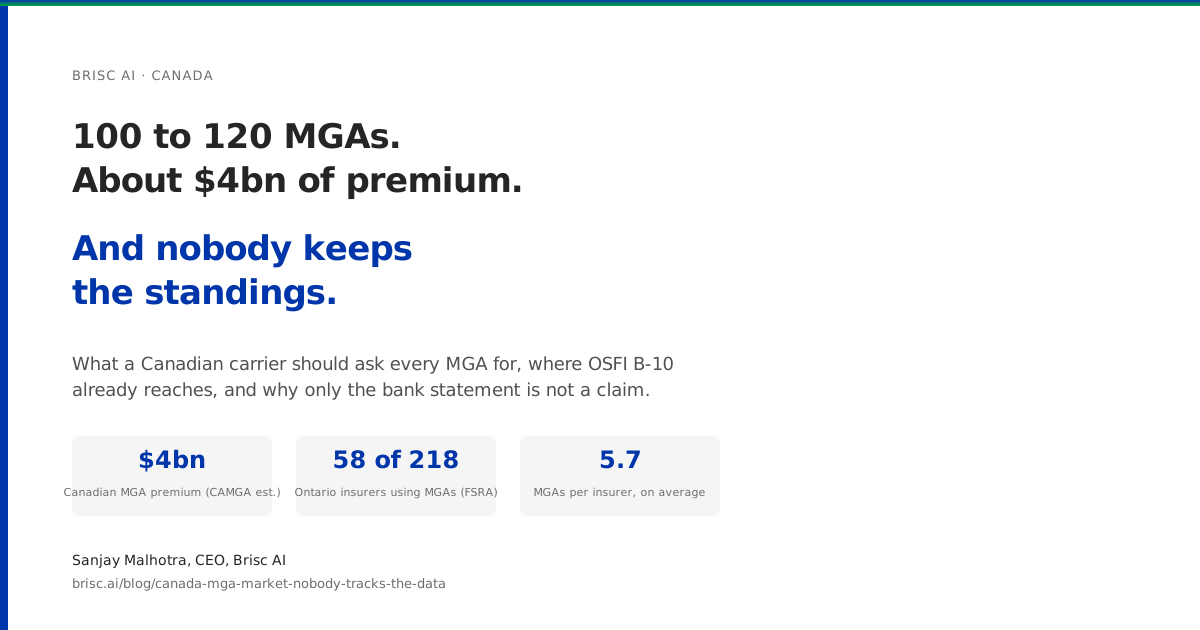
Canada has 100 to 120 MGAs writing about $4 billion of gross premium, and the number comes from the trade association, not a regulator, because no one collects it. Brett Boadway, executive director of the Canadian Association of Managing General Agents (CAMGA), told Insurance Business on 15 October 2026: “We estimate that there are 100 to 120 MGA firms across Canada,” writing “an estimated $4 billion in gross written premium,” roughly 10 to 15% of commercial lines. Then the sentence that matters: “Canada has not done a great job of actively tracking this data.”
The one hard data point is provincial. The Financial Services Regulatory Authority of Ontario (FSRA) reviewed 218 P&C insurers for 2023 and found that 58 of them outsourced functions to MGAs, that MGAs generated 6% of Ontario’s direct written premium, and that nine insurers wrote more than half their premium through MGAs. Insurance Portal’s report on the review put the Ontario figure at just under $2.33 billion across 139 MGAs and 330 insurer-MGA relationships, an average of 5.7 MGAs per insurer.
Two things follow. First, the national $4 billion is an estimate stacked on one province’s count, so a carrier’s own book is better data than the market’s. Second, the typical Canadian insurer that uses MGAs has five or six of them, each sending its own file, in its own layout, on its own date. The standings problem is inside the carrier before it is a market problem.
What does an MGA actually report to its carrier in Canada?
On Lloyd’s paper, the MGA reports through Lineage. On everyone else’s paper, it reports whatever the agreement says, which is usually a spreadsheet. Lloyd’s Canada’s Lineage portal is “a cost effective online tool used for the reporting and settlement of Canadian binding authority business.” The Canadian binding authority agreement requires the coverholder to submit premium declarations for each month’s bound policies through it, settlement runs monthly, and an Excel file is accepted only by exception with Lloyd’s Canada’s approval. Lineage is the closest thing Canada has to a bordereaux system, and it covers one slice of the market.
Off Lloyd’s paper there is no Lineage. FSRA found that 59% of contracted MGAs design products independently of the insurer whose paper they use, and that insurers “bear the ultimate responsibility for these products.” The insurer owns the outcome of a product it did not design, reported on a file it did not specify.
The people allocating capacity know it. In the same 15 October piece, Insurance Business reported that the Canadian CEO of one global carrier weighs how reliable and consistent an MGA’s data actually is when deciding whether to back one. That is capacity being allocated on data quality, in public, in Canada, this month.
Does OSFI’s Guideline B-10 reach the MGA bordereau?
It reaches the arrangement, and the arrangement produces the bordereau. OSFI’s Guideline B-10, Third-Party Risk Management, published in April 2023, applies to all federally regulated financial institutions, including foreign insurance company branches to the extent consistent with their Canadian obligations. It never uses the word MGA. It defines a third-party arrangement as “any type of business or strategic arrangement between the FRFI(s) and an entity(ies) or individuals,” excluding only customers and employees. A delegated underwriting agreement is squarely inside that definition.
Three of its expectations land on the monthly file. Monitoring “should be conducted at the individual arrangement level,” so one dashboard across all MGAs does not discharge it. Agreements “are expected to set out each party’s responsibilities for the confidentiality, availability and integrity of records and data.” And OSFI expects records “to be updated and accurate as at the end of each business day.” A bordereau that arrives on the tenth, in a layout that changed since last month, and that nobody has tied to the bank, is hard to describe as accurate at the end of any business day.
What should a Canadian carrier ask every MGA for?
Ask for six things, in writing, in the agreement, and then check the sixth against your own bank.
- A written bordereau at risk level, in one layout, every month. Policy, insured, inception, expiry, class, limit, gross premium, commission, taxes by province, net due. The layout is yours, not the MGA’s export.
- A paid bordereau on the same keys. What the MGA has actually collected from the broker or insured, by policy, by instalment. Written and paid are different files because binding and collecting happen at different times.
- A claims bordereau with paid and reserved split out, and a reserve change log, so the loss ratio you quote to your reinsurer is the one in your ledger.
- A change log. Endorsements, cancellations, mid-term adjustments, with the original policy key, so a credit on the paid file can be traced to the policy it belongs to.
- A fixed calendar. Day of month for each file, and a named person on each side for exceptions.
- A remittance that reconciles to the paid bordereau. The wire the MGA sends, the paid bordereau it says the wire covers, and the bank line it created should agree to the cent, and where they do not, the MGA should say why before you have to ask.
The sixth item is where the standings get kept. Items one to five tell you what was bound and what the MGA says was collected. Only the sixth tells you what arrived.
Where does cash reconciliation fit?
Cash reconciliation is the step that turns a bordereau from a report into evidence. A written bordereau is a claim about what was bound. A paid bordereau is a claim about what was collected. The bank statement is the only one of the three that is not a claim. Matching the three, policy by policy, is what lets a carrier say its premium receivable is a number rather than an estimate, and it is the step that neither Lineage nor a spreadsheet performs for you.
That is the work Brisc does. The Reconciliation Analyst takes the MGA’s written and paid files, the carrier’s bank feed and the remittance advice, and matches them on rules and tolerances the carrier sets. Every match carries the lines that produced it. Everything that does not match is an exception with the source documents attached, for a person to decide. The carrier’s policy system is untouched; Brisc posts the matched result back to it. If you want the longer version of how cash application works in insurance, the cash application guide covers it, and the bordereaux management guide sets out who does what in the wider category.
For a Canadian carrier with five or six MGAs, the practical result is that the question “how much of last month’s premium has actually arrived” gets an answer on the sixth working day instead of the eighth, and the answer has evidence attached. The speed is a consequence. The evidence is the point.
The games in this league have been played for years. Someone just has to keep the standings. CAMGA’s Capacity Exchange & Education Forum on 17 November 2026 is where Canadian MGAs and the carriers that back them meet; if you are in the room, the six questions above are a reasonable thing to bring.
Bring one program’s written and paid bordereaux and three months of bank statements. We will show you the matches, the exceptions and the evidence on your own data. Book a demo →
Common questions
How many MGAs are there in Canada?
CAMGA estimates 100 to 120 MGA firms writing about $4 billion of gross written premium, roughly 10 to 15% of commercial lines. No regulator publishes a national count. The only official data is Ontario's: FSRA found 139 MGAs contracted with at least one insurer in 2023.
Is the Canadian MGA market regulated?
MGAs in Canada are not licensed or supervised in the same way as insurers. FSRA's 2023 review states that insurers bear the ultimate responsibility for products sold through MGAs, and OSFI's Guideline B-10 sets third-party risk expectations for federally regulated insurers that cover delegated arrangements.
What is Lloyd's Canada's Lineage?
Lineage is Lloyd's Canada's online portal for reporting and settling Canadian binding authority business. Coverholders on Lloyd's paper submit monthly premium declarations and claims through it, and settlement runs monthly. It applies only to Lloyd's business; MGAs on other carriers' paper report by whatever means the agreement specifies, usually Excel.
Does OSFI's B-10 apply to MGA agreements?
B-10 defines a third-party arrangement as any business or strategic arrangement between a federally regulated financial institution and another entity, excluding customers and employees. A delegated underwriting agreement falls within that definition. The guideline does not name MGAs specifically.
What is the difference between a written and a paid bordereau?
A written bordereau lists the policies bound in the period and the premium due on them. A paid bordereau lists the premium the MGA has actually collected. They differ because binding and collecting happen at different times, and neither one tells the carrier what has reached its bank account.
Does Brisc replace the carrier's policy administration system?
No. The policy system stays the system of record. The Reconciliation Analyst matches the MGA's bordereaux to the bank and the remittance, returns the matched result with evidence, and posts it back. Brisc never holds or moves money.
Where is Brisc based?
Brisc AI is based in Toronto and works with carriers, MGAs and reinsurers in North America, the UK, Bermuda, the Caribbean and Latin America.
References
- Insurance Business Canada (Branislav Urosevic). "MGAs write a third of UK commercial lines. In Canada, they're not even in the textbooks." 15 October 2026. https://www.insurancebusinessmag.com/ca/news/breaking-news/mgas-write-a-third-of-uk-commercial-lines--in-canada-theyre-not-even-in-the-textbooks-593508.aspx (accessed 2026-10-20).
- Financial Services Regulatory Authority of Ontario. "New market insights are shaping FSRA's priorities in P&C supervision." 2024. https://www.fsrao.ca/announcements/new-market-insights-are-shaping-fsras-priorities-pc-supervision (accessed 2026-10-20).
- Insurance Portal (Kate McCaffery). "Ontario regulator urges insurers to uphold strong controls with managing general agencies." 11 December 2024. https://insurance-portal.ca/article/ontario-regulator-urges-insurers-to-uphold-strong-controls-with-managing-general-agencies (accessed 2026-10-20).
- Lloyd's. "Lineage and Accounting and Settlement (Canada)." https://www.lloyds.com/en-ca/lloyds-around-the-world/lineage-and-accounting-and-settlement (accessed 2026-10-20).
- Lloyd's Market Association. "Lineage and Scheme Canada: Additional Information Handout" (LMA3115 Canadian Binding Authority Agreement, section 24). October 2025. https://lmalloyds.com/wp-content/uploads/2025/10/LMA-Additional-Info.docx (accessed 2026-10-20).
- Lloyd's. "Settlements: Lineage Accounting and Settlement Portal, data entered by coverholder." https://assets.lloyds.com/assets/pdf-settlements-lineage-accounting-and-settlement-portal-data-entered-by-coverholder/1/pdf-settlements-lineage-accounting-and-settlement-portal-data-entered-by-coverholder.pdf (accessed 2026-10-20).
- Office of the Superintendent of Financial Institutions. "Guideline B-10: Third-Party Risk Management." April 2023. https://www.osfi-bsif.gc.ca/en/guidance/guidance-library/third-party-risk-management-guideline (accessed 2026-10-20).
- CAMGA. "Capacity Exchange, 12 November 2026." https://camga.ca/ (accessed 2026-10-20).