From Rekeying to Reviewing: What Changes the Day Submission Intake Becomes Infrastructure
The head of underwriting at a property MGA told me her team’s busiest season wasn’t about underwriting. It was about intake. Between March and June, broker submissions arrived faster than her team could open them, and every week she’d field the same email from a broker: “Did you get my submission?” The answer was always yes, it sat in a queue behind forty others, and nobody had noticed that the SOV was missing until an underwriter finally opened the file two days later.
Her team didn’t have an underwriting problem. They had a rekeying problem. Every submission that arrived needed someone to open it, identify the documents, extract the data, check for missing attachments, format the result for the PAS, and hand it to the right underwriter. They were rekeying brokers’ work into their own system, and the bottleneck wasn’t talent, it was the manual cycle between “broker sends” and “underwriter reviews.”
Brisc AI’s Submissions Analyst is an insurance-native AI system that converts broker submissions into structured, reviewed, PAS-ready output, with every prior underwriting decision, every broker format quirk, and every missing-document pattern retained as permanent operational knowledge. The shift isn’t from people to software. It is from rekeying to reviewing.
What submission intake looks like as infrastructure
The word “infrastructure” earns its place only when the system behaves like one: always on, fixed cost, compounds with use, doesn’t degrade under load. Here is what changes operationally when submission intake crosses that threshold.
1. Busy season stops capping how much you bind.
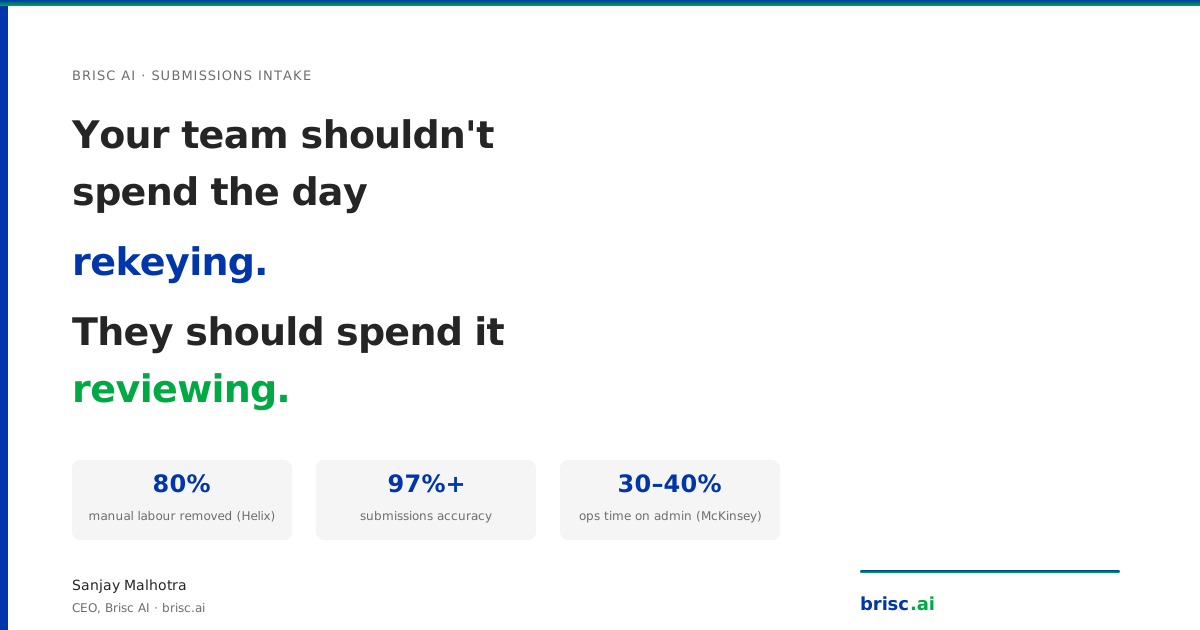
When intake is a desk, capacity is a headcount constraint. March through June, the property MGA I described earlier couldn’t process submissions faster than her team could rekey them. She wasn’t losing deals because her underwriters said no, she was losing them because her intake desk couldn’t get the submission in front of an underwriter before the broker moved on. McKinsey and Accenture estimate that 30–40% of operations time in insurance goes to administrative tasks. When that administrative load sits between the broker and the underwriter, it becomes a bind-rate ceiling.
2. The answer is the same regardless of who filled the SOV.
A team of four intake analysts will process the same SOV differently depending on who picks it up, which fields they prioritize, which format quirks they catch, which classification they apply. Brisc’s Submissions Analyst retains every prior underwriting decision the desk has ever made. The classification, extraction, and formatting is consistent across every submission because the accumulated knowledge is in the system, not in any single person’s head. Helix Underwriting Partners reports that Brisc removed 80% of manual labour from their operations, and the consistency of output was the mechanism, not the speed.
3. Missing documents are caught at intake, not three days later.
When a broker submission arrives without its SOV, ACORD form, or another expected document, the Submissions Analyst flags the gap on the dashboard and surfaces it to the operator. A half-complete file is caught at intake, not when an underwriter opens it, discovers the gap, emails the broker, waits two days for a response, and re-queues the submission behind forty new arrivals. The operator stays in control of the broker conversation; the system makes sure nothing gets quietly dropped.
4. Format changes are absorbed, not re-learned.
Brokers change SOV formats without warning. A new column, a renamed field, a date format that shifts from UK to US convention between Q2 and Q3. A human intake desk re-discovers these changes by getting them wrong. The Submissions Analyst’s learned-alias store, every broker, account, and format variant the system has ever confirmed, absorbs format drift as permanent knowledge. The next submission in the new format is handled correctly because the prior encounter was retained.
5. Clearance happens before a file hits a desk.
Sanctions screening, appetite checking, and duplicate detection happen at intake rather than after an underwriter has already spent time reviewing. Submissions that don’t meet appetite are flagged before they consume underwriting hours; submissions that duplicate an existing file are caught before two underwriters unknowingly work the same risk.
6. The team reviews instead of rekeying.
This is the operational divide. A rekeying team spends its day entering data, opening PDFs, transcribing fields, reformatting values, copying data from one system to another. A reviewing team spends its day making decisions, evaluating the structured output, handling exceptions, managing broker relationships, and applying judgment where judgment is required. The Submissions Analyst absorbs roughly 80% of the repetitive intake workflow at a fixed cost. The remaining 20%, exceptions, judgment calls, broker conversations, stays with the team. That 20% is higher-value work, and it’s the work that should never have been crowded out by rekeying in the first place.
The operating model question, not the headcount question
The most common comparison I hear from CFOs evaluating intake automation is the single-FTE benchmark: “Why pay more for software than for the person?” The question sounds reasonable, but it measures the wrong thing.
A single FTE has a salary, a ramp time of 90 to 180 days, a tenure that industry surveys place at two to three years in back-office insurance roles, and a knowledge ceiling that resets every time they leave. The per-unit cost of a person looks low until you add the ramp errors, the knowledge loss on departure, and the hiring cycle that follows. Each departure triggers a 90-day window where the desk is either understaffed or staffed by someone who hasn’t yet learned that Broker X sends SOVs in landscape orientation and Broker Y puts the building count in the wrong column.
Infrastructure doesn’t have turnover. It doesn’t ramp. It doesn’t lose knowledge. The question is not whether the software costs more than one person, it is whether the submission desk is labour or infrastructure. Labour scales linearly: more volume means more hires, each with another 90-day ramp and another departure risk. Infrastructure scales sub-linearly: more volume means more work processed at a fixed cost, with the accumulated knowledge of every submission the system has ever handled.
The Submissions Analyst delivers 99.1%+ field level accuracy on submissions processing because accuracy compounds with knowledge, every prior decision, every broker format, every edge case becomes part of the permanent operational dictionary. A people-only model delivers accuracy that resets with turnover and degrades under load.
Where intake ends and underwriting begins
The Submissions Analyst is the intake layer, the boundary between “the broker sent something” and “the underwriter has a structured, complete, classified file to review.” It does not make underwriting decisions. It does not auto-bind. It does not replace the underwriter’s judgment.
When a broker sends an updated SOV mid-quote, the system reprocesses the documents and hands the updated structured result to the operator. Re-quote orchestration stays where it belongs, with the underwriter and the policy administration system. The honest boundary matters: the Submissions Analyst handles the data pipeline; the underwriting team handles the risk decision.
That boundary is the operating model. Rekeying is a task. Reviewing is a role. Infrastructure is what makes the difference.
See how the Submissions Analyst can help you turn intake into infrastructure →
Common questions
How long does it take to deploy the Submissions Analyst?
Deployment takes 2 to 6 weeks, depending mostly on the number of broker formats in use. Day one needs no PAS integration, and the system starts learning broker-specific patterns right away.
What happens to submissions the system can't classify?
Unclassifiable submissions are flagged as exceptions and routed to the operator for manual review. Every manual resolution feeds back into the system's learned-alias store, so the same pattern is handled automatically next time.
Does this work with our existing PAS?
Yes. Day one needs no PAS integration: submissions come in, and structured, evidenced output goes out. Integration with your policy administration system comes once the output is trusted. The PAS stays the system of record. Brisc is the intake layer, not a replacement.
Can we run this in our own environment?
Not in your own cloud. Brisc is SaaS on Microsoft Azure with one dedicated tenant per customer, so your data is never pooled with anyone else's. SOC 2 Type II controls and tenant isolation apply to every deployment.
What accuracy should we expect?
Brisc's Submissions Analyst operates at 97%+ accuracy on submissions processing. Accuracy climbs with use as the system accumulates broker-specific patterns and format knowledge.
How does this compare to hiring another person?
The per-person cost of intake is not the salary, it is the salary plus the 90–180 day ramp, the knowledge loss on departure, the inconsistency between analysts, and the capacity ceiling during peak season. The Submissions Analyst delivers fixed-cost, always-on intake with no ramp and no knowledge loss. The comparison isn't software-vs-person; it's infrastructure-vs-labour.