8 Questions to Ask Before Buying a Reconciliation Analyst: CFO Guide
Every vendor demo I have ever attended — on either side of the table — ends the same way. The data matches. The dashboard is green. The salesperson says “any questions?” and the room nods. Everyone leaves thinking this could work.
Six weeks later, the pilot stalls. The tool cannot handle a broker who changed column layouts last quarter. The audit trail is a CSV dump nobody reads. The one analyst who knew the workaround for Cedant X’s quarterly restatement went on leave, and the system has no memory of her. The vendor blames the data. The CFO pulls the budget.
I have been that CFO. And I have been the founder whose tool gets evaluated by that CFO. Brisc AI builds the Reconciliation Analyst — an insurance-native AI system that matches bordereaux to cash with 97%+ accuracy while retaining every broker quirk and format pattern the system has ever encountered. But this post is not about Brisc. It is about the eight questions that determine whether any reconciliation technology survives its first quarter in production — or becomes a line item in your write-off column. Reconciliation is one piece of the larger Cash Ops function most insurers have never formally staffed for — but this guide is about the narrower decision in front of you: which tool earns a permanent place on your desk.
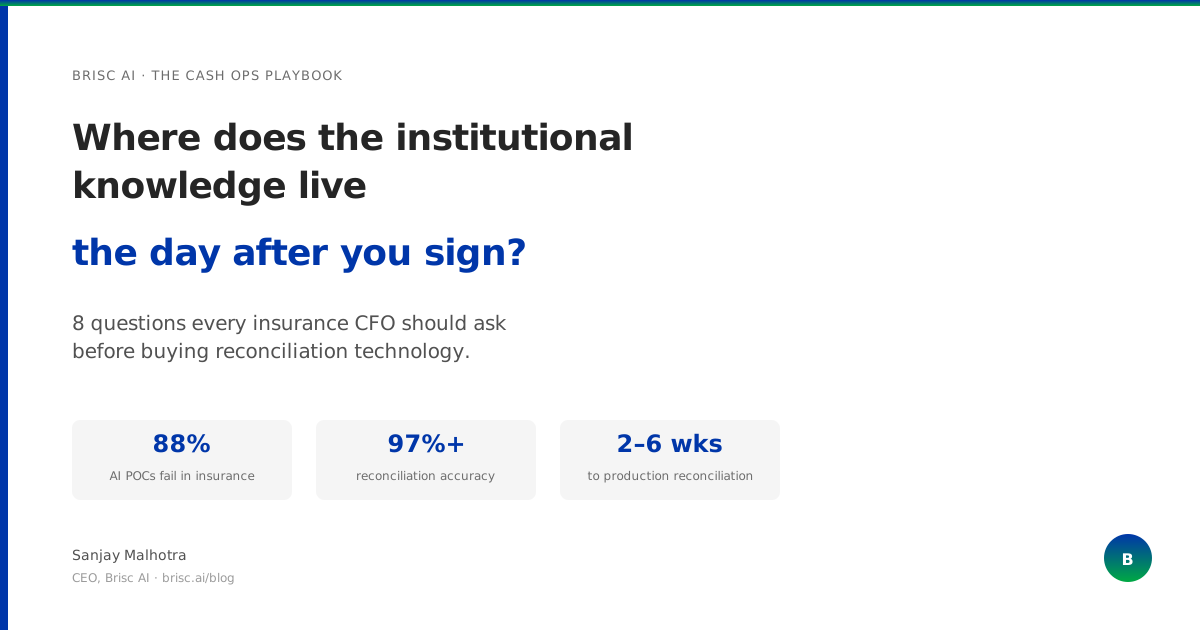
Most teams start the evaluation by asking about speed. Speed is the wrong question. The right question is: where does the institutional knowledge live the day after you sign?
1. Was the AI trained on insurance documents — or general business documents?
Insurance reconciliation is not accounts-receivable matching with different labels. A bordereaux from a Lloyd’s syndicate carries inception-to-date premium, sliding-scale commission recalculations, and broker-specific column layouts that change without notice. A claims bordereaux from a US MGA arrives with IBNR reserves that must be delta-calculated against the prior period. A bank statement reads “WIRE TXN 8847291” against a premium schedule that says “Program A, Q2 2026.”
A general-purpose matching engine trained on retail invoices and purchase orders will pattern-match some of this correctly. It will not understand why brokerage must be separated from commission, why case reserves are snapshots and not transactions, or why a cedant’s Q3 audit adjustments arrive in narrative form two months late.
Insurance-native AI is trained on the documents your desk actually sees — bordereaux, SOVs, ACORD forms, claims data, treaty statements (see how this plays out specifically for bordereaux reconciliation). The distinction is not academic. It is the difference between a system that classifies brokerage as commission on day one and a system that already knows the difference. Insurers fully embedding AI in their operations jumped from 8% to 34% in 2025. The ones who chose insurance-native tools got to production. The ones who chose horizontal AI are still in pilot.
Ask the vendor: show me three insurance document types your system has never seen before from my desk — and let me watch it process them live.
2. Does it produce the audit trail automatically — or does someone reconstruct it after?
Every reconciliation produces a result. The question is whether the evidence behind that result was captured as the work happened or assembled after someone asked for it.
In insurance, audit trails are not optional. Regulators, actuaries, your own quarterly close — all of them need to reconstruct any reconciliation decision after the fact. The trail must show which source document was read, which fields were extracted, what classification logic was applied, what confidence score the system assigned, and whether a human reviewed the output.
If the vendor’s audit trail is a log file that an analyst has to interpret and a controller has to translate into a format the auditor accepts, the tool has not automated the audit trail. It has moved the reconstruction work from one person’s desk to another’s.
Brisc produces a confidence-scored, source-traceable, fully reproducible audit trail on every transaction — automatically, without anyone pressing a button. One customer reports that the time their team previously spent reconstructing month-end audit evidence dropped to near zero. Auditors, regulators, and the CFO’s own quarterly review can pull the trail for any decision at any time.
Ask the vendor: show me the audit trail for a reconciliation you ran six months ago — the one your team did not expect me to ask about.
3. Does it ingest every format your brokers actually send — PDF, Excel, email, EDI, portal scrape?
Your brokers will not change their reporting format for your reconciliation tool. They send what they send. The tool either reads it or it does not.
The formats that arrive on a real insurance desk include multi-tab Excel workbooks with merged cells, scanned PDFs with handwritten annotations, emails with bordereaux data pasted inline, CSV exports with semicolon delimiters from European systems, and EDI transmissions from carriers running ACORD standards. Some brokers send the same data three different ways across two reports because two different teams own two different systems. We walked through what a day of reconciling those formats by hand actually looks like in Excel Archaeology: A Day in the Life of an Insurance Cash Matcher — it’s the workflow this question is really asking a vendor to replace.
A reconciliation tool that requires data normalization before it can process — “please upload in our template” — is not a reconciliation tool. It is a data-entry assignment that sits upstream of the reconciliation. McKinsey and Accenture estimate that 30-40% of insurance operations time is consumed by administrative tasks. Tools that add a format-conversion step before the actual work begins are part of that tax, not a solution to it.
Ask the vendor: I will send you three real broker files from my desk — in the formats my brokers actually use — and I want to see them processed without any manual reformatting.
4. How does it handle FX, IPT, EU stamp duties, and other cross-jurisdiction tax variance?
Cash matching across borders is where most reconciliation tools break. The premium amount on the bordereaux and the amount that arrives at the bank differ because of foreign exchange conversion, insurance premium tax, EU stamp duties, withholding tax, or a combination. The variance is legitimate — but a system that cannot explain it treats every cross-border transaction as an exception.
For any MGA or reinsurer operating across multiple jurisdictions, this is not an edge case. It is the majority of the workload. One $500M+ GWP MGA operating across six geographies told us that cross-jurisdiction tax variance is their single largest source of unresolved exceptions — one of six growth-constraining breakpoints we cover in MGAs: When Cash Matching Becomes Your Growth Constraint. UK IPT versus EU stamp duty alone accounts for more analyst hours than any other matching category.
A reconciliation tool that flags every FX or tax variance as an exception is a tool that generates work, not one that eliminates it. The system must understand — at the transaction level — which variances are expected and which are genuine discrepancies.
Ask the vendor: show me how a GBP-denominated premium with UK IPT applied looks when matched against a USD bank receipt with no tax line. Where does the variance explanation come from — the system or my analyst?
5. What is the time to first value — 24 hours, 6 weeks, or 6 months?
IDC research found that 88% of AI proofs-of-concept in insurance fail to reach production. The most common cause is not that the technology does not work. It is that the deployment timeline stretches past the organisation’s patience and budget cycle.
If the vendor’s deployment plan includes a phase called “data transformation” that lasts longer than the evaluation itself, the product is not ready for insurance data as it actually exists. If the deployment requires your brokers to change their reporting format, the deployment will never finish.
Brisc AI deploys in 2-6 weeks from signed contract to first production reconciliation on real client data. That range depends on the number of broker formats in scope and the complexity of the existing ledger structure — not on a multi-month systems-integration project.
The benchmark is not “when will the sandbox work?” The benchmark is “when will I see a result on my own data, in my own ledger, that I trust enough to act on?”
Ask the vendor: how many days from contract signature to the first reconciliation result I would actually post to my general ledger?
6. Where does the institutional knowledge live the day after you sign — in the system or in a person?
This is the question most evaluations miss entirely.
Your senior reconciliation analyst knows that Broker A always nets brokerage into the commission column. She knows that Cedant B’s Q3 audit adjustments arrive in narrative form, two months late, every year. She knows that the $47,000 sitting in the trust account since March is a transposed reference code from a wire transfer, not a missing payment.
That knowledge took years to accumulate. When she leaves — and the industry’s 20-40% annual back-office turnover says she will — her successor starts from zero. The cedant quirks, the broker patterns, the format drift — all of it has to be relearned by making the same mistakes again.
A reconciliation tool that depends on the operator’s knowledge to function is not automation. It is a fancier spreadsheet. The tool must accumulate institutional knowledge — every broker quirk, every format variation, every exception pattern — and retain it permanently. Helix Underwriting Partners reported an 80% reduction in manual labour after deploying Brisc, and the structural reason is not speed. It is that the system’s dictionary of broker patterns compounds with every cycle. When the senior analyst is on leave, the Reconciliation Analyst still knows everything she knew.
Ask the vendor: if my best reconciliation analyst resigned tomorrow, what would your system still know about my brokers that she knew?
7. What does the human review queue look like — and what do humans actually do?
The promise of AI reconciliation is not that it replaces humans. It is that it changes what humans spend their time on.
In a well-designed system, the AI handles the matching, classification, and exception identification. The human reviews the cases that require judgment — broker disputes, catastrophe-event allocations, treaty-rule edge cases, regulatory interpretations. These are the decisions that need domain expertise, not data entry skill.
If the vendor’s system routes 40% of transactions to a human review queue, the system has not learned enough to be useful. If it routes 2% — the genuine judgment calls — the system is doing its job. The remaining 97-98% should process automatically with a confidence score and a full audit trail.
Brisc’s Reconciliation Analyst achieves 97%+ accuracy on bordereaux reconciliation. That means roughly 97% of transactions process without human intervention. The human queue contains the cases that genuinely need a human — and each case arrives with the system’s reasoning, the source documents, and a proposed resolution. The human decides; the system remembers the decision for next time.
Ask the vendor: what percentage of transactions goes to human review — and show me what the reviewer sees when they open a case.
8. What is your in-house AI build alternative — and what is your historical success rate?
Every CFO evaluating reconciliation technology has a voice in the room saying “we could build this ourselves.” That voice deserves a honest answer.
The 88% AI POC failure rate that IDC reports is not a failure of ambition. It is a failure of domain specificity. Building a reconciliation system that handles clean, structured data is a six-month engineering project. Building one that handles the unstructured, format-variable, jurisdiction-spanning reality of insurance reconciliation — and that retains broker-specific knowledge across staff changes — is a multi-year effort that most organisations abandon.
One MGA in our customer base spent approximately $250,000 over eighteen months on an internal build before concluding that the system could not handle the format variability their brokers actually produce. They deployed Brisc’s Reconciliation Analyst in under four weeks. The dictionary that took their internal team eighteen months to partially build was operational in the first month — because the Reconciliation Analyst already understood insurance documents.
The build-versus-buy question is not “can we build it?” The question is “can we build it faster than the problem compounds?” At 5-8% annual labour-cost inflation in insurance back-office operations, and with a 59% labour cost reduction available from a production-ready alternative, the cost of delay is calculable.
Ask your own team: what is our historical success rate on internal AI builds — and how long did the last one take to reach production?
The question underneath all eight
Every question above is a variant of the same deeper question: does this tool accumulate knowledge, or does it just process data?
A tool that processes data is a productivity improvement. A tool that accumulates knowledge — that learns every broker’s quirks, retains every exception pattern, and compounds its accuracy with every cycle — is a structural advantage. The first saves time. The second changes the economics of your operation permanently.
That is the difference between software and an Analyst.
FAQ
Q: What is a Reconciliation Analyst?
A Reconciliation Analyst is an insurance-native AI system that matches bordereaux data — premium, claims, and commission reports — against bank receipts, premium schedules, and ledger entries. Unlike rules-based matching engines, a Reconciliation Analyst retains institutional knowledge of every broker pattern and format variation it encounters, compounding accuracy over time. Brisc AI’s Reconciliation Analyst achieves 97%+ accuracy on bordereaux reconciliation.
Q: How is this different from reconciliation software?
Traditional reconciliation software applies deterministic rules to structured inputs. It works when the data is clean and the format is consistent. A Reconciliation Analyst handles the unstructured, format-variable, multi-jurisdiction reality of insurance reconciliation — and it learns. Every broker quirk, every format change, every exception resolution becomes part of the system’s permanent knowledge. The next operator inherits that knowledge on day one.
Q: How long does deployment take?
Brisc AI deploys in 2-6 weeks from signed contract to first production reconciliation on real client data. The range depends on broker format complexity and ledger structure, not on a multi-month integration project. IDC research found that 88% of AI proofs-of-concept in insurance fail to reach production — most commonly because deployment timelines stretch past the organisation’s budget cycle.
Q: Does this replace our reconciliation team?
No. It changes what your reconciliation team spends time on. The Reconciliation Analyst handles matching, classification, and exception identification. Your team handles judgment calls — broker disputes, catastrophe allocations, treaty-rule edge cases. The result is that your team works on the problems that need human expertise, while the system handles the volume that used to consume their day.
Q: What is the accuracy rate?
Brisc’s Reconciliation Analyst achieves 97%+ accuracy on bordereaux reconciliation. That means roughly 97% of transactions process without human intervention. Every transaction carries a confidence score — low-confidence items route to human review with the system’s reasoning and source documents attached.
Q: Can it handle multiple jurisdictions and currencies?
Yes. Cross-jurisdiction tax variance — FX conversion, insurance premium tax, EU stamp duties, withholding tax — is handled at the transaction level. The system distinguishes expected variances from genuine discrepancies, which eliminates the false-exception problem that plagues rules-based matching across borders.
Q: What happens if our best analyst leaves?
The Reconciliation Analyst retains every broker pattern, format variation, and exception resolution it has encountered — permanently. When a senior analyst leaves, the institutional knowledge stays in the system. Their successor starts on day one with the accumulated dictionary of every broker the organisation has ever processed. Industry back-office turnover runs 20-40% annually; the Reconciliation Analyst makes that turnover a people problem, not a knowledge problem.
Q: How does this compare to building in-house?
IDC reports that 88% of AI proofs-of-concept in insurance fail to reach production. One MGA in our customer base spent approximately $250,000 over eighteen months on an internal build before deploying Brisc’s Reconciliation Analyst in under four weeks. The structural challenge is not engineering capacity — it is domain specificity. Insurance reconciliation requires understanding of bordereaux formats, treaty structures, broker reporting quirks, and regulatory requirements that general AI and in-house engineering teams take years to accumulate.
What to do next
If you are evaluating reconciliation technology — or wondering whether your current tool is surviving the desk as well as it survived the demo — take these eight questions into your next vendor conversation. The answers will tell you more about the product than the dashboard ever will.
The institutional knowledge on your desk should belong to your organisation, not to whoever happens to be sitting at the desk this quarter.