NOVUS Holds the Ledger. Who Matches the Cash?
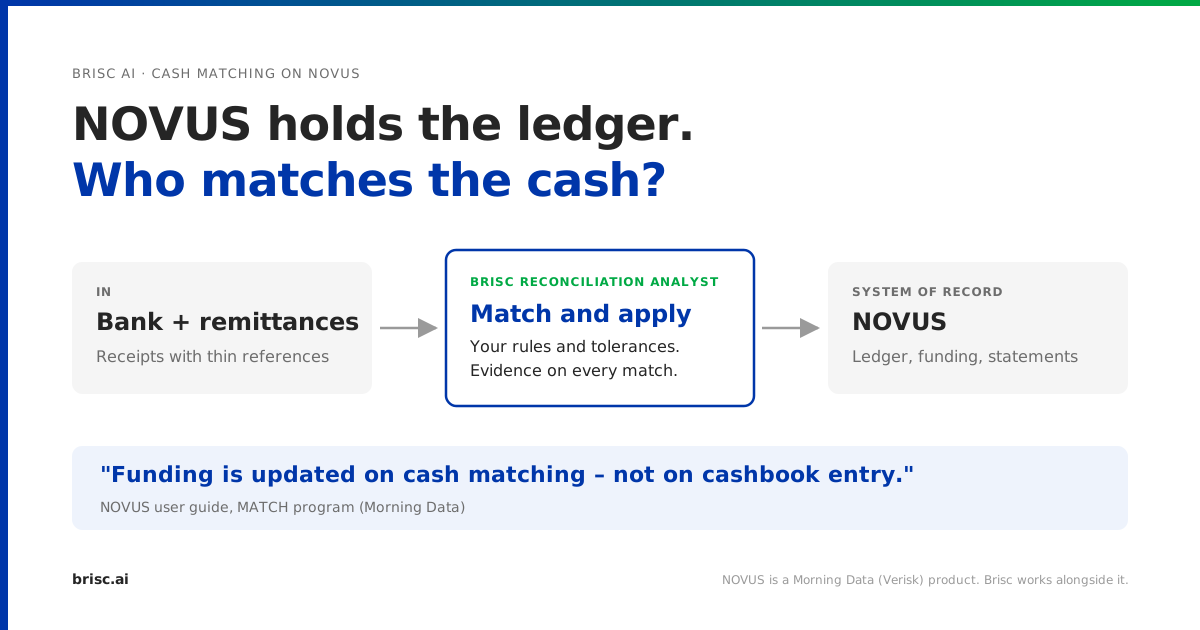
It is the fourth working day of the month at a reinsurance broker in the London market. The bordereaux are in and reconciled. The entries are booked in NOVUS: what each cedant owes, what each market is owed. Then the bank feed lands. A wire for $412,860.15 names a cedant and nothing else. It could settle one statement, three statements, or part of a fourth. A technical accountant opens a spreadsheet, filters by cedant, and starts adding up open items until something comes close.
Nothing else can move until she finds it. In NOVUS, the account stays unfunded until the receipt is matched. Until it is funded, the markets cannot be paid out with confidence.
Think of NOVUS as the address book and the bank as the post. Every receipt is a letter with half an address on it. Someone has to sort it.
Brisc AI builds insurance-native AI Analysts, and its Reconciliation Analyst does that sorting for brokers, MGAs and coverholders that run on NOVUS. It reads bank lines and remittance advice, matches each receipt to the expected items NOVUS holds on rules and tolerances the customer sets, and hands back matched cash with the evidence for every match. NOVUS stays the system of record. Brisc never holds or moves money.
What is NOVUS, and who runs on it?
NOVUS is Morning Data’s end-to-end policy administration platform for the specialty intermediary market, built for MGAs, brokers and coverholders working across Lloyd’s, the company market, reinsurance and delegated authority. Verisk acquired Morning Data on 30 May 2023, and it now sits in Verisk’s Specialty Business Solutions group alongside Whitespace and the Sequel products.
Two things make NOVUS a strong system of record for an intermediary. It is built on a full ledger, which few insurance administration systems are. And it is wired into the London market’s plumbing: Morning Data integrated NOVUS with London bureau central settlement through ACORD’s ADEPT in 2021. Morning Data was established in 1985. This is not a system anyone should be replacing.
Where does cash matching sit in a NOVUS workflow?
Cash matching sits between the bank and the ledger, and it is the one step in the post-bind flow that is still mostly people. Morning Data’s NOVUS walkthrough guide puts it plainly: “Amounts can be auto-matched if the system finds an exact match.” If not, “the MATCH program will allow manual matching of multiple entries against amounts of cash recorded as unmatched on the cashbook.” Everything that is not an exact match is a person’s job.
For a reinsurance broker, the full post-bind sequence looks like this:
- A bordereau arrives, monthly or quarterly.
- It is processed and reconciled.
- The accounting entries are booked in NOVUS: what each cedant owes, what each market is owed.
- Cash arrives in the bank.
- Each receipt is matched to the entries and applied.
- Funding updates, and the markets are paid out with a statement.
Steps 1 to 3 have had years of investment, in-house and from vendors. Step 6 runs on NOVUS. Step 5 is where the exact-match rule meets real-world cash: wires with a cedant name and no contract reference, one payment covering several statements, bank charges taken off the top, a currency that does not quite convert to the penny. Those are the receipts that end up in a spreadsheet.
Why does unmatched cash matter more in NOVUS than in a spreadsheet?
Unmatched cash in NOVUS is not just an operations backlog; it is a wrong funding position. Morning Data’s user guide for the MATCH program says: “Funding is updated on cash matching – not on cashbook entry.” The same page advises that, to monitor funding, “cash matching should be carried out as soon after cashbook entry as possible.” A receipt can be sitting in the bank account and still read as unfunded in NOVUS until someone matches it.
That has two consequences. Settlement to the markets either waits for the match, or it is released on someone’s judgement. And the backlog is a client-money question as well as a timing one. Under the FCA’s CASS 5 rules, an insurance intermediary has to be able to show which client each pound in a pooled account belongs to.
The cost of getting that wrong is now on public record. In April 2026, Insurance Business reported on the administration of a Lloyd’s broker holding about £13 million of client money. Its transactions had been tracked across three separate Excel spreadsheets, the oldest of which could not be reconciled to its broking system. The FCA modified CASS 5.6.7R for that one case. Untangling it cost £1,084,949 plus VAT up to 27 February 2026, with a further £702,068 plus VAT authorised to finish the job.
That broker was not on NOVUS. The lesson travels anyway: a ledger is only as good as the matching that feeds it.
Why doesn’t the team just grow with the book?
Matching volume grows with the book, and a team grows one hire at a time. Brokers and MGAs that have already automated the bordereaux side often find the cash side is still people and spreadsheets, so every new cedant, programme or market adds a little more manual matching and, sooner or later, another technical accountant.
The harder problem is where the knowledge lives. Which cedant always nets bank charges. Which market pays quarterly on a monthly statement. What tolerance the head of finance will accept on a cross-currency receipt. Today that sits in a technical accountant’s head and in the notes column of a spreadsheet. When she leaves, it leaves with her, and nobody can audit why a receipt was applied where it was.
Where does Brisc fit alongside NOVUS?
Brisc does step 5 and nothing else in that flow. The Reconciliation Analyst takes three inputs: bank statements, remittance advice (by upload or email), and the expected items, exported from NOVUS or pulled from a data lake as CSV, JSON or by API. It matches each receipt to the expected item on rules and tolerances you set, and every match records the rule and the evidence behind it.
What comes out is matched cash application with its evidence attached. NOVUS stays the system of record: funding, statements and settlement to the markets all still run there. Brisc does not replace the ledger, the cashbook or your treasury provider, and it never holds or moves funds.
Four design choices matter to a NOVUS shop:
- Matching is deterministic. Matching runs on rules, tolerances and confidence tiers; the AI reads the documents, never the arithmetic. A technical accountant can read why a receipt landed where it did.
- Exceptions go to a queue, not an inbox. A receipt Brisc cannot match, including a payment with no remittance advice, goes to one workspace with the reason attached. Your team resolves it there, and each decision is stamped with who made it.
- The rules are yours and they persist. Tolerances, bank-charge handling and cedant quirks are configured per tenant, so the knowledge stays when people move on.
- Day one needs no integration project. Uploads in, evidenced file out. How the matched result is posted into NOVUS depends on your setup, and we agree that in scoping.
What does good look like?
The honest benchmark is a match rate around 80% on day one, rising to 92 to 95% by about 90 days as the rules learn your cedants and markets. The Reconciliation Analyst’s output accuracy is 97%+, with every match carrying its evidence, and field-level accuracy across the Analysts in production is 99.1%. Customers go live in 2 to 6 weeks.
Across Brisc’s reconciliation customers, premium is on track to pass ~$1B a year through Brisc at our current run rate. Helix, a specialty MGA in Bermuda, reports removing 80% of the manual labour in the workflows Brisc runs. Brisc is SOC 2 Type II certified and runs as SaaS on Azure, with one dedicated tenant per customer, and your data never trains a model.
The number that matters to a NOVUS user is the one that does not show up in those figures: the funding position. If matching runs every day instead of at month end, the account in NOVUS reads funded when the money is in the bank, and payment out to the markets runs on today’s numbers.
The address book was never the problem. The sorting office is where the time goes, and that is the part Brisc runs.
See it on your own cash
For the wider picture beyond NOVUS, see our guides to cash application in insurance and premium payment matching.
Bring a month of bank statements and a NOVUS export of open items, and we will show you what matches, what doesn’t, and why. Book a demo.
References
- Verisk. “Verisk acquires Morning Data to support digital transformation of international broker and MGA market.” 30 May 2023. https://www.verisk.com/company/newsroom/verisk-acquires-morning-data-to-support-digital-transformation-of-international-broker-and-mga-market/ (accessed 2026-10-13).
- Verisk Specialty Business Solutions. “Morning Data.” https://www.verisksequel.com/morning-data (accessed 2026-10-13).
- Morning Data. “NOVUS.” https://www.morningdata.co.uk/products/novus/ (accessed 2026-10-13).
- ACORD. “Morning Data integrates NOVUS platform with London bureau central settlement services through ACORD Solutions Group’s ADEPT.” 11 May 2021. https://acord.org/news-detail/2021/05/11/morning-data-integrates-novus-platform-with-london-bureau-central-settlement-services-through-acord-solutions-group’s-adept (accessed 2026-10-13).
- Morning Data. “NOVUS Walkthrough Guide.” NOVUS user guide. https://userguide.morningdata.co.uk/index.php?title=NOVUS_Walkthrough_Guide, archived 8 August 2022 at http://web.archive.org/web/20220808051627/https://userguide.morningdata.co.uk/index.php?title=NOVUS_Walkthrough_Guide (accessed 2026-10-13; live site unreachable).
- Morning Data. “MATCH.” NOVUS user guide. https://userguide.morningdata.co.uk/index.php?title=MATCH, archived 8 August 2022 at http://web.archive.org/web/20220808042250/https://userguide.morningdata.co.uk/index.php?title=MATCH (accessed 2026-10-13; live site unreachable).
- Financial Conduct Authority. “CASS 5: Client money: insurance distribution activity.” FCA Handbook. https://www.handbook.fca.org.uk/handbook/CASS/5.pdf (accessed 2026-10-13).
- Gladys Jalipa, Insurance Business. “Lloyd’s broker’s shoddy records trap £13 million, prompt FCA rule change.” 17 April 2026. https://www.insurancebusinessmag.com/uk/news/legal-insights/lloyds-brokers-shoddy-records-trap-13-million-prompt-fca-rule-change-572122.aspx (accessed 2026-10-13).
- Brisc-original: the six-step post-bind flow comes from a reinsurance broker’s own description on a call, October 2026, anonymised.
- Brisc-original: match rate, output accuracy, field-level accuracy, run-rate premium and go-live figures are Brisc’s published figures (brisc-website
src/data/proof.ts).
Common questions
Does Brisc replace NOVUS?
No. NOVUS stays the system of record for policies, the ledger, funding, statements and settlement. Brisc does the cash matching and application step between the bank and NOVUS, and hands the matched result back.
Is Brisc a Morning Data or Verisk partner?
No. Brisc is independent of Verisk and Morning Data. NOVUS is a Morning Data (Verisk) product. Brisc works alongside it using NOVUS exports and the bank data you already have.
Does Brisc integrate with NOVUS?
Brisc takes expected items as a NOVUS export, or as CSV, JSON or by API from a data lake, and returns matched cash application as an evidenced file. Day one needs no integration project. The exact route back into NOVUS depends on your setup and is agreed in scoping.
Does Brisc move money or touch the client money account?
No. Brisc reads bank statements and remittance advice and decides which receipt settles which item. It never holds, moves or pays out funds. Your bank and treasury provider keep doing that.
Does NOVUS not already match cash?
It does, for exact matches. The NOVUS user guide describes auto-matching when the system finds an exact match. The receipts that need work are the ones that are not exact: thin references, part payments, one wire covering several statements, bank charges and currency differences.
What happens to a payment Brisc can't match?
It goes to an exception queue with the reason it did not match. A payment with no remittance advice is not split automatically; it waits for a person, who resolves it in the workspace with their decision recorded.
How does this help with CASS 5 client money?
Every match records the rule, the evidence and the reviewer, so you can show which client and which item each receipt was applied to. That trail is what a client-money review asks for. Brisc does not run your CASS 5 calculation for you.
Is this only for reinsurance brokers?
No. The same step exists for MGAs, coverholders and Lloyd's brokers on NOVUS, and for intermediaries on other platforms. Our guides to cash application in insurance and premium payment matching cover the wider picture.