Why Periodic Reconciliation Is a Financial Risk (Not Just a Process Delay)
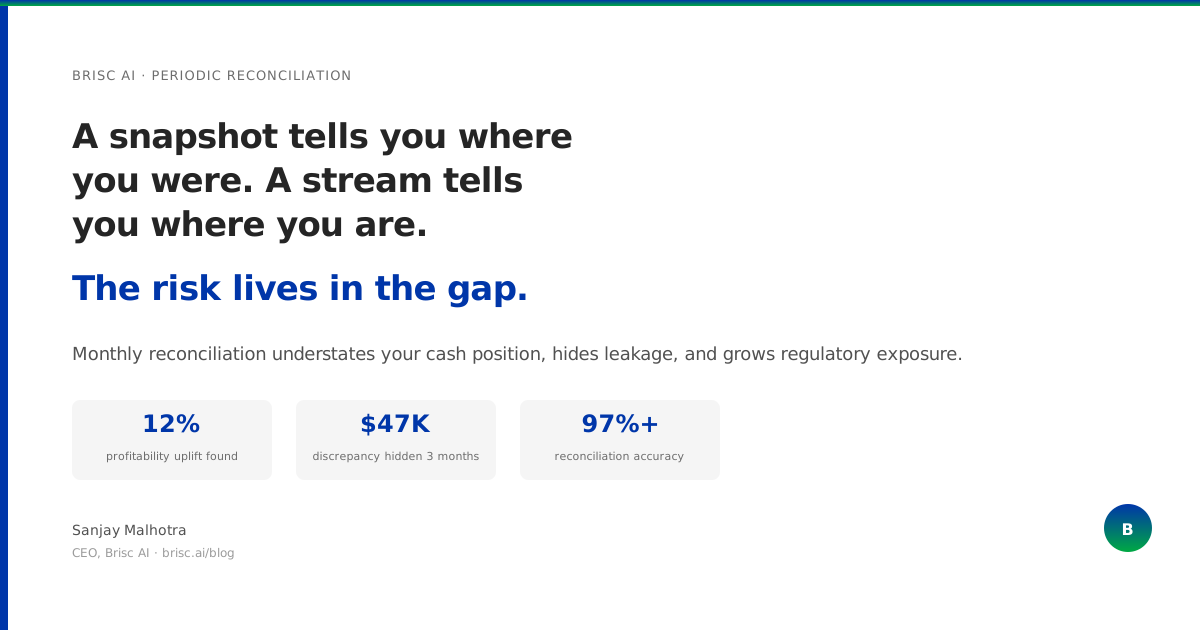
A finance director at a specialty MGA reviewed the quarterly reconciliation results on a Tuesday afternoon and found a number she could not explain. The reported cash position for the prior three months had been understated, not because a payment was missing, but because a payment had arrived in week two, been mislabelled by the broker, and sat in a suspense account until the end-of-quarter matching cycle caught it. By then, three months of management reports, board decks, and reserve calculations had been built on a cash position that was wrong. The error was not large, roughly $47,000, but the correction cascade touched every downstream report that referenced it.
Brisc AI is an insurance-native AI platform that automates bordereaux reconciliation and cash matching for MGAs, carriers, and reinsurers. Our Reconciliation Analyst matches incoming cash to policies continuously, not periodically. We built it this way because every finance director we work with describes the same structural problem: monthly or quarterly reconciliation is treated as a process cadence decision, when it is actually a financial risk decision.
This post is about what lives in the gap between reconciliation cycles, and why that gap is more expensive than most boards realise.
The Snapshot vs. the Stream
Periodic reconciliation produces a snapshot. Once a month, or once a quarter at organisations that reconcile less frequently, the team matches cash receipts to bordereaux entries, identifies exceptions, resolves what they can, and reports a position. Between snapshots, the cash continues to arrive. Bordereaux continue to land. Broker formats continue to shift. But the matching stops.
The financial risk lives in the gap between those snapshots. Every day that cash sits unmatched, the reported cash position is understated and stale. In a ledger-based environment, premium is not recognised as funded until the cash is matched. A backlog of unmatched transactions means the organisation’s reported cash position is behind reality, sometimes by weeks, sometimes by an entire quarter.
One reinsurance audit uncovered a 12% true profitability uplift that had been invisible for three years, masked by periodic reconciliation that could not surface systematic under-reporting across cedant data. The reconciliation looked correct period-by-period. It was not correct inception-to-date. The money was there. The matching was not.
The analogy that captures this most clearly is the difference between a snapshot and a stream. A snapshot tells you where you were when the picture was taken. A stream tells you where you are now. Periodic reconciliation is a series of snapshots. The risk lives in the frames you never took.
Three Risks That Compound Between Cycles
The gap between reconciliation cycles is not empty. Three categories of financial risk accumulate in it, and each compounds with time.
1. Pricing Distortion from Stale Loss Ratios
Loss ratios drive renewal pricing, reserve adequacy, and reinsurance treaty negotiations. When cash is unmatched, the earned premium denominator in the loss ratio calculation is wrong. If received premium is understated because matching has not caught up, loss ratios appear worse than they are. Renewal pricing built on a distorted loss ratio is renewal pricing built on a fiction.
McKinsey and Accenture estimate that 30–40% of operations time in insurance goes to administrative tasks. A disproportionate share of that administration exists because data produced by periodic reconciliation is stale by the time it reaches the people who need it, and they spend hours reconstructing what should have been current.
2. Undetected Premium Leakage
Premium leakage, the systematic shortfall between what should have been received and what was, is invisible until someone matches what was expected to what actually arrived. Periodic reconciliation delays this detection by weeks or months. A broker who consistently under-remits by a small percentage, or who nets a commission at a rate slightly different from the agreed schedule, creates a leak that is individually immaterial and cumulatively significant.
The 12% profitability uplift discovered in one reinsurance audit was not caused by a single large error. It was caused by hundreds of small mismatches that accumulated across three years of cedant reporting. No single quarterly reconciliation surfaced the pattern because no single quarter’s discrepancy crossed the materiality threshold. Only an inception-to-date view, the kind that continuous reconciliation produces naturally, revealed the compounding shortfall.
3. Regulatory Exposure from Reconstructed Records
The FCA’s Client Asset Sourcebook, CASS 5, requires firms holding client money to identify and correct discrepancies promptly. The word “promptly” does deliberate work. A discrepancy that exists for three months because the reconciliation cycle has not yet reached it is a discrepancy that was not promptly identified. The regulatory exposure is not hypothetical, it is a compliance surface that grows with every day between reconciliation runs.
Beyond CASS, auditors distinguish between records accumulated continuously and records reconstructed after the fact. When a reconciliation team spends the first two weeks of each quarter reconstructing the prior quarter’s matching, pulling broker correspondence, tracing reference codes, rebuilding the chain of custody for exceptions, the audit trail is a reconstruction, not a record. The difference matters when a regulator or external auditor asks how a specific match was made. “We matched it at the time” is a different answer from “we reconstructed the match three months later.”
Brisc AI’s Reconciliation Analyst operates at 97%+ accuracy on reconciliation and captures the audit trail continuously, every match, every exception, every resolution is documented at the moment it occurs, not reassembled at quarter-end. The record is the work, not a report about the work.
Why the Gap Widens with Growth
Every new program, every new broker, every new jurisdiction adds transactions to the matching queue. But the reconciliation cycle stays the same, monthly or quarterly, regardless of volume. The gap between snapshots does not scale with the business. The risk inside the gap does.
An MGA running five programs can reconcile monthly with a small team and keep the gap manageable. An MGA running twenty programs across eight brokers and three jurisdictions, with cross-border tax variances, multiple currencies, and broker-specific format quirks, faces a gap that is structurally wider. The team that closes it is larger, the reconstruction takes longer, and the period during which the reported position is stale extends further into the next cycle.
Industry data shows 20–40% annual turnover in insurance back-office roles, with 90 to 180 days before a new hire becomes productive in cash matching. Each departure resets the institutional knowledge clock, and the first reconciliation cycle after a departure is the one most likely to miss the patterns the predecessor would have caught.
The question is not whether to reconcile continuously. The question is how long the organisation can afford to operate on a cash position that is weeks behind reality, and how much risk accumulates in the gap.
What Continuous Reconciliation Actually Changes
The shift from periodic to continuous reconciliation is not a speed improvement. It is a risk-posture change.
Continuous matching means every incoming payment is matched to the corresponding bordereaux entry on the day it arrives, or flagged as an exception on the day the mismatch is detected. The cash position is current. The audit trail is accumulated, not reconstructed. The discrepancies that would have compounded across a quarter are surfaced in the week they occur.
Brisc AI deploys in 2–6 weeks and produces its first production reconciliation on real client data within that window. The Reconciliation Analyst retains every broker format, every cedant quirk, every exception pattern it has ever encountered. On submission intake, Helix Underwriting Partners reported about an 80% reduction in manual work. The institutional knowledge that previously lived in one analyst’s head, and left when they did, now lives in the system permanently.
The result is not faster reconciliation. The result is a cash position that is true, a regulatory posture that is defensible, and a finance team that reports on reality instead of reconstructing it.
Move from periodic reconciliation risk to continuous reconciliation with Brisc. Learn more →
Common questions
What is the difference between periodic and continuous reconciliation in insurance?
Periodic reconciliation matches cash receipts to bordereaux and premium schedules at fixed intervals, monthly or quarterly. Continuous reconciliation matches each transaction on the day it arrives, keeping the cash position current and surfacing exceptions in real time rather than weeks or months after they occur.
Why is periodic reconciliation a financial risk, not just a process issue?
Between reconciliation cycles, the reported cash position is understated because unmatched cash is not recognised as funded. This affects loss ratio calculations, renewal pricing, reserve adequacy, and the accuracy of board-level financial reporting. The risk compounds with the length of the gap and the volume of transactions.
How does periodic reconciliation affect regulatory compliance under FCA CASS?
The FCA's Client Asset Sourcebook requires firms to identify and correct client money discrepancies promptly. A discrepancy that exists undetected for an entire quarter because the reconciliation cycle has not yet reached it is a discrepancy that was not promptly identified, creating a compliance surface that grows with every day between cycles.
What is premium leakage, and how does periodic reconciliation hide it?
Premium leakage is the systematic shortfall between expected and received premium. It often occurs through small, recurring mismatches, broker under-remittances, incorrect commission netting, that individually fall below materiality thresholds. Periodic reconciliation cannot detect patterns that span multiple periods unless someone performs inception-to-date analysis manually.
Can continuous reconciliation work with existing policy administration systems like SICS, Sapiens, or Sequel?
Brisc AI's Reconciliation Analyst operates as a matching layer between the bank feed and the policy administration system. It reads from both, matches across both, and posts results back. The PAS stays the system of record, Brisc does not replicate it or create a parallel ledger.
How long does it take to move from periodic to continuous reconciliation?
Brisc AI deploys in 2–6 weeks from signed contract to first production reconciliation on real client data. The range depends on the number of broker formats in scope and the complexity of the existing ledger structure.
What accuracy does Brisc AI achieve on bordereaux reconciliation?
Brisc AI's Reconciliation Analyst operates at 97%+ accuracy on bordereaux reconciliation and retains every broker format pattern and exception it encounters, so accuracy improves over time as the system's institutional knowledge compounds.
How does continuous reconciliation affect the audit trail?
Continuous reconciliation produces an audit trail that is accumulated in real time, every match, exception, and resolution is documented at the moment it occurs. This is fundamentally different from periodic reconciliation, where the audit trail is often reconstructed after the fact during the matching cycle.