What SICS, Sapiens, and Sequel Operators All Have in Common (Hint: A PDF Pile)
A finance director at a specialty reinsurer is halfway through a platform evaluation. The team has spent three months comparing DXC’s SICS against Sapiens ReinsuranceMaster and Verisk’s Sequel Re. The spreadsheets are detailed. The vendor demos were polished. The decision is close.
Then she asks the implementation lead a question that doesn’t appear in any vendor scorecard: “What happens to the 200 bordereaux PDFs that arrive every month from cedants who have never heard of any of these platforms?”
The room goes quiet. The answer, across all three vendor tracks, is the same. Someone on your team opens the PDF, reads the columns, figures out the cedant’s formatting conventions, and manually rekeys the data into whatever platform you chose. The platform changes. The PDF pile doesn’t.
Brisc AI is an insurance-native AI platform that eliminates the manual translation layer between unstructured cedant documents and structured reinsurance administration systems. The platform that sits beneath the data, whether that’s DXC’s SICS, Sapiens ReinsuranceMaster, or Verisk’s Sequel Re, determines the dictionary. Brisc is the translator.
Three Platforms, One Data Model, One Bottleneck
The reinsurance administration software market is projected to grow to $14.2 billion by 2033, according to Dataintelo, driven by contract complexity and automation pressure. Three vendors dominate:
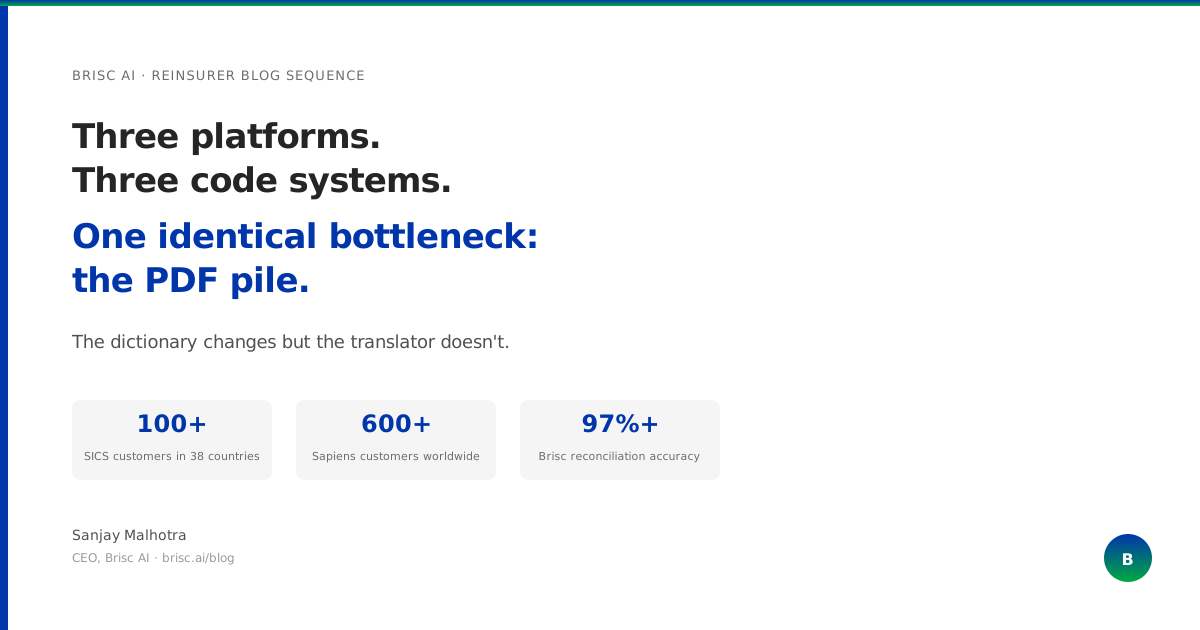
DXC Technology’s SICS, the Strategic Information and Cession System, runs the reinsurance back office at over 100 customers in 38 countries, with 25 or more in the Middle East and Africa alone. DXC has more than 40 years of experience in core insurance systems. SICS structures transactions around proprietary entry codes, written premium (code 100), commission (200), brokerage (240), paid loss (300), and dozens more, each mapping to a specific financial event in the treaty lifecycle.
Sapiens International’s ReinsuranceMaster is a SaaS platform serving P&C reinsurers globally, with ReinsurancePro targeting the US market through the Azure Marketplace. Sapiens reports more than 600 customers across 30-plus countries, though the slice running reinsurance-specific products is smaller. The platform handles all contract types, multicurrency support, intercompany retrocession, and US NAIC statutory reporting including Schedule F. Sapiens uses its own transaction-type classifications, distinct from SICS entry codes.
Verisk’s Sequel Re manages outward reinsurance for Lloyd’s syndicates and London Market insurers, facultative, proportional treaty, and non-proportional contracts. Verisk’s broader specialty suite serves more than 200 clients, including 10 of the top 10 Lloyd’s managing agents and 4 of the top 5 brokers. Sequel Re handles real-time premium and recovery calculations, credit control, and accounting period close. It uses its own code system, different from both SICS and Sapiens.
Three platforms. Three different code systems. Three different upload formats. But every one of them shares the same core data model: counterparty, treaty, transaction. And every one of them shares the same bottleneck.
The Bottleneck Is Not the Platform, It Is the Input
Every reinsurance admin platform is a structured data destination. SICS expects transactions classified by entry code. Sapiens expects transactions classified by its schema. Sequel Re expects transactions in its format. All three import structured data efficiently. That is their job, and they do it well.
The problem is upstream. Cedants do not send structured data. They send PDFs, Excel spreadsheets, emails with data pasted inline, scanned cover notes, and narrative adjustment letters. McKinsey and Accenture estimate that 30-40% of underwriter and operations time in insurance goes to administrative tasks. In cession-accounting teams that spend their days translating unstructured documents into structured platform entries, that percentage is higher, because the translation work is not a distraction from the job. It is the job.
A SICS operator translating a cedant’s PDF into entry codes does the same cognitive work as a Sapiens operator translating the same PDF into Sapiens categories. The platform they’re typing into is different. The PDF they’re reading is the same. The institutional knowledge they carry, which cedant uses which column layout, which broker nets commission differently in Q4, which program requires a gross-up calculation, is identical in nature regardless of the destination system.
This is why platform evaluations miss the real cost. The vendor comparison spreadsheet captures license fees, implementation timelines, and feature matrices. It does not capture the six-person team that will sit between the inbox and the platform, translating documents by hand, accumulating knowledge in their heads, and taking that knowledge with them when they leave.
Why the Dictionary Changes but the Translator Doesn’t
Brisc’s architecture against any reinsurance admin platform follows four steps:
- Ingest unstructured documents from cedants
- Extract fields using insurance-native AI
- Classify each field into the target platform’s specific codes using a per-customer dictionary
- Output in the format the platform accepts.
The dictionary differs for every platform. A SICS customer needs written premium classified as entry code 100. A Sapiens customer needs the same financial event classified in Sapiens categories. A Sequel Re customer needs it in the Sequel schema. The engine that reads the document, identifies the fields, and applies institutional knowledge about the cedant’s formatting conventions is the same across all three.
This is the horizontal insight. The first customer on any platform produces a dictionary and an output template that is largely reusable for the next customer on the same platform. Brisc’s work at a SICS reinsurer builds the SICS dictionary. Work at a Sapiens reinsurer builds the Sapiens dictionary. The extraction engine, the pattern library, and the institutional-memory architecture do not change.
Brisc AI maintains 97%+ accuracy on bordereaux reconciliation, verified across production deployments. Because the Analyst handles the routine work and the team keeps the judgment calls, Brisc customers report a 59% labour cost reduction. On submission intake, Helix Underwriting Partners reports about an 80% reduction in manual work. Deployments are live in 2-6 weeks because the engine is pre-trained on insurance documents, only the dictionary and template need configuration.
The Platform Comparison Table No Vendor Will Show You
Most platform comparisons focus on features: does it handle retrocession? Does it support multicurrency? Does it produce Schedule F? Those questions matter. But the question that determines your staffing plan for the next five years is different.
| SICS (DXC) | ReinsuranceMaster (Sapiens) | Sequel Re (Verisk) | |
|---|---|---|---|
| Market position | Dominant globally, 100+ customers in 38 countries | SaaS-first, 600+ Sapiens customers across 30+ countries | London/Lloyd’s focus, 10/10 top managing agents |
| Code system | Proprietary entry codes (100, 200, 240, 300…) | Sapiens-specific transaction classifications | Sequel-specific schema |
| Structured import | Yes, native + ADEPT integration | Yes, native | Yes, native |
| Unstructured document handling | No, manual rekeying | No, manual rekeying | No, manual rekeying |
| Institutional knowledge retention | In the operator’s head | In the operator’s head | In the operator’s head |
| Brisc integration | Dictionary + SICS upload template | Dictionary + Sapiens upload template | Dictionary + Sequel upload template |
The last two rows are the ones that matter. On every platform, the institutional knowledge about cedant formats, broker conventions, and treaty quirks lives in the operator’s head. When that operator leaves, and industry turnover runs 20-40% annually in back-office functions, the knowledge leaves with them. The replacement spends 90-180 days rebuilding context that was never written down.
Brisc’s Reconciliation Analyst retains every cedant’s formatting conventions, every broker’s commission-netting pattern, and every treaty’s reporting quirks as permanent system memory. The dictionary compounds with every interaction. By the tenth bordereaux from a cedant, Brisc handles that cedant without human review. By the fiftieth, the dictionary has absorbed every variation that cedant has ever produced. The platform underneath is irrelevant to that accumulation.
What This Means for Your Platform Decision
If you are evaluating reinsurance admin platforms, evaluate them on what they do well: structured data management, treaty accounting, regulatory reporting, and financial settlement. Those are the right criteria for the platform decision.
Do not expect the platform to solve the unstructured-document problem. None of them do, and none of them are building that capability; DXC is contracting, with revenue declining 5.8% year-over-year and headcount dropping from 150,000 to 120,000 over seven years. The gap between what these platforms accept natively and what cedants actually send is widening, not closing.
ACORD’s ADEPT standard is closing part of that gap for the roughly 20% of counterparties who have adopted structured digital data exchange. Digital reinsurance transactions on ADEPT grew 73% year-over-year from 2024 to 2025. But the 80% of cedants still sending PDFs and Excel files will remain on unstructured documents for years, because each cedant’s investment to adopt a new data-exchange standard exceeds their interest in accommodating any single reinsurer’s preferences.
The translator that sits between your cedants and your platform, whether that translator is a six-person team or Brisc’s Reconciliation Analyst, is the decision that determines your operating cost, your knowledge-retention posture, and your capacity to onboard new cedants without onboarding new staff.
The reinsurance admin platform you choose determines your data model. It does not determine how the data gets in. See how Brisc’s Reconciliation Analyst works with your platform →
Common questions
Does Brisc work with all three platforms, SICS, Sapiens, and Sequel?
Brisc's architecture is platform-agnostic. The extraction engine and institutional-memory system are shared. Only the output dictionary and upload template differ by platform. Configuration, not code.
How long does it take to set up a new platform dictionary?
Deployments are live in 2-6 weeks. The engine is pre-trained on insurance documents; the dictionary captures the target platform's specific code system and the customer's treaty and cedant conventions.
Does Brisc replace the reinsurance admin platform?
No. Brisc is the translation layer that sits between unstructured cedant documents and whatever structured platform you run. It complements SICS, Sapiens, or Sequel, it does not compete with them.
What about in-house or proprietary systems?
Large reinsurers like Swiss Re and Munich Re run proprietary systems with bespoke coding. Brisc's dictionary model works the same way, map the in-house codes, configure the output template, and the translator adapts.
How does Brisc handle cedant-specific formatting quirks?
Every cedant interaction teaches the Reconciliation Analyst that cedant's conventions. Column layouts, commission-netting patterns, currency formatting, tax treatment, all accumulate as permanent system memory. The knowledge does not leave when staff turn over.
What accuracy does Brisc achieve?
Brisc AI maintains 97%+ accuracy on bordereaux reconciliation, verified across production deployments. This is the accuracy of a team's best senior operator on their best day, sustained across every document, every cedant, every day.
How does Brisc relate to ACORD ADEPT?
ADEPT handles the structured 20% of counterparties who have adopted digital data exchange. Brisc handles the unstructured 80% who still send PDFs and Excel. They are complementary, ADEPT for the trunk, Brisc for the last mile. See [ADEPT Is Necessary But Not Sufficient](/blog/adept-necessary-not-sufficient) for the full analysis.
What does Brisc cost relative to a manual team?
Because the Analyst handles the routine work and the team keeps the judgment calls, Brisc customers report a 59% labour cost reduction. On submission intake, Helix Underwriting Partners reports about an 80% reduction in manual work. The cost comparison is not Brisc versus no tool, it is Brisc versus the six-person translation team you are already paying for.