The 5% You Write Off Is Where the Money Lives
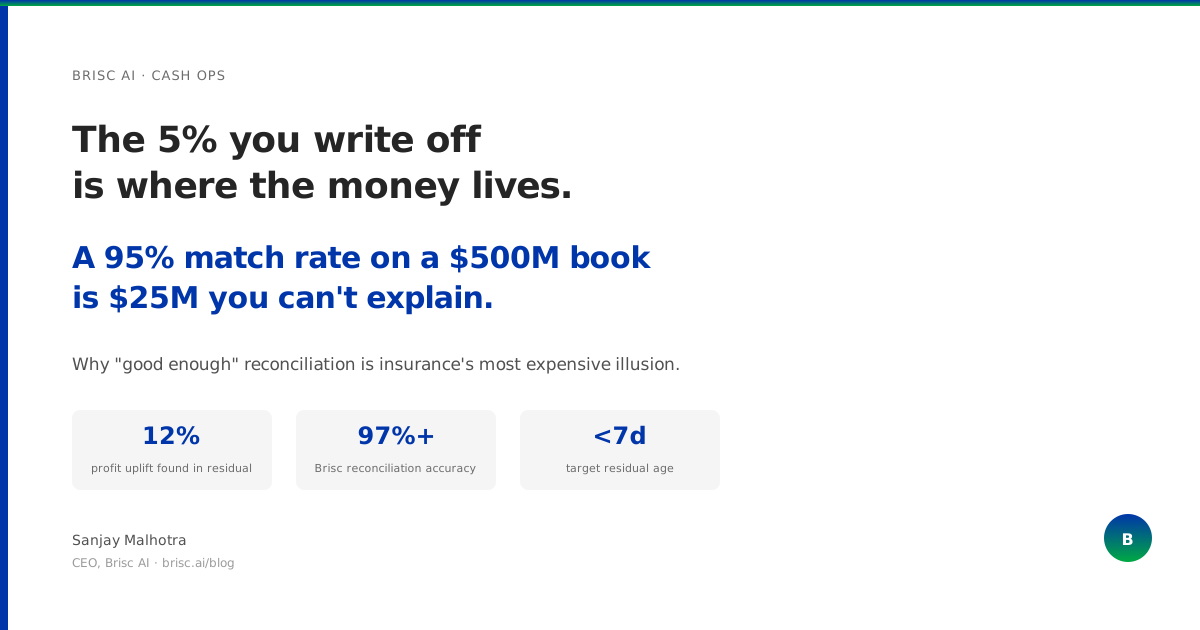
A head of credit control at a specialty MGA told me something last year that stuck: “We match 95% automatically. The other 5% goes into the exception queue. And the exception queue is where careers end.”
She was being dramatic. But she was also right. The 95% that matches cleanly is easy money, the payments line up, the references are clear, the amounts tie. Nobody gets promoted for matching the clean items. Nobody’s deal falls apart over a payment that reconciled correctly on the first pass.
The 5% that doesn’t match is where the actual risk lives, the partial payments, the over-remittances, the timing mismatches where a broker splits a payment across two periods without notice, the commission adjustments that arrive as narrative corrections three months after the fact. Every operations leader in insurance knows this, even if the board deck only reports the 95% number.
Brisc AI is an insurance-native AI platform that automates bordereaux reconciliation and cash matching for MGAs and reinsurers. We built the Reconciliation Analyst because the structural problem in insurance cash operations is not the 95% that matches. It is the 5% that doesn’t, and the compounding cost of leaving it unresolved.
What the Residual Actually Contains
The unmatched 5% is not random noise. It is systematically the hardest, highest-value, and most consequential subset of your reconciliation workload. The items that resist automatic matching resist it for specific, identifiable reasons, each of which carries financial exposure.
Partial payments. A broker remits 80% of the expected premium because they netted a mid-term adjustment the bordereau hasn’t yet reflected. The cash is there. The match isn’t. Until someone investigates, that position sits in suspense, and your reported cash position is understated by the unmatched portion.
Cross-period timing gaps. A payment lands in the bank on March 31. The corresponding bordereau reports it as April premium. Both are correct according to their respective systems. Neither matches until a human investigates. On a $500M GWP book, these timing mismatches routinely accumulate into millions of dollars of unreconciled positions that aren’t errors, they’re just unresolved.
Format-drift casualties. A broker changes their commission netting convention between reporting periods without notification. Every payment from that broker now fails the automatic match. The operator who knew the old convention left two months ago. The new convention isn’t documented anywhere. The items sit in the exception queue, aging.
Narrative corrections. A cedant sends a letter, not a structured data file, explaining that three policies from Q1 should have been classified as reinsurance rather than direct, and the premium should be adjusted accordingly. This correction arrives as a PDF attached to an email. It will never match automatically against any existing data feed.
These are not edge cases. They are structural features of how insurance money moves. The clean 95% was never where the risk lived.
The Compounding Cost of an Unresolved Queue
The most dangerous property of the unmatched residual is that it accumulates. A 5% monthly exception rate does not mean you have 5% unresolved at any given time. It means you have this month’s 5%, plus whatever portion of last month’s 5% wasn’t cleared, plus the month before that, compounding.
At one MGA running 80 bordereaux per month across 38 binder partners, the monthly exception volume was approximately 150 items. The team cleared about 110 per month. The remaining 40 rolled into the next cycle. Within six months, the unresolved queue had grown to over 300 items, representing approximately $4.2M in positions the finance team could not fully explain to their capacity provider.
McKinsey estimates that 30-40% of insurance operations time is consumed by administrative overhead. In teams with a growing exception backlog, that proportion is higher, because the investigation cost per item increases as the trail goes cold. A timing mismatch investigated on day three takes fifteen minutes. The same mismatch investigated on day forty-five takes two hours, if it can be resolved at all.
Why Boards See 95% and Hear “Fine”
The match rate is the most misleading metric in insurance operations because it measures the wrong thing. A 95% match rate measures how much of the work was easy. It says nothing about the residual, which is where the actual financial exposure accumulates.
One reinsurance programme audit discovered a 12% true profitability uplift after correcting classification errors that had accumulated unnoticed over multiple years. Those errors were all in the residual. They had all been in exception queues at some point. They had all been resolved as “manual write-off” or “small enough to close”, until an auditor followed the trail and discovered that dozens of individually small misclassifications added up to a material misstatement of programme profitability.
The 12% was not one large error. It was hundreds of residual items, each individually below the threshold that would have triggered investigation, collectively representing enough to change a renewal decision.
This is the structural problem: the residual doesn’t announce itself. Each item in isolation looks manageable. The aggregate is invisible until someone, usually an auditor, or a capacity provider asking hard questions, reconstructs it.
The Capacity Provider’s Question
Every Lloyd’s syndicate and every carrier delegating authority to an MGA eventually asks the same question: “How confident are you in these numbers?”
That confidence rests entirely on the residual. A 95% match rate means the MGA can explain 95% of its cash position with automated evidence. The remaining 5% requires manual explanation, which means it requires institutional knowledge, investigation time, and staff who remember what happened three months ago.
When capacity providers lose confidence in the numbers, they do not immediately terminate the arrangement. They tighten oversight. They request additional reporting. They add conditions to renewal. They reduce allocation to the lines where they trust the data least. Each of these responses constricts the MGA’s growth, not because the underwriting was wrong, but because the back office couldn’t resolve the residual fast enough to maintain trust.
Brisc’s Reconciliation Analyst achieves 97%+ accuracy on bordereaux reconciliation because it is designed to handle the hard cases, the partial payments, the timing gaps, the format drift, the narrative corrections that make up the residual. The system retains every pattern it encounters. A commission convention change from a broker in March is recognised automatically in April. A cedant’s unusual netting practice, once encountered and resolved, becomes permanent system knowledge rather than departing institutional memory.
The result is not just a higher match rate. It is a smaller, faster-shrinking residual, which is what the board should be measuring instead.
What “Good” Looks Like
A well-run reconciliation operation does not report a match rate and call it done. It reports three numbers:
- Clean match rate, the percentage that reconciles automatically with no human intervention. Target: 90-95% within the first 90 days of deployment; rising toward 97%+ as the system accumulates cedant and broker patterns.
- Residual age, the average age of unresolved items in the exception queue. This is the leading indicator. If residual age is climbing, the queue is growing faster than the team can clear it. Target: under 7 days average age for new items.
- Residual value, the total monetary value of unresolved positions. This is what the capacity provider actually cares about. Target: declining month-over-month as a percentage of GWP, regardless of book growth.
Most teams report only the first number. The second and third are where the money lives, and where the operational maturity shows.
Common questions
What percentage of insurance reconciliation typically fails to match automatically?
Industry estimates vary by segment, but most manual operations report 3-8% exception rates on premium bordereaux and higher rates (8-15%) on claims bordereaux, where reporting complexity and longer loss tails increase mismatch frequency.
Why do unmatched items compound over time?
Each cycle generates new exceptions while old ones remain unresolved. Unless the team's resolution capacity exceeds the generation rate, the queue grows, and investigation becomes harder as the trail goes cold.
What does a 5% exception rate cost in real terms?
On a $500M GWP book, 5% unmatched represents $25M in positions the finance team cannot fully explain. The direct cost is investigation labour; the indirect cost is reduced confidence from capacity providers, delayed financial close, and distorted reserve adequacy.
How does Brisc reduce the residual specifically?
Brisc's Reconciliation Analyst handles the structural causes of the residual, partial payments, format drift, timing mismatches, narrative corrections, by retaining every pattern encountered and applying it automatically in subsequent cycles. The system's accuracy improves continuously as it accumulates cedant and broker knowledge.
What is a realistic target match rate after deploying a Reconciliation Analyst?
Brisc goes live in 2 to 6 weeks. Match rates keep climbing after that, from around 80% on day one to 92 to 95% by about 90 days, as the system learns each cedant's patterns and quirks.
What should a board actually measure instead of match rate?
Residual age (average days unresolved), residual value (total unmatched monetary exposure), and residual trend (growing or shrinking month-over-month). Match rate alone tells you how much was easy; these three tell you how much risk remains.
Does a higher match rate mean fewer staff?
Not necessarily fewer, but differently deployed. A team that resolves the residual in 3 days instead of 30 isn't smaller; it's freed to do judgment work (broker disputes, capacity provider reporting, audit preparation) instead of data archaeology. Brisc customers report a 59% reduction in labour costs allocated to routine reconciliation, with staff redeployed rather than eliminated.
How does the residual affect renewal negotiations?
Capacity providers evaluate coverholder reporting quality at renewal. An MGA with a growing or poorly-explained residual faces tighter conditions, additional reporting requirements, or reduced allocation, constraining growth regardless of underwriting performance.