The Turnover Tax: What Insurance Back-Office Attrition Actually Costs Your Book
A CFO at a $300M GWP specialty MGA sat across from her VP of Operations last quarter and heard the same sentence for the third time in two years: “We lost Sarah, and she was the only one who knew how the Lloyd’s syndicate commission splits actually work.”
The first time, the CFO signed off on a recruiting fee and moved on. The second time, she noticed the Q3 reconciliation took six weeks longer than usual and flagged it in the board deck. The third time, she pulled the full cost, recruiting, onboarding, the error window, the downstream corrections, and stared at a number that dwarfed the salary of the person who had left.
Brisc AI is an insurance-native AI platform that automates bordereaux reconciliation, cash matching, and submissions intake for MGAs and reinsurers. We built the Reconciliation Analyst because of a pattern we see in every operations team we talk to: the single largest unpriced risk in insurance back-office economics is the knowledge that walks out the door with every resignation letter.
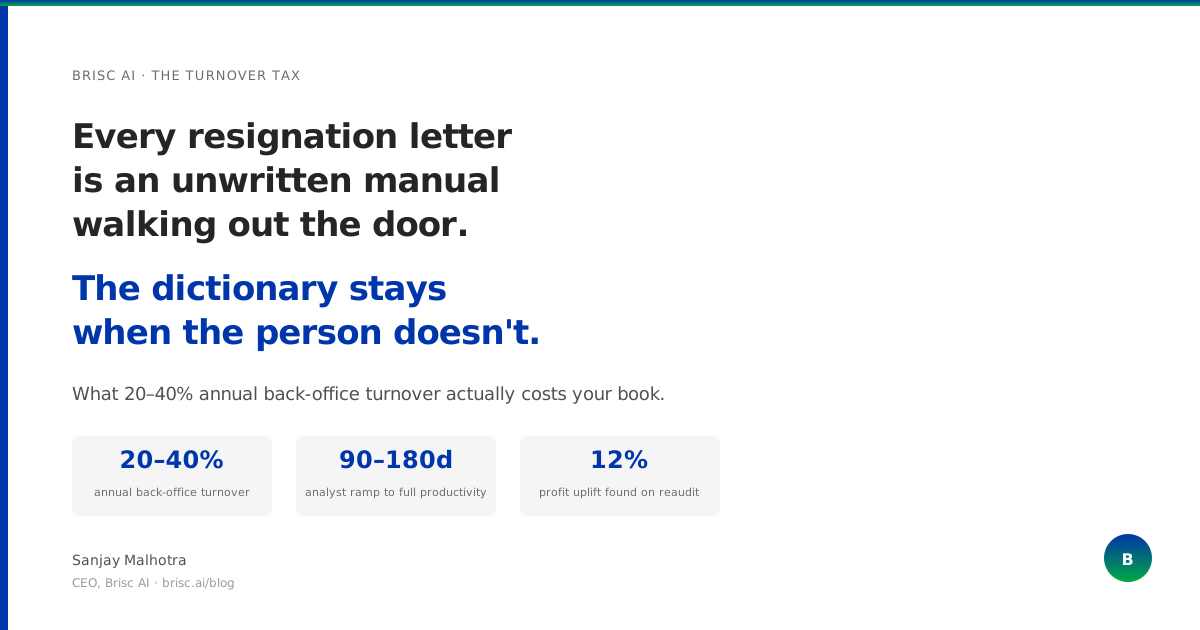
The insurance industry loses 20–40% of its back-office staff annually to turnover, according to industry workforce surveys. For a credit-control or reconciliation desk, each departure doesn’t just cost a recruiting fee. It costs accuracy, for months.
The Institutional Dictionary
Every experienced reconciliation analyst carries an unwritten manual, what we call the institutional dictionary. It is the accumulated knowledge of how each cedant’s documents actually map to correct entries: which broker nets commission before reporting, which cedant’s Q3 profit-commission true-ups arrive two months late in narrative form, which program’s bordereaux understate case reserves until the auditor reconciles them.
This dictionary is not in the policy administration system. It is not in the procedures manual. It is not in the training binder that HR hands the new hire on day one. It lives in the operator’s head, refined over years, and it leaves the company the same day they do.
The analogy that fits is a translation dictionary built one word at a time. Every cedant quirk the operator encounters and solves becomes a new entry. Every broker format change she absorbs becomes a revision. After three years, her dictionary has hundreds of entries, none of them written down, all of them load-bearing. When she resigns, the company doesn’t lose an employee. It loses the dictionary.
And then the next hire starts building it again from scratch.
Three Hidden Costs That Compound
The visible cost of turnover, recruiting fees, the weeks-of-vacancy gap, is the smallest part. The real damage lives in three layers that most CFOs never see itemised.
Cost 1: Ramp Errors
A new cash-matching analyst takes 90 to 180 days to reach the productivity of the person they replaced, based on industry ramp estimates for insurance back-office roles. During that window, they are rebuilding the dictionary by making mistakes. A commission split applied incorrectly doesn’t surface until the quarterly reconciliation. A bordereaux entry misclassified as net-of-tax when it should be gross doesn’t surface until the auditor asks why the cash position is off by tens of thousands.
McKinsey estimates that 30–40% of underwriter and operations time in insurance is consumed by administrative tasks. During the ramp window, that percentage is higher, because the new analyst is spending time on discovery that the predecessor handled from memory.
The ramp-error cost is not the salary of the new hire. It is the salary of the senior people who spend their afternoons correcting downstream effects that wouldn’t have existed if the dictionary hadn’t walked out.
Cost 2: The Discovery Tax
Every cedant quirk the predecessor knew by heart must now be rediscovered. This is not a training problem, you cannot train someone on knowledge that was never documented. It is a discovery problem, paid for in analyst hours and, frequently, in broker frustration.
One MGA we work with traced a $47K discrepancy through three months of broker correspondence before finding the root cause: a format change the previous analyst had absorbed silently. The new analyst didn’t know the format had changed because the previous analyst had never recorded that it had. The discovery cost, investigation hours, broker relationship friction, downstream report corrections, exceeded the annual salary savings the company had gained by not backfilling immediately.
The discovery tax is proportional to the complexity of the book. An MGA with 5 programs and 10 broker relationships loses a small dictionary. An MGA running 38 binder partners across 6 geographies loses an encyclopaedia.
Cost 3: The Permanent Knowledge Gap
Some dictionary entries are never recovered. The predecessor knew that Cedant X’s claim bordereaux always understated case reserves by a predictable margin. The predecessor knew that Broker Y switched column formats every January without notice. The predecessor knew that a specific Lloyd’s syndicate reported profit commission in a way that looked like brokerage if you weren’t paying attention.
When those entries are lost, the organisation doesn’t know they are lost. There is no error message. There is no alert. There is a reconciliation that “looks fine”, until an auditor or a renewal pricing model reveals that the numbers were off by enough to matter. One reinsurance programme audit uncovered a 12% true profitability uplift after correcting classification errors that had accumulated unnoticed for years, as documented in Brisc’s own customer analysis.
Why Turnover Compounds With Growth
The turnover tax would be manageable if the dictionary stayed the same size. It doesn’t.
Every new cedant adds entries. Every new broker relationship adds format quirks. Every new programme adds commission structures, tax jurisdictions, and reporting cadences. An MGA that writes $50M of premium this year and $200M in three years doesn’t have a dictionary four times larger, it has a dictionary that is four times larger and harder to rebuild, because the interactions between programmes create complexity that scales faster than the programme count.
This is why the turnover tax hits growing MGAs hardest. The book is expanding, the dictionary is expanding with it, and the probability of losing the person who carries it is 20–40% in any given year. Growth multiplies the stakes of every departure.
Helix Underwriting Partners reported an 80% reduction in manual labour after deploying Brisc’s Submissions Analyst, not because the system worked faster, but because the system retained every prior decision. New team members inherited a working dictionary rather than building one from nothing.
The Structural Fix
The turnover tax is not a management problem. You cannot solve it with better retention offers, better documentation processes, or better training programmes, not at scale. Those interventions reduce the probability of a departure; they do nothing about the cost when it happens.
The structural fix is moving the dictionary out of human heads and into a system that retains knowledge permanently. Brisc’s Reconciliation Analyst achieves 97%+ accuracy on bordereaux reconciliation because every cedant quirk, every broker format change, and every classification edge case it encounters becomes part of the system’s permanent memory. The next document from that cedant, whether processed by the same analyst or a new hire on day one, is handled with the full context of every prior encounter.
The result is a 59% reduction in labour costs, not because the system replaces people, but because people stop spending their time rebuilding knowledge that should never have been lost.
What Changes on the Desk
When the dictionary lives in the system instead of in a person’s head, two things change immediately.
First, new hires become productive in days rather than months. They are not building a dictionary, they are reviewing the system’s work against a dictionary that already exists. Their ramp is learning to supervise, not learning to do.
Second, departures stop being operational emergencies. The knowledge doesn’t leave. The reconciliation accuracy doesn’t degrade. The quarterly close doesn’t slip. The CFO stops hearing the same sentence every time someone resigns.
The deployment window for Brisc’s Reconciliation Analyst is 2–6 weeks. By the end of that window, the dictionary is accumulating. By the end of the first quarter, it is already more complete than any individual operator’s mental reference, because it absorbs every cedant interaction across the entire team, not just the interactions one person happens to handle.
Common questions
What is the "turnover tax" in insurance operations?
The turnover tax is the total cost of losing institutional knowledge when a back-office operator leaves, not just recruiting and onboarding, but the ramp errors, discovery costs, and permanent knowledge gaps that degrade reconciliation accuracy for months after each departure. In insurance, where back-office turnover runs 20–40% annually, it is one of the largest unpriced operational costs.
How long does it take a new cash-matching analyst to reach full productivity?
Industry estimates put the ramp at 90 to 180 days for a cash-matching or reconciliation analyst, depending on book complexity. During that window, error rates are elevated, senior staff are pulled into corrections, and reconciliation cycle times expand.
Why can't better documentation solve the knowledge-retention problem?
Documentation captures what the organisation already knows it knows. The most valuable dictionary entries, the cedant quirks, the broker format changes, the classification edge cases, are absorbed by experienced operators without being formally recorded. They are not in any procedures manual because nobody recognised them as procedures. They were just things the experienced person "knew."
How does Brisc's Reconciliation Analyst retain institutional knowledge?
Every document the Reconciliation Analyst processes adds to a permanent cedant-specific dictionary. Format quirks, commission structures, tax-jurisdiction rules, and classification patterns are captured at the point of encounter and applied automatically to every subsequent document from the same source. The dictionary compounds across the entire team, not just one operator's desk.
What is the impact on reconciliation accuracy during staff transitions?
Without a permanent dictionary, reconciliation accuracy typically degrades for 3–6 months after a key departure, as the replacement rebuilds context through trial and error. With Brisc's Reconciliation Analyst, accuracy holds at 97%+ regardless of staff changes because the dictionary persists in the system.
How does the turnover tax scale with business growth?
Every new cedant, broker, programme, and jurisdiction adds entries to the dictionary. A growing MGA doesn't just face turnover on a larger team, it faces turnover on a larger, more complex dictionary that is harder and costlier to rebuild each time. The turnover tax compounds with scale.
What is the deployment timeline for Brisc's Reconciliation Analyst?
Deployment takes 2–6 weeks. By the end of the first quarter, the system's dictionary is typically more comprehensive than any single operator's accumulated knowledge, because it captures interactions from every analyst on the team.
How does this differ from traditional reconciliation software?
Traditional reconciliation platforms apply deterministic rules to structured data. They clear the clean items, the 50–60% that arrive in predictable formats, and leave the unstructured remainder to people. Brisc's Reconciliation Analyst handles the unstructured tail by retaining the contextual knowledge that traditional systems cannot store: which cedant's "commission" column means three different things, which broker's format changed in January, which programme's loss reserves need adjustment before they can be posted.