What Counts as 'One Reconciliation'? The Unit Definition That Changes How You Compare Vendors
A CFO I know sat down with two vendor proposals for bordereaux reconciliation software last quarter. Both quoted a “per reconciliation” price. Both looked reasonable on paper. Then her team ran the numbers on the same book, the same twelve-month portfolio, the same broker mix, the same bank feed.
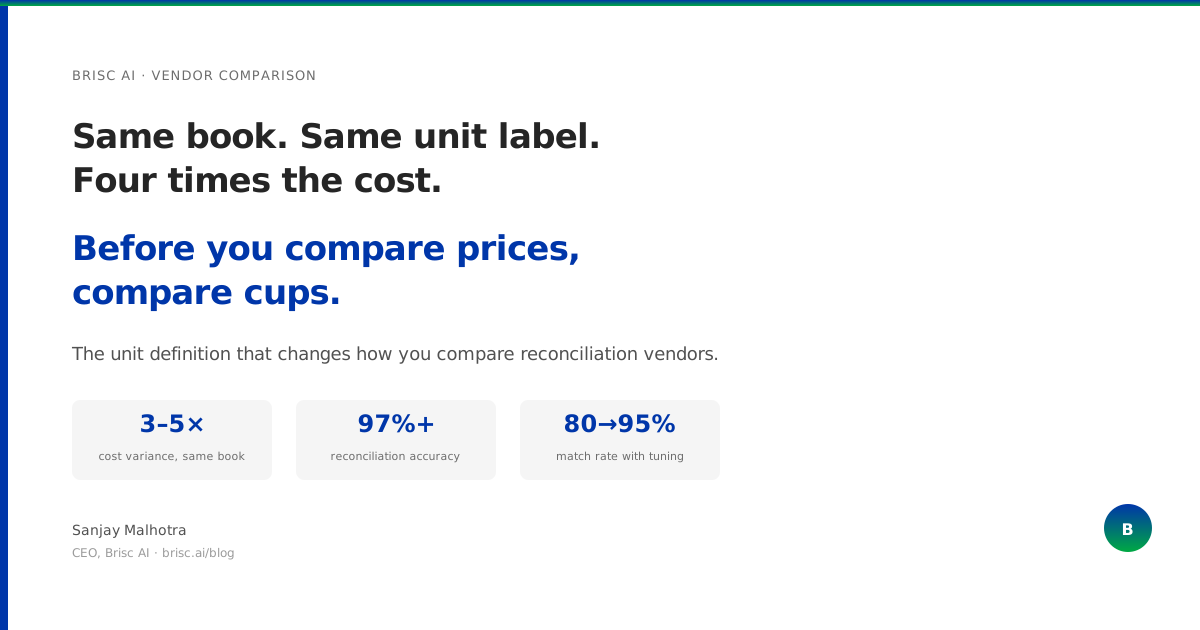
One proposal came back at roughly $50,000 a year. The other came back at over $200,000. Same book. Same unit label. Four times the cost.
The difference was not in the technology. It was in the measuring cup. One vendor defined “one reconciliation” as one bank entry processed. The other defined it as one matched cash-to-contract event, the work of tracing a payment through layers, treaties, and programme structures to the policy it belongs to. The word was the same. The unit was not. And the invoices diverged by a factor of four on identical data.
Brisc AI builds the Reconciliation Analyst, an insurance-native AI system that matches bordereaux to cash with 97%+ accuracy while retaining every broker quirk and format pattern the system has ever encountered. This post is not about choosing Brisc. It is about the unit-definition question that determines whether any vendor comparison you run is meaningful or misleading.
Why the unit matters more than the price
Every reconciliation vendor quotes a per-unit price. The number looks specific. It invites comparison. But the comparison is meaningless if the units are different sizes.
A bank entry is a line on a statement, a wire receipt, a remittance, a deposit. Processing a bank entry means reading it, normalising the reference data, and attempting a match. That is real work, but it is the starting point of reconciliation, not the outcome.
A matched cash-to-contract event is what the CFO actually needs: a payment traced to the policy, layer, or treaty it belongs to, with the evidence attached, the source document, the extracted fields, the classification logic, the confidence score. One bank receipt that resolves across several layers is the high-value case that justifies the software. Counting it as one unit or as seven units changes the arithmetic by an order of magnitude.
The vendor who prices per bank entry charges less per unit but delivers less per unit. The vendor who prices per matched event charges more per unit but delivers the outcome the finance team measures against. Without a shared unit definition, comparing the two is like comparing hotel rooms priced per square foot against hotel rooms priced per night. The number is precise. The comparison is useless.
The three unit definitions you will encounter
In practice, reconciliation vendors use one of three definitions. Each changes what you pay for and what you get.
Per bank entry. The unit is a line on the bank statement. Every entry is processed regardless of whether it matches. The count is high, the per-unit price is low, and the invoice scales with bank volume, which the buyer does not control. A busy month of remittances from twenty brokers produces a large invoice even if every payment matched cleanly.
Per bordereaux line. The unit is a row on the bordereaux file. This penalises complex programmes with high line counts; for example, a cedant sending inception-to-date bordereaux with two thousand lines per quarter generates a large invoice even though the underlying premium may be modest. It also creates a perverse incentive: the vendor charges more when the data is more detailed, which is the opposite of what you want.
Per matched cash-to-contract event. The unit is the outcome, a payment mapped to its corresponding contract, with evidence. One bank receipt that resolves across five layers counts as one reconciliation, not five. The count tracks the complexity of the book, not the volume of inputs. It is the closest per-unit measure of what a reconciliation system actually delivers.
What happens to the records that do not match
The unit-definition question has a companion: do you pay for records that fail to match?
This matters because no reconciliation system matches everything on day one. Brisc AI’s Reconciliation Analyst reaches approximately 80% match rates on day one, climbing to 92 to 95% by about 90 days as the system’s learned-alias store absorbs every broker quirk, reference code pattern, and format variation the book produces. The gap between 80% and 95% is the tuning period, and during that period, a significant share of records are processed, normalised, and flagged as exceptions rather than matched.
The Reconciliation Analyst ingests, normalises, and attempts to match every record across the whole book. An unmatched record costs the same processing as a matched one, and still delivers value: a flagged exception with the source documents attached, the attempted match logic visible, and the reason for the mismatch explained. The team gets a prioritised exception queue, not a pile of unexplained failures.
Brisc prices on the premium you manage, not on matches, so unmatched records cost nothing extra. As match rates climb with tuning, the exception queue shrinks. The team does less manual work for the same fee. The economics improve with time, not against it.
A vendor that charges only for successful matches sounds appealing until you realise what it means: the 20–30% of records that do not match on day one are your problem, not theirs. You pay less, but you also get less, and the records that failed to match are precisely the ones that need the most attention.
How to compare vendors when the units differ
If two vendors use different unit definitions, the only valid comparison is total annual cost on the same book. Ask each vendor to quote against the same twelve-month dataset, the same bank feed, the same bordereaux files, the same broker mix, and compare the resulting invoices, not the per-unit prices.
Three questions cut through the ambiguity:
What is one unit? Get it in writing. A bank entry, a bordereaux line, or a matched cash-to-contract event. If the vendor hesitates to define the unit precisely, the invoice will be the definition, and it will arrive after you have signed.
What happens at layer boundaries? One bank receipt that touches five programme layers under a single treaty: is that one reconciliation or five? The answer changes the invoice by a factor of five on reinsurance books with complex treaty structures.
What do I pay for when nothing matches? The unmatched records are the ones that generate the most downstream work, the exceptions that keep analysts at their desks past close. If the vendor charges nothing for them, ask who resolves them. If the answer is “your team,” the vendor has not automated reconciliation. They have automated the easy part and left you the rest.
The measuring cup, not the price tag
Vendor comparison in insurance reconciliation starts with the unit, not the dollar. The price per reconciliation means nothing until you know what the vendor counts as one. A low per-unit price on a high-count definition produces the same invoice as a higher per-unit price on a definition that measures outcomes. The difference is whether the invoice reflects the work your team actually needed done, or the volume of inputs the system happened to touch.
Brisc AI avoids the unit problem entirely: the Reconciliation Analyst is priced on the premium you manage, not on a count of reconciliations. The matched cash-to-contract event is still what the system delivers, what the finance team measures, what the auditor reviews and what the CFO reports against. One bank receipt that resolves across several layers is the case the system was built for, not a billing multiplier.
Before you compare prices, compare cups.
See how the Reconciliation Analyst works on your data →
Common questions
What does "per reconciliation" actually mean?
There is no industry-standard definition. It can mean per bank entry, per bordereaux line, or per matched cash-to-contract event. The definition changes the cost by 3–5× on the same book. Always ask the vendor to define the unit in writing before comparing proposals.
Does Brisc charge for records that do not match?
No. Brisc does not charge per record at all. The Reconciliation Analyst is priced on the premium you manage, and it processes, normalises and attempts to match every record. Unmatched records still produce a flagged exception with source documents and attempted match logic attached.
How does the cost change as match rates improve?
It does not. Pricing follows the premium you manage, not how many records match. As match rates climb from around 80% on day one to 92 to 95% by about 90 days, the exception queue shrinks and the team does less manual work for the same fee.
What is a matched cash-to-contract event?
A payment traced to the specific policy, layer, or treaty it belongs to, with evidence: the source document, the extracted fields, the classification logic, and the confidence score. This is the outcome the CFO measures against, not an intermediate processing step.
How do I compare vendors with different unit definitions?
Ask each vendor to quote against the same twelve-month dataset, the same bank feed, the same bordereaux files, the same broker mix. Compare the total annual invoices, not the per-unit prices.
What if a vendor only charges for successful matches?
Ask who handles the records that do not match. If the answer is your team, the vendor has automated the portion of reconciliation that was already relatively straightforward. The exceptions, the records that require judgment, context, and institutional knowledge, remain manual.