ADEPT Is Necessary But Not Sufficient: Why the 80% Still Sends PDFs
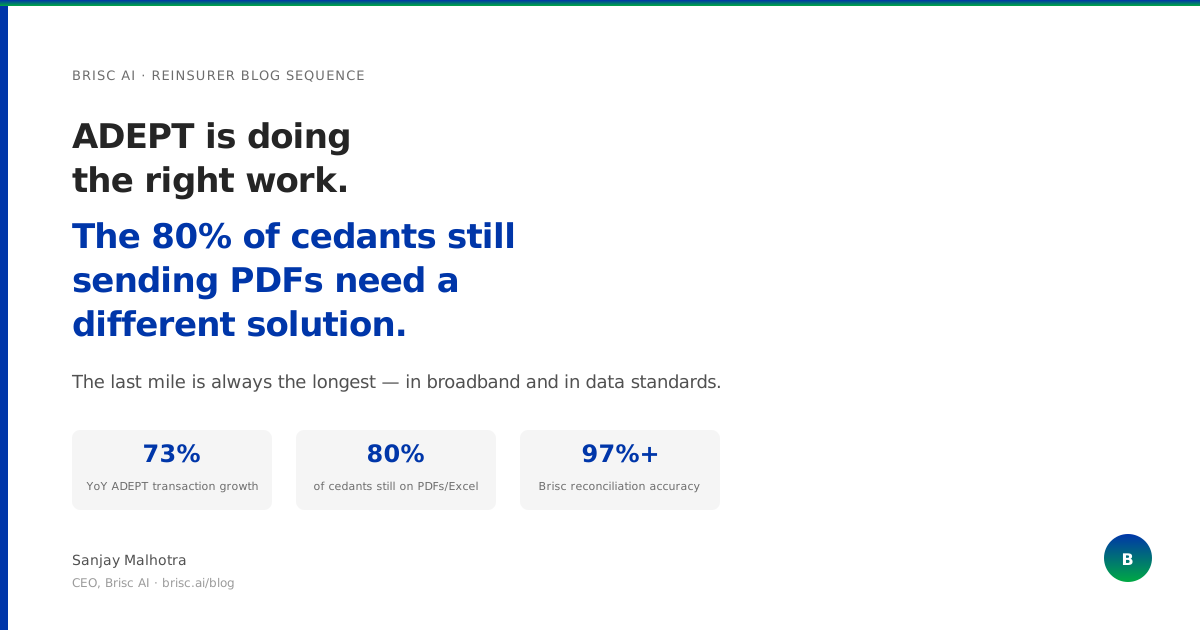
An operations lead at a mid-size reinsurer reads ACORD’s latest press release. Digital reinsurance transactions grew 73% year-over-year from 2024 to 2025. Growth since 2023 exceeds 300%. The North America hub went live in July 2025. Early adopters report an 80% improvement in data quality and a 60% reduction in manual effort.
For a moment, the operations lead feels something close to relief. Maybe the industry is finally building the infrastructure to eliminate manual rekeying. Maybe the flood of unstructured PDFs, inconsistent Excel files, and narrative adjustment letters that consume the cession-accounting desk is about to recede.
Then they open their inbox. Forty-seven bordereaux emails from cedants. Not one in ADEPT format.
ACORD’s Automated Data Exchange Platform & Translator, ADEPT, is the reinsurance industry’s emerging standard for structured digital data exchange between brokers, cedants, and reinsurers. It is real, it is growing, and it is solving a genuine problem. What it is not solving, and cannot solve on its current trajectory, is the last-mile problem: the 80% of cedants who still send PDFs, Excel files, and emails, and who will continue doing so for years.
ADEPT’s Growth Validates the Problem, Not the Solution
ACORD reports that digital reinsurance transactions on ADEPT grew 73% from 2024 to 2025, with aggregate volume exceeding 300% of the 2023 baseline. Participating organizations report an 80% improvement in data quality, a 60% reduction in manual effort, and a 50% reduction in claim-transaction turnaround time. The DXC integration brings ADEPT into the Strategic Information and Cession System, SICS, enabling real-time digital data exchange for reinsurers already on the dominant platform.
These numbers validate what every reinsurer already knows: the manual translation of unstructured documents into structured platform entries is expensive, error-prone, and growing worse as books expand. McKinsey and Accenture estimate that 30-40% of underwriter and operations time in insurance goes to administrative tasks. In cession-accounting teams, that percentage is almost certainly higher, because the translation work is the core of the job, not a distraction from it.
ADEPT’s existence, and its growth, confirms that the industry recognizes the cost and is willing to invest to fix it. That is a validator. It is not, by itself, the fix.
Why the Last Mile Is Always the Longest
Every industry standard follows the same adoption curve. The largest, most sophisticated counterparties adopt first because they process enough volume to justify the investment. The long tail of small and mid-size counterparties follows slowly, if at all.
ADEPT is no exception. The platform requires both sides of a trading relationship to adopt the standard. A reinsurer running SICS can integrate ADEPT on their end. But each cedant on the other side must also invest in ADEPT-compliant systems, data formatting, and workflow changes. For a large global broker managing thousands of treaty placements a year, that investment makes sense. For a small specialty cedant placing three treaties annually, the cost of adopting a new data-exchange standard exceeds the benefit of accommodating one reinsurer’s platform preferences.
This is the last-mile problem. The trunk infrastructure is proven. The benefits for connected participants are documented. Connecting every endpoint, every small cedant in every market, is a different problem entirely. Telecom laid fiber-optic trunk lines in the 1990s; last-mile broadband to individual premises took another decade. The pattern in reinsurance data exchange will be similar. ACORD’s regional hub model, Italy, Spain, Bermuda, North America, reflects this reality. Adoption expands hub by hub, counterparty pair by counterparty pair. It does not flip a switch.
The structural reason is economic. Each cedant’s investment to adopt ADEPT is non-trivial relative to their interest in cooperating with any single reinsurer’s platform. A cedant with three treaty relationships does not have the same return on that investment as a global broker with three thousand. The long tail is not a temporary backlog. It is a permanent feature of a fragmented market.
Transaction Growth Is Not the Same as Counterparty Coverage
The 73% year-over-year growth in digital reinsurance transactions is a meaningful signal. It is also a metric that can obscure as much as it reveals.
Transaction volume growth from a small base tells you that existing adopters are processing more transactions through the standard. It does not tell you how many distinct counterparties are live on ADEPT versus how many are still sending unstructured documents. A single large broker digitizing its full treaty portfolio creates enormous transaction growth without adding a single new counterparty to the network.
The reinsurance administration software market is projected to grow from $7.8 billion in 2025 to $14.2 billion by 2033, reflecting contract complexity and automation pressure across the industry. DXC’s SICS alone serves over 100 reinsurers in 38 countries. Each of those reinsurers manages relationships with dozens to hundreds of cedants. The total counterparty count that ADEPT must reach to eliminate unstructured document handling is not in the tens or the hundreds, it is in the thousands, spread across every market where reinsurance business is written.
Until the counterparty adoption rate matches the transaction growth rate, the 80% remains the 80%.
What the 80% Actually Needs Is a Translator, Not a Standard
The 20% of counterparties who have adopted ADEPT need a standard. They have the scale, the sophistication, and the economic incentive to invest in structured data exchange. ADEPT serves them well, and its coverage of that segment will continue to improve.
The 80% need something different. They need the documents they already produce, PDFs, Excel files, emails with data pasted inline, scanned cover notes, to arrive at the reinsurer’s platform in the correct structured format, without requiring the cedant to change anything about how they report.
That is a translator, not a standard. And the distinction determines your staffing plan.
Brisc AI’s Reinsurance Accounting Analyst reads the unstructured documents cedants send and classifies every field into the reinsurer’s specific entry codes using a per-customer dictionary that accumulates institutional knowledge with every interaction. The first bordereaux from a new cedant gets reviewed by the operator. The dictionary learns the cedant’s format, column conventions, and reporting quirks. By the tenth interaction, Brisc handles that cedant without human review. By the fiftieth, the dictionary has absorbed every variation that cedant has ever produced.
Brisc AI maintains 97%+ accuracy on bordereaux reconciliation, verified across production deployments. Because the Analyst handles the routine work and the team keeps the judgment calls, Brisc customers report a 59% labour cost reduction. On submission intake, Helix Underwriting Partners reports about an 80% reduction in manual work. Deployments are live in 2-6 weeks.
The structural difference: ADEPT requires both sides of the relationship to invest. Brisc requires only the reinsurer. The cedant keeps sending what they have always sent. The reinsurer’s platform receives what it has always expected. The gap between the two, the gap that fills your cession-accounting desk with rekeying work, is closed by the Reconciliation Analyst, not by waiting for the last mile to be paved.
The Complementary Frame
ADEPT and Brisc are not competing solutions. They address different segments of the same problem along different timelines.
ADEPT for the 20% of counterparties who have digitized their data exchange. Brisc for the 80% who still send PDFs and Excel.
As ADEPT’s adoption grows, and it will grow, the 20% will become 25%, then 30%. That trajectory plays out over years, not quarters. In the meantime, the 80% is where the translation cost lives, where the operator hours accumulate, where institutional knowledge leaks when staff turn over, and where errors compound into next quarter’s reconciliation problems.
A reinsurer running Brisc alongside ADEPT covers the full counterparty base, the structured minority through the standard, and the unstructured majority through the translator. One does not replace the other. Together, they eliminate the manual desk entirely.
For a detailed walkthrough of the six core SICS entry categories that consume most of a cession-accounting desk’s time, see Six SICS Entries Your Team Translates by Hand Every Day. For the cost analysis of the human translator desk that bridges unstructured documents to SICS, see Why SICS Doesn’t Eat PDFs (And What That Costs You).
What to Do Next
ADEPT is building the right infrastructure for the reinsurance industry’s structured future. That future is real, and it is arriving, counterparty pair by counterparty pair, regional hub by regional hub.
Your cedants’ PDFs are arriving today.
The 80% of your counterparty base that sends unstructured documents is not waiting for a standard. They need a translator, one that retains every cedant’s reporting quirks, accumulates institutional knowledge across your full book, and delivers structured platform-ready data without requiring the cedant to change anything.
See how Brisc handles bordereaux automation →
Common questions
What is ACORD ADEPT?
ACORD's Automated Data Exchange Platform & Translator is the reinsurance industry's emerging standard for structured digital data exchange. Built in collaboration with the world's largest reinsurers and brokers, ADEPT handles treaty placement, submission, quote, order, signed line, and document exchange between brokers and reinsurers. Regional hubs operate in Italy, Spain, Bermuda, and North America.
Does Brisc compete with ADEPT?
No. ADEPT solves the structured data-exchange problem for cedants who have adopted the standard, roughly 20% of most reinsurers' cedant base today. Brisc handles the other 80% who still send PDFs, Excel, and email. The two are complementary: ADEPT for the digitized minority, Brisc for the unstructured majority.
If ADEPT is growing 73% year-over-year, won't it eventually cover all cedants?
Transaction volume is growing at 73% year-over-year from 2024 to 2025. Counterparty adoption is a different metric. Each new cedant joining ADEPT requires investment in structured data exchange, systems, formatting, workflow changes. Large brokers adopt quickly because volume justifies the cost. Small and mid-size cedants face a different cost-benefit equation. Full counterparty coverage is a multi-year trajectory, not a near-term event.
Can Brisc output ADEPT-format messages?
Brisc's architecture processes unstructured documents into structured, platform-specific output. ADEPT-format output is a natural extension of that architecture, turning unstructured cedant documents into ADEPT-compliant structured data. This positions Brisc as a potential on-ramp to ADEPT for reinsurers whose cedants have not yet adopted the standard.
Is this only relevant to SICS reinsurers?
No. The unstructured-to-structured gap exists on every reinsurance administration platform, SICS, Sapiens ReinsuranceMaster, Verisk Sequel, in-house systems. Brisc's engine is platform-agnostic; the entry-code dictionary and output template change per platform. ADEPT's integration with SICS is the most visible example, but the complementary positioning applies across the market.
How accurate is Brisc compared to a human operator?
Brisc AI maintains 97%+ accuracy on bordereaux reconciliation, verified across production deployments. That accuracy holds on the first document of the day and the thousandth, regardless of volume or fatigue. Human operators' accuracy degrades with volume, with format complexity, and with the departure of experienced staff who carry institutional knowledge. Brisc's dictionary retains that knowledge permanently.
What does deployment look like?
Brisc deployments are typically live in 2-6 weeks. The variable is the number of cedant dictionaries to configure at launch. Each subsequent cedant onboarded is faster than the last as the dictionary accumulates shared patterns. Most reinsurers start with their highest-volume cedants and expand from there.
How does Brisc handle cedants that change their reporting format?
Format drift, when a cedant changes column definitions or reporting conventions without notice, is one of the highest-cost problems on a cession-accounting desk. Brisc detects format changes automatically, flags them for review, and updates the dictionary once the operator confirms the new pattern. The next occurrence processes without intervention.