Reinsurance Bordereaux Automation: 7 Questions to Ask Before You Buy
Every vendor demo looks the same. A clean PDF arrives. The system extracts the fields. The entry codes populate. The operator smiles. Total time: forty-five seconds. Standing ovation.
Then you go back to your production floor. A cedant in São Paulo sends a quarterly Excel file with merged cells and a column layout that changed sometime in Q4 without telling anyone. A London broker forwards a PDF that’s actually a scan of a fax, and the commission split doesn’t match the treaty terms because they’re netting an enduring deduction your platform doesn’t know about yet. Your senior operator handles both in twenty minutes because she’s seen these patterns before. Your admin platform handles neither, because it was built for structured data that arrives in the format it expects.
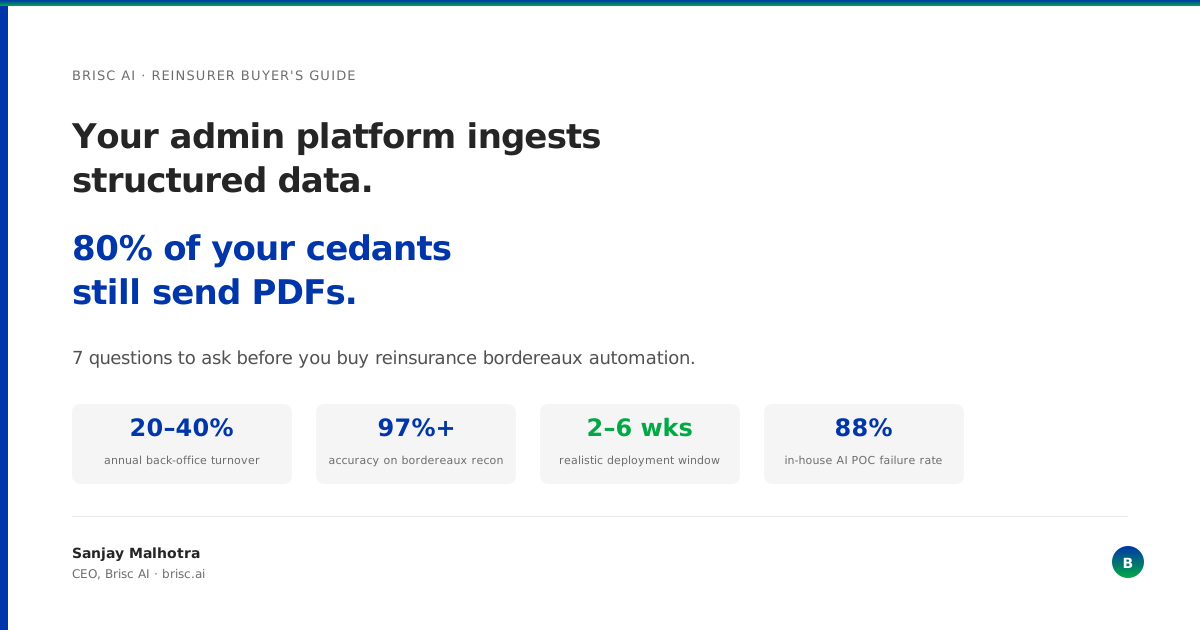
Reinsurance bordereaux automation, the category of software that bridges the gap between unstructured cedant documents and your administration platform, is growing because the problem is growing: cedant formats are proliferating, staff turnover runs at 20–40% annually across insurance back-offices, and every reinsurance admin platform, whether DXC’s SICS, Sapiens ReinsuranceMaster, Verisk Sequel, or a bespoke in-house system, ingests structured data well but handles the unstructured 80% poorly or not at all.
The gap between the demo room and the production floor is where most evaluations fail. These seven questions are designed to close it.
1. Does it understand your admin platform’s data model, or does it treat every reinsurer the same?
Reinsurance administration platforms use proprietary entry codes, schemas, and upload formats. DXC’s SICS structures transactions around codes like 100 (Written Premium), 200 (Commission), 240 (Brokerage), and 300 (Paid Loss), proprietary to DXC, not industry standard. Sapiens ReinsuranceMaster uses a different schema entirely. Verisk Sequel uses its own. In-house systems at firms like Swiss Re and Munich Re run bespoke data models built over decades.
What good looks like: The vendor can name your platform, explain how their system maps extracted fields to your specific entry codes, and show you the dictionary they’ve built for your platform. The dictionary is a configuration artifact, not a custom development project.
Red flag: The vendor talks about “universal” or “platform-agnostic” ingestion without addressing how extracted data lands in your system’s native format. Extraction without classification into your platform’s schema is half the job at best, the operator still has to rekey the output.
2. Can it ingest the full range of formats your cedants actually send?
Roughly 80% of cedants still send bordereaux as PDFs, Excel spreadsheets, or email attachments rather than through structured data-exchange standards like ACORD’s ADEPT platform. ADEPT adoption is growing, 73% year-over-year transaction growth according to ACORD, but the long tail of mid-size and regional cedants who send PDFs will persist for years. A system that only handles structured inputs ignores the majority of your volume.
What good looks like: The vendor demonstrates ingestion of the messiest real-world formats, scanned PDFs, multi-sheet Excel files with merged cells, email-body bordereaux, portal downloads in inconsistent layouts, not just a clean sample file. Ask to run a test on three actual cedant documents from your current queue.
Red flag: The demo uses a single clean PDF. Your production floor doesn’t look like that, and the vendor knows it.
3. How does it handle per-treaty rule variations?
Treaty accounting is where reinsurance bordereaux complexity lives. Gross-up versus share basis. Commission netting across multiple intermediaries. Enduring deductions that carry forward across periods. Partial applicability rules. Exclusion clauses that change how premium is allocated within a single bordereaux. Each of these creates a classification decision the system must make correctly, not just once, but consistently across every quarterly cycle for the life of the treaty.
What good looks like: The vendor walks you through a treaty with at least three rule variations and shows how the system classifies each without manual intervention. Ask specifically about enduring deductions and partial applicability, these are where most automated systems break down and push exceptions back to the operator.
Red flag: The vendor treats every treaty the same way, or can only demonstrate clean proportional treaties. Reinsurance accounting requires per-treaty configuration, not one-size-fits-all processing.
4. What happens when you onboard a new cedant?
A reinsurer processing 3,000 bordereaux per year across 400-plus contracts is not a static environment. New cedants arrive. Existing cedants change formats, broker reports silently alter column definitions month over month. The system needs to absorb new patterns without a development cycle every time.
What good looks like: Onboarding a new cedant is a configuration task measured in days, not a custom build measured in months. The vendor shows you how their system learns a new cedant’s format quirks and retains them permanently, so the next bordereaux from that cedant processes without the same learning curve. Brisc AI calls this approach “configuration, not code”: the engine is shared, and per-cedant dictionaries are configured and maintained as institutional assets.
Red flag: Each new cedant requires a professional-services engagement, a new connector, or “training” that sounds suspiciously like a development sprint. At 400-plus contracts, that model doesn’t scale.
5. Where does the institutional knowledge live when your senior operator leaves?
Insurance back-offices lose 20–40% of their staff annually. The ramp time for a replacement, someone who understands every cedant’s quirks, every treaty’s exception patterns, every broker’s formatting habits, runs 90 to 180 days in reinsurance operations. When your best SICS operator resigns, what leaves with them is not a procedures manual. It is the accumulated judgment of thousands of edge cases, stored in their memory and nowhere else.
What good looks like: The system retains every classification decision, every exception resolution, every cedant-specific pattern, permanently. Institutional knowledge becomes a system asset, not a person-dependent liability. The 97%+ accuracy Brisc AI achieves on bordereaux reconciliation is a direct consequence of this retained knowledge: the system compounds accuracy over time because it never forgets a pattern it has seen before.
Red flag: The vendor’s accuracy depends on the operator’s expertise. If switching operators degrades output quality, the system hasn’t solved the knowledge-retention problem, it has outsourced it to a person who will eventually leave.
6. Does it produce an audit trail automatically, or is that reconstructed after the fact?
Regulatory scrutiny of reinsurance operations is increasing. Auditors and regulators expect to trace every financial entry back to its source document, through the extraction logic, through the classification decision, to the final entry in the admin platform. In one reinsurance audit, a systematic review of bordereaux classification accuracy uncovered a 12% true profitability uplift, discrepancies that had compounded undetected across multiple quarters.
What good looks like: The system captures a complete lineage, source document, extracted fields, classification rationale, confidence score, human review decision (if any), and final output, continuously, not as a quarter-end reconstruction exercise. Every entry is traceable at any moment a CFO or auditor asks.
Red flag: The vendor talks about “auditability” but the audit trail is assembled retrospectively from logs. Reconstructed audit trails are what your team already does manually. That’s the problem, not the solution.
7. What’s the realistic time-to-first-value, and what does “value” mean in your context?
Beware the vendor who claims twenty-four-hour deployment. That is a demo, not a deployment. Equally, beware the vendor whose implementation timeline stretches past six months, that is a custom build, not a product.
What good looks like: A realistic deployment window of 2–6 weeks, with value defined as accurate, auditable output landing in your admin platform, not as processing speed. The right question is not “how fast does it process a bordereaux?” but “how accurate is the output on day thirty, and does that accuracy hold at day ninety?” Brisc AI’s Reconciliation Analyst achieves 97%+ accuracy on bordereaux reconciliation within the deployment window, and that accuracy improves over time as the system encounters and retains more cedant-specific patterns.
Red flag: The vendor leads with speed metrics, “processes bordereaux in sixty seconds”, without addressing accuracy at scale or knowledge retention across cycles. Speed without accuracy is worse than slow-and-right in reinsurance operations, where a misclassified entry today becomes a reconciliation problem next quarter.
The comparison criteria at a glance
| Question | What good looks like | Red flag |
|---|---|---|
| Platform data model | Knows your entry codes by name | ”Universal” ingestion with no platform mapping |
| Format coverage | Demos on your actual messiest documents | Single clean PDF demo |
| Per-treaty rules | Handles enduring deductions, partial applicability | One-size-fits-all treaty processing |
| New cedant onboarding | Configuration in days, not a build in months | Professional-services engagement per cedant |
| Knowledge retention | System retains all patterns permanently | Accuracy depends on operator expertise |
| Audit trail | Continuous, automatic, traceable | Reconstructed retrospectively from logs |
| Time-to-value | 2–6 weeks; value = accuracy, not speed | 24-hour deployment or 6+ month build |
See it on your own cedant statements
Send a few real cedant statements, redacted is fine, and watch the Reinsurance Accounting Analyst classify them into your entry codes in a working session. Book a demo.
Common questions
What is reinsurance bordereaux automation?
Reinsurance bordereaux automation is software that bridges the gap between unstructured cedant documents, PDFs, Excel spreadsheets, emails, and a reinsurer's administration platform such as DXC's SICS, Sapiens ReinsuranceMaster, or Verisk Sequel. The system extracts data from these documents, classifies each field into the platform's native entry codes, and outputs files the platform can ingest, replacing the manual rekeying work that operations teams do today.
How is this different from general document processing or IDP?
General intelligent document processing handles extraction, pulling fields from a PDF. Reinsurance bordereaux automation adds classification into platform-specific entry codes, per-treaty rule handling (gross-up vs. share basis, commission netting, enduring deductions), and output in the admin platform's native upload format. Extraction without classification leaves the operator doing the hardest part of the job manually.
Does ACORD ADEPT make bordereaux automation unnecessary?
ACORD's ADEPT platform handles structured data exchange for the roughly 20% of counterparties that have adopted the standard. ADEPT transaction volumes are growing at 73% year-over-year according to ACORD. For the remaining 80% of cedants who still send PDFs, Excel, and email, bordereaux automation is the solution. The two are complementary: ADEPT for the structured minority, automation for the unstructured majority.
What platforms does bordereaux automation work with?
Insurance-native bordereaux automation works across any reinsurance administration platform, DXC's SICS (used by 100-plus reinsurers in 38 countries), Sapiens ReinsuranceMaster, Verisk Sequel, or bespoke in-house systems. The extraction engine is shared; the per-platform dictionaries and output templates are configured per customer. Brisc AI's architecture is explicitly "engine plus N dictionaries plus N templates."
How long does deployment take?
Realistic deployment for a production-grade reinsurance bordereaux automation system is 2–6 weeks. Faster claims typically describe a demo or pilot, not production deployment. Longer timelines, six months or more, indicate a custom build rather than a configured product.
What accuracy should a buyer expect?
Brisc AI achieves 97%+ accuracy on bordereaux reconciliation, and that accuracy improves over time as the system retains cedant-specific patterns. The critical test is not initial accuracy on clean documents but sustained accuracy across cedant format drift, treaty changes, and new counterparty onboarding, the conditions of your production floor, not your demo room.
What does bordereaux automation cost a reinsurer?
Total cost of ownership should be evaluated against the labour it displaces. A mid-size reinsurer processing 3,000 bordereaux per year across 400-plus contracts carries a substantial onshore and outsourced labour cost for bordereaux breakout. Because the Analyst handles the routine work while the team keeps the judgment calls, Brisc customers report a 59% labour cost reduction, with institutional knowledge retained in the system rather than lost to turnover.
Can a reinsurer build this in-house instead of buying?
Industry data from IDC shows an 88% failure rate for AI proof-of-concept projects. In-house builds face the same extraction challenge as commercial vendors, plus the additional burden of building and maintaining per-platform dictionaries, per-treaty rule logic, and the institutional-knowledge layer that compounds accuracy over time. Most reinsurers that attempt an in-house build discover the maintenance cost exceeds the software cost within eighteen months.