Unallocated Cash in Reinsurance Is a Lineage Problem
The controller had been in the job a few weeks when she shared her screen with us. On it was the receivables ageing from her reinsurance accounting system, and one line in it read: unallocated cash, eight figures.
She wasn’t asking us to make that number smaller. She was asking something more basic. Pick one payment, she said, and show me how it got here. Which remittance advice it came from, when it was recorded, when it was allocated, and who decided which treaty layer it belonged to.
Nobody in the building could tell her. Not because the team was careless, but because the answer was spread across five places and none of them kept the whole story.
Her standard was simple. She would not build on a number she could not reconcile, even roughly. First she needed to see how the money flowed.
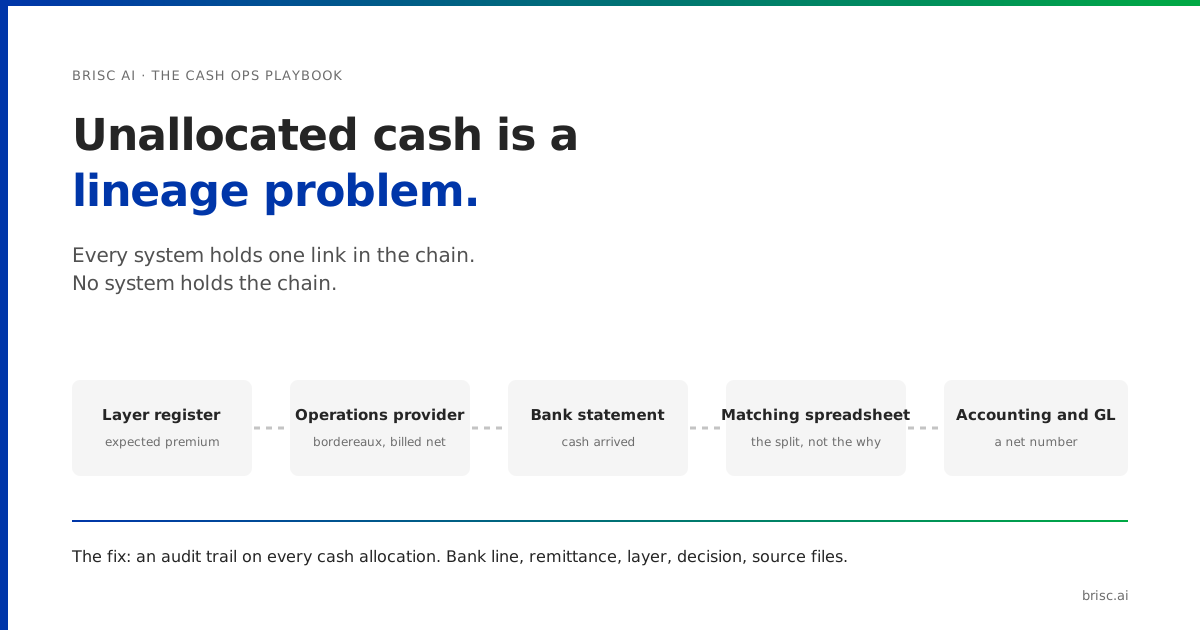
Unallocated cash in reinsurance is premium that has reached the bank but hasn’t been tied to the contract, layer and instalment it pays. The usual diagnosis is a capacity problem: too much cash, too few people to match it. After a year of matching reinsurance cash with Brisc AI’s Reconciliation Analyst, our diagnosis is different. Unallocated cash is a lineage problem. Every system holds one link in the chain, and no system holds the chain.
Why does unallocated cash keep growing even after a clean-up?
Unallocated cash grows back after a clean-up because the clean-up fixes the balance, not the process that produced it. If allocations are still made in a spreadsheet and loaded into the ledger as net totals, every new payment arrives without its history. The balance rebuilds at the same rate it was cleared.
The scale is not small. Published clean-up case studies from the London market describe a medium-sized global insurer struggling to pass audits with US$60 million of unallocated premium after an acquisition, and a second re/insurer that had built up more than $80 million of booked premium it needed to allocate.
The detail in those clean-ups tells you what was actually missing. In one, an overseas portfolio’s premium variance came down from $40 million to $500,000 once the team built mappings between the different systems so every balance could be traced back to its origin. In other words, the fix was rebuilding lineage after the fact.
The analogy we use with customers is a chain of custody. An evidence locker doesn’t just hold the evidence. It logs every hand that touched it, when, and why. Lose one entry in that log and the evidence is worthless, however carefully it was stored. Reinsurance cash is held carefully at every step. It is logged at almost none of them.
Which systems does one reinsurance payment pass through?
One reinsurance premium payment typically passes through five systems between the bank and the general ledger, and each one records a different fact about it. None records how those facts connect. Here is the relay at the reinsurer we were working with, described by role:
| Step | System (by role) | What it knows | What it drops |
|---|---|---|---|
| 1 | Policy admin and layer register | The expected premium for each layer | How many instalments, and when |
| 2 | Outsourced reinsurance operations provider | The bordereaux and the broker-billed net per layer | Which bank receipt settled which bordereau |
| 3 | Bank statement | That cash arrived, and how much | What it was for |
| 4 | The cash-matching spreadsheet | Which layers a receipt was split across | Who decided, when, and on what evidence |
| 5 | Reinsurance accounting system, then GL | Net cash received per layer, loaded quarterly | Everything above |
By the time a payment reaches the ageing report, it is a net number in a “cash received” column. The controller could see a layer expecting four instalments totalling a net amount, with two of them due. She could see cash received running about 45% above that schedule. She could not see which receipts made up the figure, so she could not tell an overpayment from a misallocation.
Why can’t a new controller trace a payment from bank to layer?
A new controller can’t trace a payment because the trail lives in people, not in records. The person who does the matching knows why a receipt was split across five layers. The spreadsheet records only the split. When the controller asks why, the answer has to be reconstructed from memory, if the person is still there.
That is where institutional knowledge leaks out. The controller in our story was new, which is exactly when lineage matters most. Every successor, auditor and acquirer asks the same question she did, and every one of them gets a reconstruction instead of a record.
It also hides data errors. On the same call, a filter on one cedent returned that cedent against almost every layer in her ledger extract. In Brisc, the same cedent had four layers. Somewhere between the spreadsheet and the ledger, a mapping had gone wrong, and it had quietly distorted the whole report. Without lineage, one bad mapping and genuine unallocated cash look identical.
Isn’t a ledger the audit trail?
A ledger is not an audit trail if people keep it by hand. A ledger records the outcome: this receipt went to these layers, in these amounts. An audit trail records the decision, meaning the evidence it rested on, who made it, and when. A hand-kept ledger, usually a spreadsheet in practice, captures the first and loses the second.
We hear the objection often, most recently from a reinsurance intermediary that sits in the cash flow between cedants and their markets. They have a ledger, so the cash is accounted for. Then you look at how the ledger is kept. Someone reads the bank statement, opens the remittance advice and types a row. The row keeps the amount but not the bank line, the remittance or the reasoning. A cell can be overwritten with no record of the old value. A wrong split looks the same as a right one.
That is bookkeeping, and it matters, but nobody can audit it. An auditor sampling that ledger has to rebuild every row from the bank statement and the remittance, which is the work the ledger was supposed to save. Moving the same rows into a better system of record doesn’t fix it either. If they arrive as typed totals, the lineage is still gone before the system ever sees them.
The test is simple. Pick any row in your ledger and ask whether it can show you its bank line, its remittance and who approved it, without asking anyone. If it can’t, you have a ledger and no audit trail, and the lineage problem is still there.
Does outsourcing bordereaux or technical accounting reduce unallocated cash?
Outsourcing reinsurance operations improves the work but doesn’t, by itself, connect the chain. A good operations provider runs bordereaux processing with discipline and hands finance a clean output. But that output is one more link that finance receives as a finished number, with its own lineage inside someone else’s systems.
That is not a criticism of outsourcing. The reinsurer in our story relies on its provider’s billing breakdown as the best source of premium movement it has. The point is narrower: when work moves across a company boundary, the record of how a number was built has to cross with it, or finance ends up taking it on trust.
What should an audit trail for each cash allocation record?
An audit trail for a cash allocation should let anyone rebuild the decision without asking the person who made it. That takes five fields per allocation, kept together:
- The bank line. The receipt, its date and amount, and the statement it came from.
- The remittance advice. The broker’s breakdown that explains the receipt.
- The layer and instalment. Which contract layer it settles, and which instalment, such as “one of two instalments of this layer’s share of net premium.”
- The decision. Which rule or person matched it, who approved it, and when.
- The source files. The original statement and advice, retrievable from the allocation itself.
This is what Brisc keeps for every match. On the call we mentioned above, Brisc’s Head of Onboarding opened the controller’s problem layer and showed the payment that settled it, the date it arrived, the remittance it matched, and both source files, downloadable in one click. Brisc’s Reconciliation Analyst delivers 97%+ output accuracy, and every match carries its evidence. Match rates start at about 80% on day one and rise to 92 to 95% by about 90 days, and every exception goes to a person, not a guess.
How do you trace one payment end to end? A one-layer exercise
The fastest way to see your own lineage gap is to trace five layers yourself. The controller proposed this exercise, and it’s the best diagnostic we know. It takes an afternoon and needs no new software.
- Pick five layers that puzzle you. Include an excess of loss treaty, a quota share, one prior-year layer, one current-year layer and one in a non-dollar currency.
- Start at the ageing report. Note the expected, received and outstanding amounts for each layer.
- Walk back to the bank. For each receipt in “cash received”, find the bank line and the remittance advice.
- Record every hand-off. Who touched it, in which system, on what date.
- Tie the period out. Allocated cash plus unallocated cash for the period should equal total movement on the bank statements.
Every step where you have to ask a person instead of reading a record is a break in the chain. In our experience, most reinsurers find the first break at step three.
How do you reduce unallocated cash without adding headcount?
You reduce unallocated cash without adding headcount by making every new allocation carry its own lineage, so the balance stops rebuilding. Clearing the backlog is a project. Stopping it from coming back is a process, and it doesn’t scale with people, because each additional matcher adds another memory the controller has to interview.
Brisc customers go live in 2 to 6 weeks, working from the bank statements, remittance advices and layer listing they already have. Brisc is on track to reconcile about $1 billion of premium a year at our current run rate. The control comes from the chain of custody, not from extra reviewers.
The controller ended our call by asking for a working session to follow the money, one layer at a time. That is the right instinct. Unallocated cash is what a cash process looks like when nobody logged the hand-offs. Log them, and the number explains itself.
Related reading: Reinsurers: The Three Buckets of Cash You Can’t Yet See and Your Reconciliation Process Is the Audit Finding.
Send us five layers you can’t trace. We’ll walk through them with you, from bank line to layer. Book a working session.
Common questions
What is unallocated cash in reinsurance?
Unallocated cash in reinsurance is premium received in the bank that has not yet been matched to the contract, layer and instalment it pays. It is often held in a premium suspense account. It overstates receivables on one side and understates allocated premium on the other until it is resolved.
What is the difference between unallocated cash and unapplied cash?
Unallocated cash and unapplied cash describe the same condition from different angles: cash received but not tied to the obligation it settles. Reinsurance teams more often say "unallocated" because allocation runs at the level of contract layers and instalments, not invoices.
Why does unallocated premium matter to auditors?
Unallocated premium matters to auditors because it signals that cash and technical accounting can't be reconciled from records alone. One published clean-up case describes a US$60 million unallocated balance at a company struggling to pass audits. An auditor wants to see how a balance was built, not just the balance.
We already keep a cash ledger. Isn't that enough?
A ledger is enough to know the balance, but not to prove how it was built. If the ledger is kept by hand, each row records the outcome of an allocation but not the bank line, remittance and approval behind it. Auditors and successors then have to rebuild every row from source documents.
Does Brisc replace our reinsurance accounting system or our operations provider?
No. Brisc's Reconciliation Analyst sits alongside the policy admin system, the operations provider and the accounting system. It matches bank statements, remittance advices and the layer register, and keeps the evidence for each match. It holds no write access to your systems, and nothing is applied without one of your team approving it.
Can the matching run in parallel with our existing process?
Yes, and that is how most reinsurers start. Run Brisc's matches side by side with the spreadsheet for a period and investigate every difference. Where Brisc and the team disagree, the evidence trail shows which one is right.
How long does it take to go live?
Brisc customers go live in 2 to 6 weeks, using files they already produce. No integration with the policy admin system is required to start.
References
- London-market insurance services firm. "Unallocated Cash in Insurance: Scenarios 1 & 2." 2021. https://pro-global.com/wp-content/uploads/2021/02/Pro-Unallocated-Cash-sceanrios_1-2.pdf (accessed 2026-10-15).
- London-market insurance services firm. "Millions in unallocated premium sitting on re/insurers' books." May 20, 2021. https://pro-global.com/millions-in-unallocated-premium-sitting-on-re-insurers-books/ (accessed 2026-10-15).
- Brisc AI, first-hand: the one-layer trace, the cedent mapping error and the five-system relay are from a Brisc customer working session, October 2026, anonymised.
- Brisc AI production figures: 97%+ output accuracy with evidence on every match; match rates of about 80% on day one rising to 92 to 95% by about 90 days; live in 2 to 6 weeks; on track for about $1 billion of premium a year at the current run rate.