How Long Should You Run AI Reconciliation in Parallel?
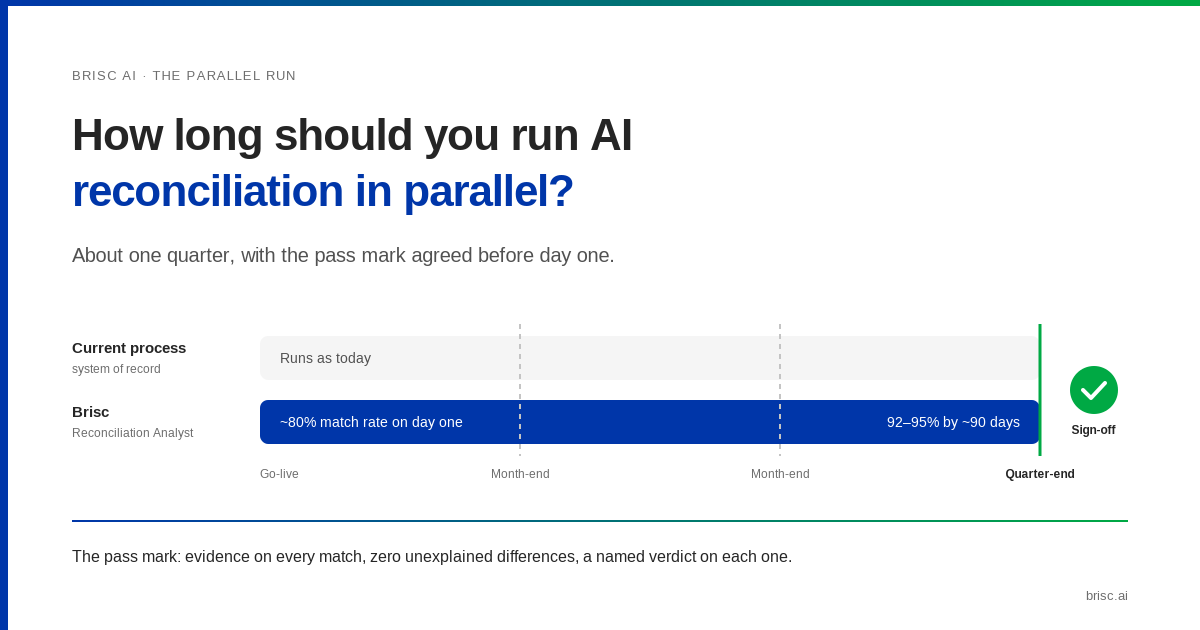
Run AI reconciliation in parallel for about one quarter, and agree the pass mark before you start. A quarter covers several month-ends and a quarter-end, and it is roughly how long Brisc’s match rates take to climb from about 80% on day one to 92 to 95%. Judge the run on evidence: every difference between the old process and the new one gets investigated, and the evidence shows which side was right.
Brisc is insurance-native AI for the insurance back office. Its Reconciliation Analyst matches bank receipts and remittances to premium with rule-based matching, and attaches the evidence for every match. This guide is written from the controller’s side of the table: how to design the run, what counts as a pass, and who signs.
Why do finance teams insist on a parallel run?
Because the people who own the numbers will not trust a new matcher until it has been checked against the one they already know. That instinct is right. A finance lead told us, in effect, that as an accountant she would run both processes side by side for three months, and if the new one held up she would believe its data.
The failure is not the parallel run. The failure is running one with no agreed pass mark. Three months pass, the team has a feeling that the new system is “mostly fine”, and nobody can say what would have made it a fail. Think of a driving test rather than a learner’s permit. You agree the route and what counts as a fail before the car moves, and the examiner signs at the end.
What pass mark should you agree before you start?
Write down four or five measures a controller can sign, before day one. None of them should be about speed. A workable set looks like this:
- Evidence on every match. Every matched item carries the remittance, the bank line and the rule that linked them, so a reviewer can open any row and see why.
- Zero unexplained differences. Every item where the old and new processes disagree has a recorded explanation by the end of the run.
- A verdict on each difference. For every disagreement, a named person records which side was right and why.
- Exceptions go to a person. Items the rules cannot resolve are queued for a human with the reasoning attached, not guessed at.
- Aged unallocated cash, month by month. The balance of cash sitting unallocated at each month-end should fall, not drift.
Keep the match rate out of the pass mark as a single headline. A match rate tells you how much the system did. It does not tell you whether what it did was right. Brisc reports the two separately: 97%+ output accuracy with evidence on every match, and a match rate that starts at about 80% and rises to 92 to 95% by about 90 days as the system learns your brokers, payers and formats.
How long is long enough?
About one quarter. Shorter runs miss the events that expose a reconciliation process: month-end cut-offs, quarter-end true-ups, a broker who changes a remittance layout, a payer who starts using a new name. A run that never sees a quarter-end has not been tested on the day it matters most.
Longer than a quarter is rarely worth it. After one full quarter with the pass mark holding, extra months add cost, because your team keeps doing the work twice, without adding evidence. Brisc goes live in 2 to 6 weeks, so a team that starts the parallel run on go-live can be ready to decide inside two to three months of signing. For what the system itself does across those weeks, see the first 90 days of a Reconciliation Analyst deployment.
Who should judge the run, and what do they need to see?
The people who will own the numbers afterwards, which usually means accountants, and often the contract or interim accountants who run month-end. They read for evidence and control, not for headcount savings, so write the run for them.
What they need is lineage on every row: what the system proposed, what a person chose, who approved it, when, which rule or alias fired, and a click-through to the source document behind each value, exportable for the auditor. Brisc keeps exactly that, and the accuracy and audit page shows what the trail contains. If a reviewer cannot answer “why was this matched?” from the row itself, the run is not producing the evidence it exists to produce. The same lineage is what regulators and auditors look for, as covered in why your reconciliation process is the audit finding.
What do you do when the two processes disagree?
Investigate every difference, and let the evidence settle it. Where the old process and the new one disagree, the trail shows which is right. Sometimes the new matcher is correct and the old spreadsheet carried a long-standing mistake. Sometimes the old process knew something the rules did not, and that becomes a lesson for the system.
Two rules keep the run honest. Nothing is guessed: an item the rules cannot resolve waits in an exception queue for a person, with its reasoning and source documents attached. And nothing is silently corrected: a changed outcome has to appear in the trail with a reason. Keep a simple difference log with four columns: the item, what each process said, which was right, and why. At the end of the quarter that log is your sign-off document.
What about the history you are carrying in?
Agree on a rule for old open items before the run starts, not during it. This is process advice, and it applies whatever tool you use. Old unallocated items clutter the comparison and tempt people to clear them in bulk without looking.
A sensible rule has three parts. Decide a cut-off date: items older than it are settled separately from the run. Settle them by the evidence the previous process left behind, such as a matched remittance or a documented broker confirmation. And review them in groups that share the same evidence, so that a reviewer decides the pattern once and then spot-checks, rather than approving thousands of lines one at a time. Keep a sample of the grouped items and check them by hand before you sign the group off.
What happens when a correction is needed mid-run?
Record it as a new version of the item, not an overwrite, so the trail still shows what changed and why. This is the point where parallel runs quietly fail. If a fix cannot land inside the process, people go back to the spreadsheet to make the change, and from that moment the run proves nothing, because the real work is happening off the record.
Agree up front who may make a correction, how it is recorded, and who reviews it. Every correction should carry who made it and why. If your pass mark includes “no off-system changes”, say so, and check for them at each month-end.
When are you ready to switch the old process off?
When the pass mark has held through a month-end and a quarter-end, and the difference log has no open items. Finance makes that call, against the pass mark that finance agreed on day one, not against a vendor’s assurance.
Then cut over one stream at a time rather than all at once. A common order is bank-statement matching first, then the cash entries, then statements of account, then the claims side. After each stream, keep the old process available for one more month-end as a fallback. The aim is a switch-off nobody argues about, because every question was answered with evidence before it was asked.
Next step
Bring a month of your own files and inspect the lineage on every record. Book a demo and we will run your data so you can see what the system proposed, what a person chose, and the evidence behind both.
Common questions
Can AI reconciliation run alongside our existing process?
Yes, and that is how most teams start. The new system reads the same bank statements and remittances as your current process, and both produce results for the same period so you can compare them item by item. Your existing process stays the system of record until the pass mark is met.
Is three months too long for a parallel run?
Usually not. A quarter covers several month-ends and a quarter-end, and shorter runs miss the cut-off and true-up events that expose weak matching. If the pass mark has held through a quarter-end, there is little to gain from running longer.
Does the AI decide the matches?
No. Matching is rule-based, using tolerances and confidence tiers. AI reads the documents, such as remittances and statements, and people decide the exceptions the rules cannot resolve. Nothing is guessed, and nothing is silently corrected.
What accuracy should we expect?
Brisc delivers 97%+ output accuracy, with the evidence for every match attached. Match rates are a separate figure: about 80% on day one, rising to 92 to 95% by about 90 days as the system learns your brokers, payers and formats. Keep the two figures separate when you set the pass mark.
Do we need to integrate with our policy administration system to run in parallel?
No. A parallel run does not need a policy administration system integration. Brisc goes live in 2 to 6 weeks, and you can start comparing results as soon as it is processing your files.
What do auditors see?
The exportable trail for every record: what the system proposed, what a person chose, who reviewed it, when, which rule or alias fired, and a click-through to the source document. Auditors can test a sample directly from the row.
Is our data used to train the AI?
No. Your data never trains a shared model. Brisc is SaaS on Azure with one dedicated tenant per customer, and the platform is SOC 2 Type II certified.
Who should sign off the cutover?
Finance, against the pass mark agreed at the start. The sign-off document is the difference log, showing every disagreement between the two processes, which side was right, and why.
References
- Brisc-original: the parallel-run pass mark, the one-quarter window and the cutover order are Brisc's operator guidance, drawn from finance-team evaluations of the Reconciliation Analyst. No third-party statistics are cited.
- Brisc AI. "Accuracy and audit." brisc.ai/platform/accuracy-and-audit (accessed 2026-11-02). Source for lineage fields and exportable trail.
- Brisc AI. "Reconciliation Analyst." brisc.ai/reconciliation-analyst (accessed 2026-11-02). Source for exception handling and no guessing.